Screen Repair vs. Replacement: When to Do Which
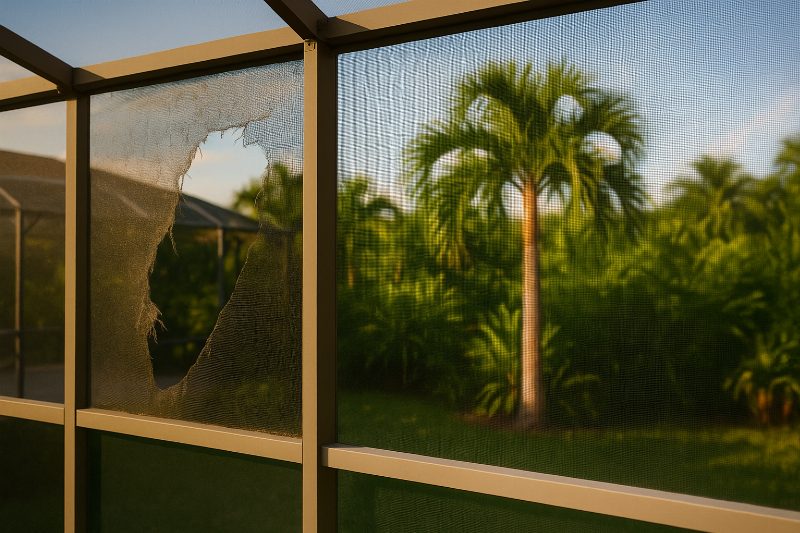
Choosing wrong costs you twice. Repair a screen that truly needs full replacement and you'll be calling someone back in six months. Replace an entire enclosure when a few panels would have done the job and you've left a few hundred dollars on the table for no reason. The goal here is to help you read what your enclosure is actually telling you, so you spend the right amount and nothing more.
What "repair" and "replacement" actually mean
The terms get used loosely, so let's be precise before going further.
- Panel re-screening - the aluminum frame of a single bay stays in place; only the mesh and spline are removed and replaced. This is the most common repair.
- Frame section repair - a bent or cracked frame rail or corner piece is cut out and replaced while the majority of the structure stays put.
- Full re-screen - every panel of mesh in the enclosure is replaced at once, but the frame itself is kept. This makes sense when the whole screen is uniformly aged or storm-damaged.
- Full enclosure replacement - frame and screen come down and an entirely new structure goes up. This is the biggest commitment, but sometimes the only sensible one.
Understanding which category your problem falls into is the whole game.
Start with the screen mesh itself
Walk the perimeter of your lanai or pool cage on a sunny morning. Natural light at a low angle makes damage obvious. Look for:
- Holes or tears, even small ones. A hole the size of a dime will pass no-see-ums freely, and Florida's Gulf Coast bugs are relentless. If you've been fighting that battle, our post on keeping no-see-ums out of your screened lanai for good explains exactly which screen grades close that gap.
- Sagging or ballooning mesh. Screen that bellies outward has lost its tension. It won't snap back on its own, and a loose screen tears faster in the next windstorm.
- A grey, chalky, or brittle look to the fiber. This is UV degradation, and it's extremely common here in Bradenton, Sarasota, and along barrier islands like Anna Maria Island and Siesta Key where sun exposure is nearly constant. UV damage is the silent killer of screen mesh - the fibers weaken before they visibly tear, meaning a screen that "looks fine" can fail catastrophically in a moderate storm.
- Holes at the spline groove. This is where the mesh is anchored into the frame channel with a rubber or vinyl cord. If mesh is pulling free at the edge, the spline has hardened and shrunk, which is a normal aging sign and always a repair job, not a reason to replace the frame.
Rule of thumb for mesh: If damage is limited to one to three panels and the rest of the enclosure looks uniform in color and texture, re-screen only those bays. If more than half the panels show UV graying or brittleness, plan a full re-screen while the frame is still sound. Mixing new bright mesh with old grey mesh also looks mismatched - something homeowners in Lakewood Ranch HOA communities especially want to avoid at inspection time.
Now look at the frame
The mesh gets all the attention, but the aluminum frame tells a deeper story. Step back and look at the whole structure from outside.
Minor frame issues that are repainable:
- A single bent vertical or horizontal rail from an impact (a ladder falling over, a tree branch)
- One or two damaged corner connectors or ridge clips
- A loose anchor bolt at the base of an upright post
- Surface oxidation or mild corrosion that hasn't compromised structural integrity
Frame issues that point toward full replacement:
- Multiple posts leaning, twisted, or out of plumb. When the geometry of the cage is off, re-screening the mesh is a band-aid. The frame will continue to rack, and the new screen will be uneven and stressed.
- Horizontal rails that are visibly bowed along a long run. This usually means undersized original framing or chronic wind load over many years.
- Widespread corrosion at the base plates and footer connections. Salt air from the Gulf accelerates this, and homeowners in Palmetto, Ellenton, and along the waterfront communities of Osprey and Nokomis see it more than those further inland. When the base plates are eaten through, the posts have nothing solid to stand on.
- Storm damage that has pushed the entire cage off its footings or sheared multiple anchor points. After a major hurricane, the first steps after your screen enclosure takes hurricane damage matter a lot, including whether to file an insurance claim before any work begins.
To understand the individual parts and what failure looks like in each, the detailed breakdown in the anatomy of a pool cage is worth reading before you have a contractor visit. An informed homeowner asks better questions and gets better work.
The age factor: how old is the structure?
Age alone doesn't determine the answer, but it's a significant variable.
Most aluminum screen enclosures in our area were built to last 15 to 20 years under normal Florida conditions. Enclosures on barrier islands like Longboat Key or Lido Key, where salt spray and UV are more aggressive, may show wear at the 10 to 12 year mark. An enclosure that is 8 years old with two torn panels is almost certainly a repair job. An enclosure that is 22 years old with widespread screen degradation, soft or corroded footer plates, and a history of storm events is a different conversation entirely.
One useful test: check whether replacement parts are still commonly available for your frame profile. Older proprietary frame systems sometimes use sizes or connector shapes that are no longer stocked. If your contractor is having trouble sourcing matching extrusions, that's a practical signal that a full replacement may serve you better in the long run.
The cost logic: when repair is cheaper and when it isn't
This is where homeowners sometimes make the wrong call. Repair is almost always cheaper per event, but replacement can be cheaper over a five-year window if repairs become a recurring cost.
A realistic way to think about it:
- Repair is clearly the right choice when the total cost of the repair is less than roughly 30 to 40 percent of what a full enclosure replacement would cost, and the frame has meaningful life left in it.
- Replacement starts to make sense when you've already invested in repairs twice in three years, when the frame shows the warning signs above, or when you're planning a lanai upgrade (like adding privacy screen or transitioning sections to glass) that makes a fresh structure the natural starting point.
On that note, if you've ever wondered about the difference between standard mesh and solid privacy panels, the comparison between Florida glass and privacy screen options walks through the trade-offs in plain terms.
For homeowners who experienced storm damage and are weighing repair vs. replacement in the context of a homeowner's insurance claim, the process is a bit different. The insurer may have specific requirements about documentation and contractor estimates before you proceed. Our guide to filing a screen damage insurance claim in Florida covers what adjusters look for and how to protect yourself.
What a professional assessment covers
When a qualified screen contractor visits your property, they should do more than glance at the obvious tears. A thorough assessment includes:
- Checking every panel for UV degradation, not just visible holes
- Pulling on the spline in several locations to test its grip
- Inspecting every base plate and anchor bolt, especially on corners
- Looking at the peak and ridge connections, which take the most wind load
- Identifying whether the frame is out of plumb and by how much
- Noting whether any existing repairs (prior re-screens, patch jobs) were done correctly
The assessment should produce a clear recommendation with a reason behind it, not just a price. If a contractor recommends full replacement on a 6-year-old frame without explaining why, ask them to walk you through the frame inspection findings specifically.
Parrish, Ellenton, and the inland difference
Homeowners in inland communities like Parrish and Ellenton generally see slower salt-related frame corrosion than those on the coast, but they deal with other factors: heavy afternoon thunderstorm seasons that drive debris into screens and occasional freeze events (rare but real) that can stress anchor connections. The screen mesh still degrades from UV at a similar rate everywhere in our service area, so mesh replacement timelines don't differ much. Frame lifespan tends to be a bit longer inland, which is worth factoring in when you're deciding whether a frame has enough life to justify a full re-screen investment.
How to get the right answer for your specific enclosure
Every enclosure is a little different, and a photo or a quick description over the phone can only go so far. The most reliable path is a professional on-site look. Our team works across the full Gulf Coast area from Bradenton and Lakewood Ranch down through Sarasota and Siesta Key, and we're used to giving homeowners a straight answer rather than a sales pitch.
You can see the full range of what we do on our screen and pool-cage repair services page, and if you have specific questions before you book, the FAQ page covers the most common ones. When you're ready for a real set of eyes on your enclosure, reach out and we'll set up a visit.
The bottom line is simple: repair when the frame is solid and damage is limited. Replace when the structure itself has lost integrity or when the cumulative cost of continued repairs doesn't make financial sense. Getting that call right is what we're here for.