Filing a Screen-Damage Insurance Claim in Florida
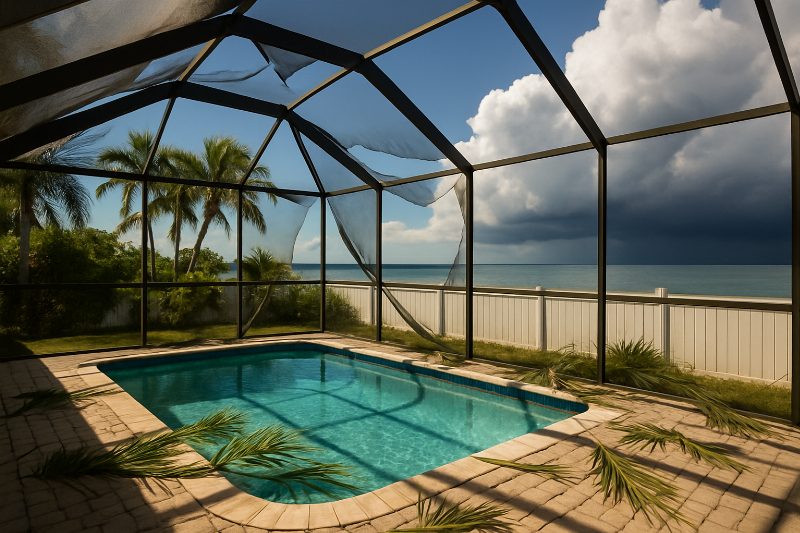
Your pool cage looked fine at sunset. By morning, after a fast-moving storm rolled through Bradenton or rattled the barrier islands, half the screen panels are gone and a frame rail is bent. Now comes the part nobody enjoys: dealing with the insurance claim.
The good news is that screen-enclosure damage is a legitimate, well-recognized claim type in Florida. The less-good news is that homeowners frequently make avoidable mistakes that reduce their payout, delay approval, or get the claim denied outright. This guide walks you through every stage of the process, from the moment the storm passes to the day a check clears, so you can approach your insurer from a position of knowledge rather than guesswork.
Understand what your policy actually covers (and what it does not)
Florida homeowner policies are not all alike, and the language around "other structures" - which is how most policies classify a screen enclosure or pool cage - varies significantly from carrier to carrier.
A few things worth knowing before you file:
- Other-structures coverage is typically set at 10% of your dwelling coverage limit. If your home is insured for $400,000, you may have roughly $40,000 available for detached structures including pool cages, fences, and sheds combined. Whether that is enough depends on the size and condition of your enclosure.
- Named-storm deductibles in Florida are often a percentage of your total insured value, not a flat dollar amount. A 2% hurricane deductible on a $400,000 home means you absorb the first $8,000 of storm damage before coverage kicks in. Many enclosure repairs fall below that threshold, which is exactly why a thorough, accurate damage estimate matters so much.
- Wind vs. flooding is a critical distinction. Standard homeowner policies cover wind damage; flood damage typically requires a separate NFIP or private flood policy. If water intrusion during the storm caused additional damage to your lanai flooring or outdoor furniture, clarify which peril caused each loss.
- Cosmetic-damage exclusions have become more common in Florida policies in recent years. Bent screening that still functions, surface oxidation on aluminum frames, and minor screen discoloration may be excluded under some policies as cosmetic rather than structural. Read your declarations page carefully.
- Age and depreciation play a role in actual-cash-value (ACV) policies. If your cage is 15 years old and the policy pays ACV rather than replacement-cost value (RCV), the insurer will depreciate the structure's value before cutting a check. An RCV endorsement eliminates that deduction, and it is worth confirming which type of coverage you carry before a storm ever hits.
If you have questions about what a specific repair involves structurally, our post on the anatomy of a pool cage - frame, screen, spline, and hardware gives you the vocabulary to talk confidently with both your contractor and your adjuster.
Step one: safety first, documentation immediately after
Do not walk into a damaged enclosure until you have verified there are no sharp frame edges at head height, no overhead panels hanging by a single screw, and no pooled water hiding electrical hazards. Pool cage aluminum can shear at angles that are genuinely dangerous.
Once you have confirmed it is safe to enter:
- Photograph everything before touching anything. Shoot wide angles first to establish the overall scope of damage, then move in for close-ups of every torn panel, bent rail, popped spline channel, and broken hardware fitting. If any debris - a tree branch, a neighbor's fence section, roofing material - landed inside the cage, photograph it in place before removing it.
- Take video. A slow, steady walk-around video that narrates what you are seeing is often more persuasive to an adjuster than a stack of still photos alone.
- Note the date and time on all photos. Most smartphones embed this metadata automatically, but manually writing a note in frame (or in your photo captions) creates an extra layer of proof.
- Document the interior too. If rain drove in through breached screens and damaged your outdoor furniture, pavers, or lanai ceiling, photograph that damage as part of the same event.
Keep all of this organized in a single folder, labeled with the storm date and your policy number. You will refer to it repeatedly.
Step two: make only emergency, protective repairs
Your policy likely has a "duty to mitigate" clause, which means you are required to take reasonable steps to prevent additional damage after an initial loss. That is not a trap; it is simply fair. But it does mean you need to act carefully.
What is appropriate at this stage:
- Covering a large opening with a tarp or temporary mesh to keep debris and animals out of the pool area
- Removing a hanging panel that is swinging loose and could cause further frame damage
- Photographing and safely discarding debris that creates a hazard
What to avoid:
- Beginning full screen re-screening or frame replacement before an adjuster has inspected the damage. If you restore the enclosure before the adjuster arrives, you have effectively destroyed the evidence.
- Signing any contract with a repair company that includes an "assignment of benefits" (AOB) clause. Florida has taken steps to curb AOB abuse, but contracts with these provisions can complicate your claim and sometimes remove your control over the settlement process entirely.
If you are unsure what repairs are considered emergency vs. permanent, our frequently asked questions page covers common questions about the repair process, and you can always reach out to us directly before starting any work.
Step three: file your claim promptly and completely
Florida Statute 627.70132 requires that hurricane-related claims (and supplemental claims) be filed within three years of the date of loss for events occurring after January 1, 2023. For non-hurricane wind events, the window may differ based on your specific policy. Check your declarations page and file sooner rather than later. Delays raise questions about causation, and adjusters may note that the damage could have occurred in multiple events over time.
When you call or log in to file:
- Have your policy number, the date of the storm, and a brief written description of the damage ready.
- Report every item of damage in a single claim filing if they all arose from the same event. Supplemental claims are possible but add complexity and time.
- Ask the representative to confirm the claim number in writing (email or letter) and to tell you the expected timeline for adjuster assignment.
Step four: prepare for the adjuster's visit
An insurance adjuster - either a staff adjuster employed by your carrier or an independent adjuster contracted for storm surge - will schedule an inspection. This visit is the most consequential part of the process. Here is how to prepare:
Get a contractor estimate first. Before the adjuster arrives, have a qualified screen-enclosure contractor walk the damage with you and produce a written, itemized estimate. This gives you a reference document and ensures you do not overlook damage the adjuster might otherwise minimize or miss. Our team serves homeowners throughout Sarasota, Lakewood Ranch, Parrish, Anna Maria Island, and the surrounding area, and we are familiar with what adjusters look for.
Be present during the inspection. Walk every inch of the enclosure with the adjuster. Point out each area of damage using your photos as a guide. Do not assume they will find everything on their own.
Ask what is being documented. You are entitled to ask the adjuster which items they are including in their scope and which they are not. If they exclude something you believe is storm-related, note it and ask them to explain their reasoning in writing.
Do not accept the first estimate as final. Adjusters work from software pricing tools that may underestimate local labor and material costs, particularly in coastal markets like Siesta Key, Longboat Key, or Lido Key, where enclosure work sometimes commands a premium due to salt-air material requirements and access logistics.
Step five: review the claim settlement and push back if needed
When the insurer issues a written estimate and coverage determination, read it carefully against your contractor's estimate. Common discrepancies include:
- Missing line items - panels the adjuster did not count, spline runs not included, or hardware fittings overlooked
- Underpriced labor rates - adjuster software often lags behind local market rates
- ACV deductions that seem excessive - depreciation should be calculated on the actual age and condition of the materials, not a blanket percentage
- Denial of related interior damage - water intrusion from a breached enclosure that damaged your pavers or outdoor electrical should be part of the same claim
If the gap between the insurer's offer and your contractor's estimate is significant, you have options:
- Negotiate directly. Provide your contractor's itemized estimate, photos, and any manufacturer pricing you can reference. Many adjusters have room to revise their scope.
- Invoke appraisal. Most Florida homeowner policies include an appraisal clause that allows each party to hire an independent appraiser; the two appraisers then agree on an umpire whose decision is binding. This process is faster and cheaper than litigation.
- Hire a public adjuster. A licensed public adjuster represents you, not the insurer, and works on a percentage of the final settlement. They are most useful on large, complex claims.
- Consult an attorney. For denied claims or very large disputes, a property insurance attorney can advise you on your rights under Florida law.
After a hurricane: special considerations
Hurricane damage to screen enclosures is extremely common along the Gulf Coast. If your damage follows a named storm, see our detailed post on what to do after a hurricane damages your screen enclosure for a step-by-step walkthrough specific to that scenario. Demand for repairs spikes dramatically after a major storm, and licensed contractors book up quickly, so documenting and filing early gives you the best chance of a timely repair.
Homeowners in Ellenton, Palmetto, and Bradenton often see heavy storm-cell damage that is distinct from named hurricanes. These non-hurricane wind events are still covered under most standard homeowner policies, but the filing window and applicable deductible may differ. Read your policy language carefully or call your agent to confirm.
A note on screen condition before the storm
One factor that can complicate a claim is the pre-existing condition of the enclosure. If your screen was already grey, brittle, and deteriorated before the storm, an adjuster may argue that the panels failed due to age rather than storm force. This is a legitimate defense on their part, and it is worth understanding. Our post on why screen looks grey and brittle - UV damage explained describes exactly how sun degradation progresses, and knowing the terminology helps you make the case that storm-force wind, not ordinary wear, caused the failure.
The practical takeaway: if your enclosure is aging, replacing or re-screening before a major storm is both a safety measure and a way to preserve your claim rights should damage occur. A brand-new screen installation with a clear before-and-after timeline is much easier to defend than a decade-old screen that was already showing UV fatigue.
Getting a repair estimate you can actually use
An insurance-ready estimate is not the same as a quick verbal quote. You need a written, itemized document that lists panel counts, screen mesh type and grade, linear feet of spline, frame components, and labor separately. This level of detail allows the adjuster to match line items and reduces the chance of lowballing.
You can learn more about our screen and pool-cage repair services or get in touch for a free estimate any time. We work throughout Bradenton, Sarasota, Siesta Key, Longboat Key, Nokomis, Osprey, and all surrounding communities, and we are used to working alongside homeowners who are navigating active insurance claims.
The claim process does not have to be adversarial. With thorough documentation, a solid contractor estimate, and a clear understanding of your policy, most screen-enclosure claims can be resolved fairly and efficiently. Take it one step at a time, keep copies of everything, and do not hesitate to push back if the initial settlement does not reflect the true cost of putting your enclosure right.