Why Your Screen Looks Grey and Brittle: UV Damage Explained
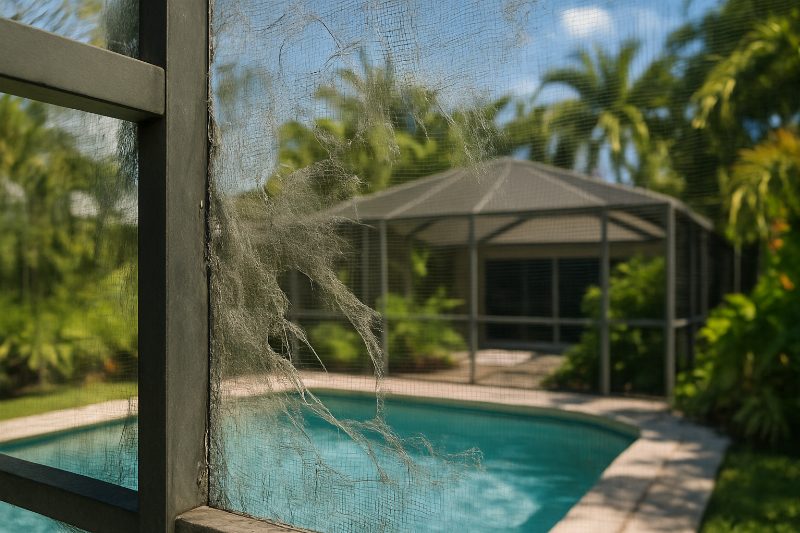
Florida sun is relentless, and nowhere is that clearer than in the lifespan of your screen enclosure. If your lanai screen has turned a dull pewter-grey and crumbles at the slightest touch, UV radiation has already done its damage - and patching individual holes won't fix a screen that has lost its structural integrity from the inside out.
This post walks through exactly what happens to screen mesh under prolonged UV exposure, how to spot the stages of deterioration before the screen gives out completely, and what your options are when it's time to act. Whether you're in Bradenton, out on Siesta Key, or anywhere else along the Suncoast, this information applies directly to your enclosure.
What Screen Mesh Is Actually Made Of
Most residential screen mesh is woven fiberglass coated with a PVC (polyvinyl chloride) layer. That coating is what holds the mesh together, gives it flexibility, and provides the grey or charcoal color you're used to seeing. Aluminum mesh is also common, particularly on older enclosures and on pool cages that need a stronger barrier.
Understanding the material matters because UV radiation attacks each type differently:
- Fiberglass screen - The PVC coating degrades first. UV energy breaks down the plasticizer molecules in the PVC, causing it to stiffen, crack, and eventually powder off. Once the coating goes, the bare fiberglass strands beneath are brittle and snap under minimal pressure.
- Aluminum screen - Aluminum itself doesn't degrade from UV the way PVC does, but the oxide layer on the surface becomes chalky and rough over time, and any protective coating over the aluminum weave can still fail. More importantly, aluminum becomes work-hardened and brittle in Florida's temperature swings, making it prone to cracking at the weave intersections.
For a deeper look at all the components involved, the anatomy of a pool cage: frame, screen, spline, and hardware is worth reading before you start shopping for replacement options.
The UV Damage Timeline
UV degradation doesn't happen overnight. It follows a predictable sequence that most homeowners can recognize once they know what to look for.
Stage 1: Color Shift (Years 1-3)
New fiberglass screen has a clean, consistent charcoal or grey color. In the first year or two, UV exposure begins breaking down the surface of the PVC coating. You'll notice the screen starts looking slightly lighter or chalky in spots, especially on south- and west-facing panels that receive the most direct afternoon sun. At this stage the screen is still fully functional - the color change is cosmetic.
Stage 2: Stiffening and Minor Brittleness (Years 3-6)
As the plasticizers in the PVC continue to break down, the mesh loses its natural flexibility. A healthy screen bounces back when you push on it. A UV-degraded screen at this stage feels stiff and papery. You may notice:
- Small holes appearing without any obvious cause (pets, debris, or impact)
- Edges fraying where the screen meets the spline channel
- The mesh pulling away slightly from corners under tension
- A powdery residue on your hands after touching the screen
Minor repairs can still make sense at this stage if the damage is isolated. But if you're seeing stiffness across most of the panels, widespread replacement is more cost-effective than chasing individual holes.
Stage 3: Full Structural Failure (Years 6-12+)
At this point the PVC is largely gone. The fiberglass strands are exposed and glassy-brittle. The screen tears in large sections under light wind pressure, and any repairs you make to one spot immediately cause failure at the next weakest point. The grey color has often shifted to a light silvery-white. This is the stage where the screen is doing almost nothing to keep insects out - including the notorious no-see-ums that plague coastal areas like Anna Maria Island and Longboat Key during the warmer months.
If you want to understand why no-see-um control depends so much on screen integrity, the post on keeping no-see-ums out of your screened lanai for good covers mesh grades and maintenance together.
Why Florida Accelerates the Process
The UV damage timeline above is general. In Southwest Florida - covering communities from Parrish and Palmetto in the north down through Sarasota, Osprey, and Nokomis to the south - several factors compress that timeline significantly.
UV Index. Florida consistently records UV Index values between 10 and 11 (the "extreme" range) from April through September. Screen mesh in this environment absorbs years' worth of UV dose in a compressed period. A screen that might last 12 years in a northern climate may start failing noticeably in 6 to 8 years here.
Heat cycling. Overnight lows in winter dip into the 40s and 50s while summer afternoons push past 95°F. This temperature swing - repeated daily for years - causes the PVC coating to expand and contract. Each cycle stresses the molecular bonds a little more, accelerating the breakdown that UV radiation started.
Salt air. If your property is within a few miles of the Gulf, salt-laden air adds an additional oxidizing layer to the degradation process. This is especially relevant for homeowners on barrier islands like Siesta Key and Anna Maria Island, where salt aerosol is nearly constant.
Humidity and mildew. High relative humidity keeps moisture against the screen surface for extended periods. While mildew itself doesn't destroy screen mesh, it does trap dirt and organic material against the PVC, which can accelerate surface breakdown.
How to Test Your Screen Without a Professional
You don't need to call anyone to do a quick field assessment. Here's a simple three-step check:
- The push test. Press lightly on the center of a panel with two fingers. A healthy screen flexes and springs back. A UV-degraded screen feels stiff and may crack or crumble under very light pressure.
- The rub test. Rub the mesh gently between your thumb and forefinger. If you get a grey or white powder on your skin, the PVC coating is actively breaking down.
- The spline inspection. Look at where the screen is held in the frame channel by the rubber spline. If the screen around the spline is fraying or pulling, UV damage at the edges is often more advanced than at the center - and that's where failure usually starts.
If you fail any two of these three tests on multiple panels, you're likely past the point where selective patching makes sense.
Grey Screen vs. Dirty Screen: How to Tell the Difference
One question we hear often is whether a screen just needs cleaning or has actually degraded. Here's the difference:
- Dirty screen looks grey or green from accumulated pollen, mildew, and dust. When you rinse it with a garden hose, the color improves noticeably. The mesh feels flexible.
- UV-damaged screen looks grey or silvery and does not get significantly darker or cleaner after washing. The mesh feels stiff or crumbly regardless of how clean it is.
A good soft-wash and gentle scrub is worth doing once a year for maintenance. If your screen still looks washed-out after cleaning, UV has changed the material itself - not just the surface.
Choosing a Replacement Screen: What to Consider
When it's time to replace, you have real choices to make. Standard 18x14 fiberglass mesh is the most common and most affordable option. But depending on your situation, you may want to consider:
- Solar screen / privacy screen - A denser weave that reduces heat gain and glare while limiting the view into your lanai. If you're weighing this option, the comparison of Florida glass vs. privacy screen for your lanai lays out the trade-offs honestly.
- No-see-um screen - An 20x20 or tighter weave that closes the gaps standard screen leaves open. It reduces airflow somewhat but is worth it in coastal locations.
- Pet-resistant screen - A heavier vinyl-coated polyester that holds up better against claws and is also more UV-resistant than standard fiberglass.
- Aluminum screen - More expensive and harder to install cleanly, but holds up well in high-impact areas near pool equipment or heavy vegetation.
Each of these choices comes with trade-offs in cost, airflow, and longevity. Our frequently asked questions page covers common mesh selection questions in more detail.
What About the Frame and Spline?
When screen mesh fails from UV exposure, it's worth asking whether the frame and spline are worth keeping. In most cases the aluminum frame itself is fine, because aluminum is far more UV-resistant than PVC-coated fiberglass. The spline - the rubber or vinyl cord that holds the screen into the channel - degrades more similarly to the screen. If the screen is in Stage 3 failure, the spline is often brittle and cracked as well and should be replaced at the same time.
If you've had a storm recently and aren't sure whether you're dealing with UV failure, impact damage, or a combination, the post on what to do after a hurricane damages your screen enclosure walks through the assessment process step by step. Wind damage and UV failure can look similar from a distance but require different approaches.
When Insurance Might Help
Florida homeowners sometimes ask whether UV-damaged screen is covered under their property insurance. The short answer is that gradual UV degradation is typically considered normal wear and tear and is not covered. Storm damage to screen is different, and many policies do include it - but the claim process has its own requirements. If a recent storm is part of the picture, the post on filing a screen-damage insurance claim in Florida is a useful starting point before you call your agent.
What to Expect From a Professional Re-Screen
A professional re-screen on a typical lanai or pool cage involves removing the old spline and screen, cleaning out the frame channel, cutting new mesh to size, and rolling in fresh spline to hold it taut and square. Done correctly, the result is a drum-tight, wrinkle-free panel that will last for years.
The difference between a professional installation and a DIY repair is mostly in the tension. Screen installed too loosely sags, collects water, and fails faster at the spline channel. Screen installed too tightly puts stress on the frame corners. Getting the tension right across a large panel takes practice and the right tools.
If you're in the Lakewood Ranch area and wondering what's involved for your specific enclosure, our screen and pool-cage repair services in Lakewood Ranch page has relevant details, and you can always reach out directly for a no-pressure assessment.
The Bottom Line
Grey, brittle screen is not a cosmetic nuisance. It's a failing material that is no longer doing its job of keeping insects out, reducing UV exposure on your furniture, or providing the privacy barrier you expect. Florida's combination of extreme UV, heat cycling, and salt air means the timeline for replacement is often shorter than homeowners expect - especially on panels with southern or western exposure.
The good news is that re-screening is one of the more straightforward and cost-effective home maintenance projects available to Florida homeowners. Catching it at Stage 2 rather than Stage 3 gives you more options, better results, and often a lower total cost. If your screen is passing the grey-and-powdery test on multiple panels, it's worth getting a professional set of eyes on it sooner rather than later.
Explore our full range of screen and pool-cage repair services to see what options fit your enclosure, or browse our service areas to confirm we cover your part of the Suncoast.