Keep No-See-Ums Out of Your Screened Lanai for Good
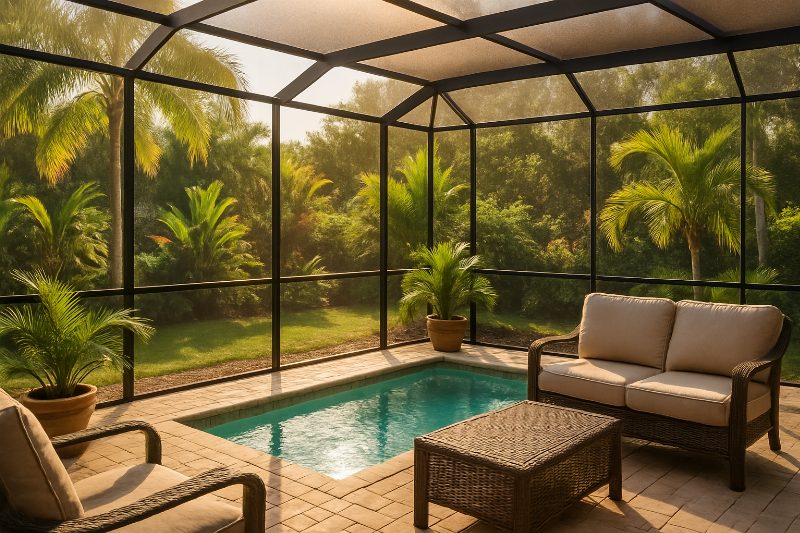
No-see-ums ruin more Florida evenings than mosquitoes do, and they do it invisibly. You sit down on the lanai with a cold drink, feel nothing for a few minutes, and then the biting starts. By the time you notice the welts, the insects are long gone. If this sounds familiar, the problem almost certainly is not your imagination. It is your screen.
Standard pool-cage and lanai screen is designed to keep out mosquitoes, leaves, and debris. No-see-ums - technically biting midges from the family Ceratopogonidae - are a different challenge entirely. They are small enough to pass straight through most screen mesh without slowing down. Understanding why that happens, and what to do about it, is the difference between spending evenings outside and spending them swatting in your own home.
Why No-See-Ums Are a Special Problem in Southwest Florida
The Sarasota and Bradenton coastline, the mangrove flats around Anna Maria Island and Longboat Key, the brackish edges near Palmetto and Ellenton - all of these are prime breeding habitat for biting midges. No-see-ums need shallow, moist, organically rich soil to breed, and southwest Florida has that in abundance. Population peaks typically happen in spring and fall, but in a warm year like most years here, you can encounter them from February through November.
Their size is what makes them so difficult to exclude. Adult no-see-ums range from about 1 to 3 millimeters in body length, and their body width is even smaller. The typical fiberglass or aluminum lanai screen has an opening size of roughly 18x14 mesh (18 threads per inch horizontally, 14 threads per inch vertically). That grid is large enough for a no-see-um to fly through without touching a single strand of screen material.
Many homeowners in Lakewood Ranch and Siesta Key discover this the hard way after investing in a brand-new screen enclosure, expecting relief that never comes. The enclosure is built perfectly. The screen is undamaged. But the insects are still inside, because the screen was never designed to stop insects this small.
The Real Solution: Fine-Mesh "No-See-Um" Screen
The good news is that a purpose-built product exists. No-see-um screen, sometimes listed as 20x20 mesh or described as "fine mesh screen," has significantly tighter weave than standard pool-cage screen. At 20 threads per inch in each direction, the openings are small enough to block even the tiniest biting midges.
Before you order a roll and call it done, there are two trade-offs to understand honestly.
Airflow reduction. Tighter mesh means less open area for air to pass through. A standard 18x14 screen has roughly 38 percent open area. A 20x20 no-see-um screen is closer to 26 to 29 percent open area, depending on the manufacturer. In the coastal breeze of Lido Key or Nokomis, you may not notice the difference. On a still August evening inland, you might find the lanai feels warmer and stuffier. Adding a ceiling fan or two inside the enclosure largely offsets this.
Debris accumulation. Finer mesh catches more dust, pollen, and organic material. In areas with heavy oak pollen or near construction - parts of Parrish and Lakewood Ranch come to mind - fine mesh may need rinsing with a garden hose more often than standard screen to keep it looking clean and flowing air well.
Neither of these is a reason to avoid no-see-um screen. They are simply things to plan for so you are not surprised after installation. You can read more about screen types and what goes into a full enclosure in our post on the anatomy of a pool cage: frame, screen, spline, and hardware.
Inspecting What You Already Have
Before spending money on new screen, spend ten minutes inspecting the screen you already have. No-see-um intrusions are not always a mesh-size problem. A small tear, a lifted spline, or a corner gap can let in thousands of insects that would otherwise be excluded, even with standard mesh.
Here is how to do a thorough inspection:
- Walk the full perimeter of the enclosure. Look at every panel at eye level and at the base where the screen meets the concrete or paver deck. Small gaps at the bottom are common and easy to miss.
- Check the spline channels. The spline is the rubber cord that holds the screen into its aluminum channel. Where the spline has dried out, shrunk, or popped loose, the screen edge pulls away from the frame and leaves an opening insects can enter freely.
- Look at the corners and door frames. Screen doors and their surrounding frames take more abuse than any other part of the enclosure. The seal between the door screen and the door frame is often the first place gaps appear.
- Backlight the screen from inside. On a bright day, step inside the enclosure at midday and look outward. Gaps and holes will appear as bright spots against the darker background of the yard. This is the single fastest way to find problem areas.
If you are finding multiple gaps or if the screen material itself is brittle and discolored, you may be dealing with UV degradation on top of a mesh-size issue. Sunlight breaks down fiberglass screen over time in ways that are not always obvious. We cover that process in detail in why your screen looks grey and brittle: UV damage explained.
Partial Re-Screen vs. Full Re-Screen
Once you know where the problems are, you can decide whether a targeted repair or a full replacement makes more sense.
Targeted repair makes sense when:
- The damage is limited to one or two panels
- The rest of the screen is in good condition and less than five or six years old
- The frame is solid with no bent or corroded members
Full re-screen makes sense when:
- The screen is uniformly faded, brittle, or saggy across most panels
- You want to upgrade the entire enclosure to no-see-um mesh for consistent protection
- The enclosure is seven or more years old and repairs are becoming a recurring expense
In Bradenton and the barrier islands especially, salt air accelerates corrosion on screen frames and spline alike. What looks like a one-panel problem sometimes reflects broader material fatigue across the structure. A professional set of eyes can tell you which situation you are in. Our screen and pool-cage repair services cover both targeted repairs and full re-screen projects throughout the area.
What the Re-Screen Process Actually Looks Like
If you have never had screen replaced, it helps to know what to expect so you can plan accordingly. A professional will remove the old spline from each channel using a flat tool, pull out the existing screen, cut new no-see-um mesh to size with some overlap, press it into the channel, and then roll fresh spline over it to lock the mesh in place. The excess screen is trimmed flush with a utility knife.
The whole process for a typical pool cage ranges from half a day to a full day depending on the number of panels and whether any frame repairs are needed at the same time. You do not need to move furniture off the lanai ahead of time in most cases, though it does speed things up. You will want to keep pets and children away from the work area.
After installation, the screen should be taut and flat with no waves or sags. The spline should be fully seated in its channel with no sections riding up or popping out. If you press lightly against the screen with your hand, it should feel firm and spring back rather than stretching loosely.
Maintenance That Extends the Life of Fine Mesh
No-see-um screen is an investment, and a few simple habits protect it. Rinsing the screen with a garden hose every couple of months removes pollen, mildew spores, and insect debris before they break down the fiberglass strands. Never use a pressure washer directly on screen material. The concentrated stream can tear even new screen or force the spline out of its channel.
Trim vegetation away from the outside of the enclosure. Branches and shrubs that rub against the screen cause abrasion damage over time. No-see-ums also rest in vegetation near the enclosure, so reducing that habitat near the structure reduces the pressure at the screen itself.
For homeowners near the water on Anna Maria Island or Siesta Key, occasional salt-spray rinses from the garden hose keep salt crystals from accumulating in the weave and accelerating UV breakdown.
When the Problem Is the Neighborhood, Not Just the Screen
Sometimes a homeowner does everything right and still sees more no-see-ums than expected. This is more common in areas with standing water nearby. If your lot backs up to a pond, a retention area, or a tidal flat, the insect pressure is simply higher than in a dry interior neighborhood. Fine mesh screen will still reduce intrusions dramatically, but it will not eliminate every insect that finds its way in when doors are opened and closed.
In those situations, combining no-see-um screen with a small oscillating fan near seating areas helps. No-see-ums are weak fliers. Even a modest airflow makes it hard for them to land and bite. This is not a replacement for proper screen but it complements it well, especially on the evenings when pressure is highest at dusk.
You might also consider whether a more enclosed option suits your space better. If you are weighing the trade-offs between open screen and something more solid, our comparison of Florida glass vs. privacy screen for your lanai walks through the options honestly.
Getting Help from Someone Who Knows the Area
Every neighborhood from Ellenton and Palmetto in the north to Osprey and Nokomis in the south has its own combination of insect pressure, salt exposure, pollen load, and housing stock. What works best on a Lakewood Ranch home on a dry interior lot differs from what works best on a Longboat Key condo screen enclosure fifty feet from the Gulf.
If you are not sure which screen type fits your situation, or if you want a professional to assess whether your current enclosure can be repaired or needs a full upgrade, we are glad to take a look. Our frequently asked questions page answers many of the most common questions about screen types, timing, and what the process involves.
You can also reach out directly through our contact page to schedule an assessment. We serve homeowners across the region, and you can find location-specific information for your area on our service locations page.
No-see-ums are a fact of life in southwest Florida. But sitting inside to avoid them should not be. The right screen, properly installed and maintained, gives you your lanai back.