Florida Glass vs. Privacy Screen for Your Lanai
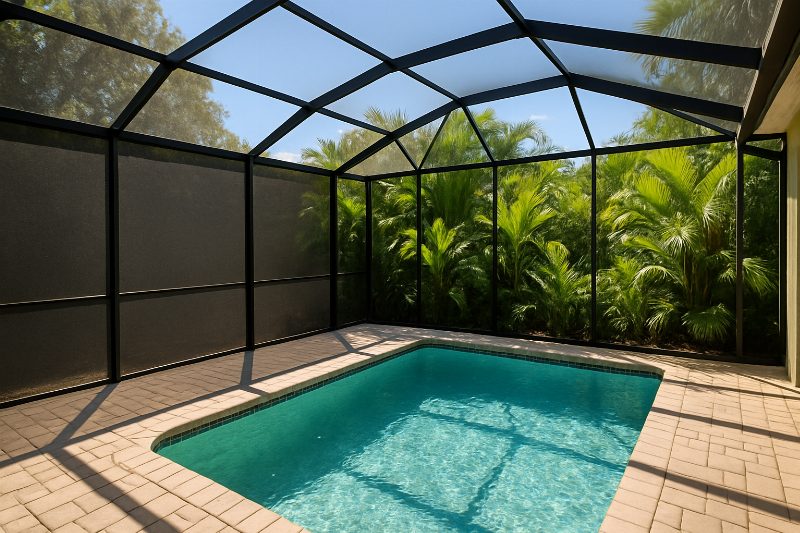
Florida homeowners spend real money on their lanais, and the choice between Florida glass and privacy screen is one of the biggest decisions you will make for that space. Get it right and your lanai becomes a year-round living room. Get it wrong and you end up with a hot, dark, or mosquito-filled room that nobody uses.
This guide walks through both options honestly, including what each one costs in general terms, where each one shines, and the specific conditions along the Gulf Coast that should influence your choice.
What Exactly Are These Two Options?
Before comparing them, it helps to be clear about what each product actually is.
Florida glass (sometimes called acrylic or "EZ Breeze" panels after a popular brand) refers to vinyl or tempered glass panels that slide or swing into the lower sections of your screen enclosure. They seal the bottom portion of the cage while the upper sections remain screened. The result is a semi-enclosed room that blocks wind, rain, and cold but still allows some ventilation through the upper screens.
Privacy screen (also called solid screen, shade screen, or solar screen) is a tightly woven mesh installed in place of standard fiberglass or aluminum screen. Unlike regular pool-cage screen, which is nearly transparent, privacy screen blocks a significant portion of your outward sightlines and cuts the amount of light entering the space. It is still a mesh product, so air moves through it, but the tight weave reduces airflow compared to standard screen.
Both products are commonly installed in existing screen enclosures across Bradenton, Sarasota, Lakewood Ranch, and throughout the barrier islands. Neither is automatically better. They solve different problems.
What Problem Are You Actually Trying to Solve?
This is the most important question to answer before you spend a dollar. Homeowners generally choose one of these options for one of three reasons:
- Neighbors are too close. If you live in a newer Lakewood Ranch or Parrish subdivision where lots are compact, your lanai may look directly into a neighbor's window or yard. Privacy screen addresses this without altering the fundamental feel of an open-air space.
- Rain and wind blow in. If you live on or near the water, say on Anna Maria Island, Siesta Key, or along Sarasota Bay, afternoon storms and winter cold fronts can make a standard screen enclosure nearly unusable for months. Florida glass handles this far better than any mesh product.
- Bugs and glare are the main annoyance. If your existing screen is doing its job but you want to reduce afternoon glare or keep out tiny no-see-ums, a solar or privacy screen mesh is often the simpler and more affordable fix.
Knowing your real problem steers the whole decision.
Florida Glass: The Pros
Florida glass panels transform the lower walls of your enclosure into something closer to a sunroom. Here is where they genuinely excel.
Weather protection. Gulf Coast winters are mild by national standards, but a cold front pushing down from the north can drop temperatures into the 40s overnight. Florida glass keeps a lanai comfortable on those nights without heating the entire space. During our rainy season, which runs roughly June through September, afternoon thunderstorms can dump an inch of rain in thirty minutes. Glass panels keep that rain out of the furniture and off your floors.
Wind buffering. Coastal homes in Palmetto, Ellenton, and along the barrier islands deal with persistent onshore breezes. Those breezes feel great in October but brutal in January. Glass panels on the windward side of your cage make an enormous difference in comfort.
Extends usable season. Many Sarasota and Bradenton homeowners find that a standard screened lanai sits empty from December through February because it simply gets too cold and breezy to sit outside comfortably. Florida glass can extend your usable season by two to three months at either end of the year.
Resale appeal. Many buyers in the Gulf Coast market specifically look for enclosed lanai space. Florida glass is a visible upgrade that photographs well and often features in real estate listings.
Florida Glass: The Cons
Nothing is perfect, and Florida glass has real drawbacks worth knowing before you commit.
Heat buildup. This is the biggest one. Glass traps heat. On a July afternoon in Bradenton or Sarasota, a fully glassed-in lanai can reach temperatures ten to fifteen degrees higher than the surrounding air. If you do not have a ceiling fan or a mini-split unit out there, the space becomes unusable in summer. Screen, by contrast, allows air to move freely through the enclosure.
Cost. Florida glass is more expensive than privacy screen in virtually every situation. The panels themselves cost more per square foot than mesh, and the installation requires more labor. If budget is tight, this matters.
Reduced airflow. Part of the charm of a screened lanai is the cross-breeze. Glass eliminates that for the sections it covers. This is a real trade-off, not a minor inconvenience, especially for homes positioned to catch prevailing breezes off the Gulf.
Maintenance. Glass panels need cleaning. Salt air from the coast etches glass over time and leaves a film that standard window cleaning helps manage but never fully eliminates. Vinyl panels scratch more easily than tempered glass and can yellow after years of UV exposure.
Privacy Screen: The Pros
Privacy screen is, in essence, a denser version of what you already have. That simplicity is its strength.
Airflow is preserved. Privacy screen is still a mesh product. Air passes through it. On a breezy evening in Osprey or Nokomis, your lanai still feels like an outdoor space, just with a bit more shelter from the sun and prying eyes.
Glare and heat reduction. Solar-grade privacy screen blocks a meaningful percentage of incoming sunlight (the exact percentage varies by product density). If your lanai faces west or southwest, afternoon sun makes it difficult to watch television or simply sit comfortably. A quality privacy screen cuts that glare significantly without requiring fans or air conditioning.
Lower cost. Privacy screen is generally less expensive than Florida glass, both in materials and installation time. If your enclosure already needs a rescreening (because the existing mesh is torn, saggy, or brittle from UV damage), upgrading to privacy screen may add only a modest cost to what you were already planning to spend.
Aesthetics from inside. Many homeowners are surprised by how much they like the look. Privacy screen gives the interior of the lanai a slightly softer, more intimate feel. It reduces visual clutter from the yard beyond.
For a deeper look at how UV exposure degrades standard screen mesh over time, see our post on why your screen looks grey and brittle. If your existing screen is already showing those signs, a full rescreening with privacy mesh is worth considering.
Privacy Screen: The Cons
Rain still gets in. Privacy screen is mesh. It does not stop rain. If wind-driven rain is your main complaint, privacy screen will not solve it. Only a solid panel product will keep rain out.
Cold still gets in. Same logic applies to cold air. A dense mesh slows the wind slightly but does not insulate. On a January night when temperatures drop into the low 40s in Ellenton or Parrish, privacy screen provides essentially no thermal benefit.
Reduced outward view. This is the intended trade-off, but it is worth naming plainly. If you love the open, expansive view from your lanai, whether it is a pond, a golf course, or a slice of sky, privacy screen diminishes that view. From inside looking out, the mesh creates a darkening effect that is noticeable, especially on overcast days.
Bug resistance is not improved. Privacy screen is designed for visual privacy and solar control, not for pest exclusion. If no-see-ums or gnats are your issue, you need a screen product specifically designed with a finer mesh. Our post on keeping no-see-ums out of your screened lanai goes into this in detail.
A Side-by-Side Comparison
Here is a quick reference to keep the trade-offs clear:
| Feature | Florida Glass | Privacy Screen | |---|---|---| | Blocks wind-driven rain | Yes | No | | Provides thermal insulation | Yes (moderate) | No | | Maintains airflow | No | Yes | | Reduces glare | Moderate | Yes | | Provides neighbor privacy | Moderate | Yes | | Cost (relative) | Higher | Lower | | Excludes insects | Yes (lower panels) | No better than standard | | Affects views outward | Minimal | Noticeable |
Can You Use Both?
Yes, and it is more common than you might think. A hybrid approach uses Florida glass panels on the lower walls, particularly on the windward or street-facing sides, and privacy screen in the upper sections or on walls where airflow and privacy matter more than weather protection.
This lets you dial in the specific conditions of your property. A home in Lakewood Ranch with a neighbor's yard ten feet away and a western exposure might use privacy screen on the west wall and glass on the north wall where winter wind is the bigger problem.
If you are unsure what combination makes sense for your specific enclosure layout and location, our team is happy to walk through the options with you. You can reach us on our contact page or browse our full range of screen and pool-cage repair services to understand what we do.
Local Conditions That Should Influence Your Choice
The Gulf Coast is not a single climate. Conditions vary enough between inland communities and the barrier islands to matter.
Barrier island homes (Anna Maria Island, Longboat Key, Lido Key, Siesta Key): These locations deal with persistent salt air, stronger onshore breezes, and more frequent wind-driven rain events. Florida glass holds up well here but requires more frequent cleaning due to salt film. Privacy screen on barrier island homes also benefits from a salt-resistant frame and fasteners.
Inland communities (Parrish, Ellenton, Lakewood Ranch, parts of Bradenton): These areas are more sheltered from coastal breezes but tend to see more intense heat in summer. Airflow is more valuable here in summer than on the coast. Privacy screen that preserves some ventilation is often the better warm-weather choice for these homes.
Waterfront properties on inland bays and lakes: If your lanai looks out over Tampa Bay, Sarasota Bay, or a freshwater lake, the view is part of the value. Privacy screen can diminish that significantly. Florida glass preserves the view while adding weather protection.
What About the Frame and Spline?
Neither Florida glass nor privacy screen operates in isolation. The condition of your enclosure frame, screen spline, and hardware matters enormously. A new set of privacy screen panels installed into a frame with corroding fasteners and cracked spline channels will not perform or look the way it should. Before committing to either upgrade, it is worth having someone assess the underlying structure.
Our guide on the anatomy of a pool cage, frame, screen, spline, and hardware explains how all these components work together and what to look for when evaluating an enclosure.
If your enclosure suffered damage in a recent storm, there may also be insurance implications worth understanding. Our post on filing a screen-damage insurance claim in Florida can help you navigate that process before you decide on any upgrade.
Getting a Quote
Both Florida glass and privacy screen are customizable to your enclosure's specific dimensions, frame color, and panel configuration. There is no universal price because every enclosure is different. The factors that move the cost include the size of the enclosure, the number of panels or bays being addressed, the product type chosen, and the condition of the existing frame.
The best starting point is a site visit. We serve homeowners across the Gulf Coast, including all of our service locations, and we are glad to take a look, answer your questions, and give you a straightforward quote with no pressure attached. If you have questions before scheduling, our FAQ page covers many of the most common ones.
The Bottom Line
Florida glass is the right choice when weather protection, year-round comfort, and extending your usable season are the priorities. Privacy screen is the right choice when airflow, glare reduction, neighbor privacy, and budget are the priorities. Neither is universally better. The right answer depends on your home's orientation, your location along the coast, how you use your lanai, and what problem you are actually trying to solve.
Take the time to answer that question honestly before spending any money, and you will end up with a lanai that works for you twelve months a year.