Parrish new-construction pool cages: what builders leave out that you'll need to add within two years
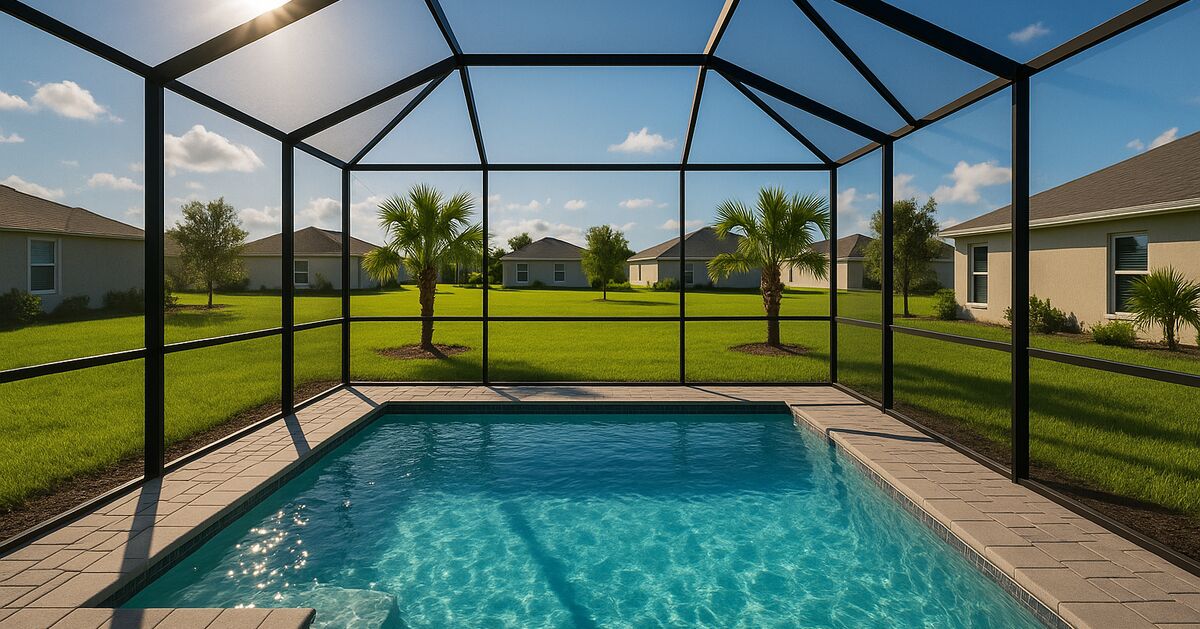
Moving into a brand-new home in Parrish and finding a shiny pool cage out back feels like the whole Florida dream delivered on a platter. But that cage almost certainly has gaps, and not the kind you can see right away.
Parrish has exploded with new construction over the past several years. Communities like North River Ranch, Crosscreek, and Harrison Ranch are adding hundreds of homes annually, and most of those homes come with a builder-grade pool cage included. That cage checks a box on the feature list. What it rarely does is anticipate what life in inland Manatee County will actually throw at it.
Here is what experienced screen and pool-cage repair professionals see again and again: homeowners in these communities calling for service somewhere between 18 months and three years after move-in. The problems are almost never freak accidents. They are the predictable result of what the builder left out during construction.
Builder-grade screen is the minimum, not the right fit
The screen mesh a production builder installs is almost always standard 18x14 fiberglass mesh. That is the baseline product. It meets code, it looks clean on move-in day, and it is inexpensive enough to keep the home's price point competitive.
The problem is that Parrish sits in a pocket that gets heavy insect pressure, particularly no-see-ums (biting midges) during the warmer months. Standard 18x14 mesh has openings large enough for no-see-ums to pass right through. You will not notice this at your final walkthrough in December, but come May, you will notice it very much.
Upgrading to 20x20 no-see-um mesh addresses this, but builders almost never offer it as standard because it adds cost and slightly reduces airflow, which can affect their spec sheet numbers. The upgrade is not expensive when done proactively during a re-screen, but if you wait until panels start tearing and schedule a repair anyway, you can often combine the mesh upgrade with the repair for a better result and less inconvenience.
Understanding how to choose the right screen mesh for your Florida home is a worthwhile read before you make any decisions here.
The spline situation that nobody warns you about
Spline is the flexible cord that locks the screen into the aluminum frame channel. It is the unsung hero of every screen panel, and it is the first thing to fail in a builder-installed cage.
Here is what happens: builders install screen enclosures quickly, often subcontracting to crews working on tight schedules across multiple homes in the same development. The spline used is frequently the thinnest gauge that will hold the screen in place on the day of installation. It looks fine. It does its job for a while.
Within 12 to 24 months under Florida sun, that thin spline becomes brittle. Corners loosen first, then full panels start bowing or popping out. You might notice a screen that looks like it is "bubbling" in the middle or pulling away from the frame at the bottom. That is a spline failure, and it is almost always an indication that the entire cage needs its spline assessed, not just the one panel that caught your eye.
Our post on why your screen panels keep popping out covers this in detail, but the short version is: if one panel's spline is failing, its neighbors are not far behind.
Hardware that was never rated for long-term outdoor use
Pool-cage hardware includes door hinges, door handles, latches, spring closers, and the screws and fasteners holding frame sections together. In a builder-grade cage, these components are typically the lowest-cost option available that still meets installation standards.
Parrish is roughly 15 to 20 miles inland from the Gulf, which means it does not face the same relentless salt-air assault as, say, screen enclosures on Anna Maria Island or Longboat Key. But Parrish has its own challenges: summer humidity stays punishing, afternoon thunderstorms are frequent and intense, and new-construction neighborhoods often have standing water and soft soil around pools that keeps moisture levels elevated near the cage base for much of the year.
Mild steel screws rust through. Cheap door hinges seize. Screen-door closers lose tension and doors start sagging or banging. Most homeowners assume these are signs of a "broken" cage when they are really signs of hardware that was never chosen for longevity in this environment.
The fix is straightforward: replace hardware with stainless-steel or quality powder-coated aluminum components when you first notice a problem, and check all fasteners during any service visit. Trying to delay this leads to frame sections working loose, which is a bigger and costlier repair. If you are already seeing any wobble in the frame, our post on why wobbly pool cages are usually a fastener problem explains exactly what to look for.
No gutters or water management on the cage roof
A pool cage in Parrish is going to get rained on, hard, almost every summer afternoon. Where does that water go? In a properly planned enclosure, it runs off the screen panels and away from the pool deck and the cage base.
In many builder-installed cages, there is no additional water management at all. Rain water rushes off the roof panels, drops straight onto the pool deck or the surrounding soil, and erodes the area around the cage footings over time. If the deck was poured with a slight crown, this works reasonably well. If the grade is flat or slopes inward, water pools at the base, keeps the anchor bolts and lower frame sections perpetually wet, and accelerates corrosion.
Some homeowners add gutters to the low sides of the cage roof. Others have the grade re-established around the perimeter. Neither is something builders typically include or discuss at closing. If you are not sure whether your drainage situation is an issue, look at the base track after a heavy rain. If there is standing water sitting against it, you want to address that before it becomes a structural concern.
The screen door: usually the weakest component in the whole cage
Ask any screen repair technician in Parrish or the broader Bradenton area what breaks first in a new pool cage, and they will almost always say the same thing: the screen door.
Builder-grade screen doors are lightweight frames with minimal bracing. They are installed with basic hinges and a simple spring closer. They handle light foot traffic fine. They do not handle the reality of family life, dogs, kids, pool floats being dragged in and out, or the door being allowed to slam in the wind because the closer tension is off.
A misaligned door pulls at the frame and warps the spline channel. A sagging door eventually stops latching, which is a safety concern if you have children. A door that slams in the wind over and over loosens the hinge fasteners from the frame, which then requires more than just a hinge replacement to fix properly.
The right move after move-in is to have a professional check the door alignment, closer tension, and latch function within the first few months. It takes very little time, costs very little, and prevents the cascade of secondary problems that an ignored door problem creates.
Our practical guide on how to stop your screen door from sagging and sticking walks through what to check yourself and when to call someone.
What builders do not tell you about cleaning and maintenance
There is no owner's manual for a pool cage. Builders hand over a home and move on. What most new homeowners in Parrish do not realize is that a pool cage needs regular, intentional maintenance to stay in good condition, especially in Florida's climate.
The specific issues that accumulate quickly:
- Algae and mildew grow on screen panels shaded by trees or fencing, weakening the mesh fibers from the outside
- Bird droppings are mildly acidic and eat into screen material and aluminum finish when left to sit
- Leaves and organic debris collect in the base track and hold moisture against the frame
- Spider webs in frame corners trap moisture and debris in the same spot repeatedly
None of this is catastrophic by itself. All of it is cumulative. A cage that is never cleaned or inspected can go from "fine" to "needs significant work" within two or three seasons.
A light rinse with a garden hose every month or so and a closer look at the base track and door hardware twice a year will catch the small stuff before it compounds. If you want a structured approach, our screen-enclosure maintenance checklist for Suncoast homeowners is a good starting point.
The two-year window and what to do with it
The reason so many Parrish new-construction homeowners are calling for service between 18 months and two years after move-in is simple: that is roughly when builder-grade components begin to visibly fail under real-world conditions. The spline goes. A panel pops. The door starts sticking. A hinge rusts.
This is not a disaster. It is a window.
If you are in a new-construction home right now and the cage is still looking sharp, that is the best possible time to be proactive. Have a professional come out and assess the spline condition across all panels, check every door hinge and latch, look at the base track fasteners, and tell you honestly whether your mesh is appropriate for the insect pressure in your neighborhood. You may find that everything is fine for another year. You may find that a few targeted upgrades now will save you a much larger service call later.
Our services page covers what a proper assessment and repair visit looks like, and if you have specific questions before scheduling anything, the FAQ page covers many of the things Parrish homeowners ask most often.
Getting ahead of it rather than reacting to it
There is nothing wrong with a builder-grade pool cage as a starting point. It gets you into the home with a functional screened enclosure, and that is genuinely valuable. The issue is treating it as finished rather than as a baseline.
The homeowners who get the most out of their pool cage over the long term are the ones who understand what they have, know what to watch for, and make a couple of smart upgrades proactively. Better mesh for no-see-um protection. Quality hardware on the door. A spline check before a panel decides to let go at an inconvenient time.
Parrish is a great place to have an outdoor living space. The summers are hot enough that a pool cage is not a luxury, it is how you actually use your pool without misery. Protecting that investment with a little attention in the first two years pays off for every year that follows.
If you are ready to have someone take a look, get in touch with us and we can schedule an assessment for your Parrish home. We also serve homeowners throughout Manatee and Sarasota County, so if you have neighbors or family in Lakewood Ranch, Palmetto, or Ellenton who are in the same boat with a newer cage, the same advice applies.