Choosing the right screen mesh for your Florida home
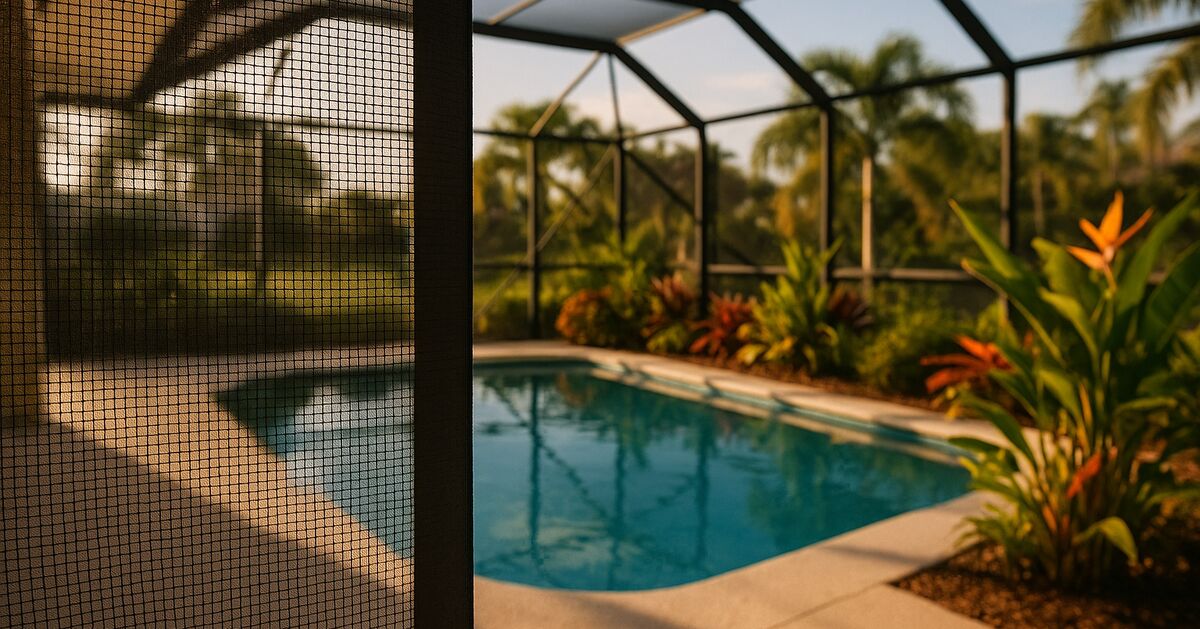
The screen mesh you choose matters far more than most homeowners realize - get it wrong and you'll be back to swatting bugs, squinting through a grey wall of heat, or patching tears before the year is out.
Florida's environment is unlike anywhere else in the country. You've got relentless UV radiation, salt-laden air blowing off the Gulf, afternoon thunderstorms that turn into tropical systems, no-see-ums so small they laugh at standard mesh, and pets that treat a pool cage like an obstacle course. Every one of those factors should influence what mesh you put in your screens. This guide walks through every common mesh type available to homeowners in Bradenton, Lakewood Ranch, Sarasota, and the surrounding Suncoast communities, explains what each one is actually made of, and helps you match the right product to your real-life situation.
Why mesh type is not a one-size-fits-all decision
Walk into any hardware store and you'll see rolls of grey fiberglass screen stacked floor to ceiling, priced to move. That product is fine for a guest bedroom window in Ohio. For a Gulf Coast lanai that faces west and doubles as a year-round living space, it may be the wrong call entirely.
The decision turns on five factors:
- Where the screen lives (pool cage, porch enclosure, window, door)
- What you're keeping out (mosquitoes, no-see-ums, debris, curious cats)
- How much sun hits the surface and from which direction
- How close you are to salt water
- How long you want the screen to last before re-screening
Get clear on those five things first, and the right mesh type usually becomes obvious.
Fiberglass mesh: the workhorse option
Standard fiberglass screen is the most commonly installed mesh in Florida homes, and with good reason. The strands are coated with a PVC compound that resists corrosion, the material is flexible enough to roll and cut without special tools, and it costs less than any specialty alternative.
The standard weave pattern is 18x16 (18 strands per inch horizontally, 16 vertically). That count keeps out mosquitoes and most common flying insects reliably. The mesh is light enough that airflow through a pool cage or lanai barely diminishes, which matters when you're trying to feel a Gulf breeze on a July afternoon.
Where fiberglass falls short in Florida is longevity. Constant UV bombardment degrades the PVC coating over time, causing the mesh to become stiff, brittle, and discolored. If you've looked at an older screen enclosure and noticed the grey, chalky appearance, that's UV breakdown at work. Our post on UV damage and screen degradation covers that process in detail. In a typical Suncoast installation with good sun exposure, standard fiberglass often needs replacement within seven to ten years.
Best for: Budget-conscious re-screens on covered porches, shaded enclosures, and interior window screens where UV exposure is limited.
Aluminum mesh: heavier, longer-lasting, and worth the upgrade in the right spots
Aluminum screen is woven from thin aluminum wire rather than fiberglass strands. It is noticeably stiffer, holds its shape better under impact, and does not degrade from UV the way fiberglass does. A well-maintained aluminum screen in a pool cage can outlast fiberglass by several years.
The tradeoff is corrosion. Bare aluminum oxidizes when exposed to salt air, and if you're on Anna Maria Island, Longboat Key, Lido Key, or anywhere within a few miles of the Gulf or bay, that oxidation can appear within a few seasons. The telltale sign is a white powdery residue and, eventually, small holes forming at the oxidation points. If you're going aluminum in a coastal setting, look for aluminum mesh that has been factory-coated or anodized.
Aluminum mesh is also heavier than fiberglass, which can stress older spline channels in pool cage frames. If your frame is original to a home built in the 1980s or 1990s, a conversation with a screen professional before switching materials is worthwhile. You can learn more about how frames and spline channels interact in our breakdown of pool cage anatomy.
Best for: Pool cages and porch enclosures on homes that are set back from the coast, where the combination of durability and UV resistance pays off over time.
No-see-um screen: the mesh that actually stops the tiny stuff
No-see-ums (biting midges, technically) are the reason many Suncoast homeowners eventually throw up their hands with standard 18x16 mesh. The insects are roughly one to three millimeters in length and pass straight through conventional openings. Standard mesh openings are approximately 0.033 inches wide. No-see-ums need an opening of about 0.025 inches or smaller to be reliably blocked.
No-see-um screen is typically woven to a 20x20 count or tighter, closing that gap. The result is effective insect exclusion even against the smallest biting pests. This is particularly valuable in coastal areas and near mangrove zones, where no-see-um populations peak in spring and fall.
The practical consideration is airflow. A tighter weave reduces air passage, so a screened lanai with no-see-um mesh will feel slightly less breezy than one with standard mesh. In practice, homeowners who make the switch rarely complain. They're usually too relieved to stop getting bitten at dusk.
No-see-um mesh is also available in fiberglass variants, so the UV degradation issue mentioned above still applies. If you're installing no-see-um mesh on a sun-exposed elevation, ask about higher-grade formulations. This topic gets its own deep treatment in our guide to keeping no-see-ums out of your screened lanai.
Best for: Any lanai, porch, or pool cage where biting midges have been a persistent nuisance. Near-essential on Siesta Key, Nokomis, Osprey, and other areas close to tidal flats and mangroves.
Solar and super-screen mesh: sun control built into the fabric
Solar screen is a heavier, denser mesh designed specifically to reduce heat gain and glare. The weave density typically ranges from 80 to 90 percent openness factor, meaning it blocks a significant portion of solar radiation before it reaches the interior of your enclosure or home. Common thread weights are 17x20 or similar, using thicker individual strands.
The visual effect is noticeable. Solar screen has a darker, more opaque appearance than standard mesh, which some homeowners love (more privacy) and some find too dim. If your lanai has a western exposure and becomes unbearably hot from mid-afternoon on, solar screen can make a genuine difference in comfort and may reduce cooling costs for an adjacent living area.
Because the strands are heavier and the weave tighter, solar screen also holds up better to wind-driven debris, which is a meaningful benefit during storm season. It does cost more per square foot than standard mesh, so for large pool cages, the budget impact is real.
Siesta Key and Longboat Key homeowners in particular sometimes pair solar screen on the sun-facing panels of a pool cage with standard mesh on shaded elevations. That hybrid approach balances comfort, airflow, and cost effectively.
Best for: West- or south-facing screen walls on lanais and pool cages where heat and glare are a problem. Also worth considering when added privacy is a goal, as an alternative to the options covered in our comparison of Florida glass and privacy screen.
Pet-resistant screen: for homes with cats, dogs, and determined climbers
Pet-resistant screen is a category of heavy-duty mesh engineered to resist the damage that dogs and cats routinely inflict on standard fiberglass. Standard mesh tears under surprisingly little force. A medium-sized dog jumping at a screen door can pop a panel out or tear it within a season.
Pet-resistant products are typically made from a heavier vinyl-coated polyester, sometimes marketed under trade names. They're roughly seven times thicker than standard fiberglass and can withstand repeated impact from claws and paws without tearing. The mesh is available in charcoal and other neutral tones and does not look dramatically different from standard screen once installed.
It is noticeably more expensive per square foot than standard fiberglass, and it is heavier, so older spline and framing hardware should be inspected before installation. But for households with active pets, the cost-per-year calculation often favors the upgrade because standard screen may need replacing every one to two years.
Best for: Screen doors, lower wall panels of pool cages and lanais in homes with dogs or cats. Also useful on porch enclosures where neighborhood cats make unauthorized visits.
Phifer BetterVue and similar high-clarity options
A newer category of mesh prioritizes optical clarity above all else. Products like Phifer BetterVue use a fine, dark-coated fiberglass weave that dramatically reduces the visual "grey film" effect common with standard screen. Looking through it feels more like looking through open air.
These products are genuinely impressive for homeowners who invested in a beautiful water or garden view and don't want a screen dulling it. They aren't dramatically more expensive than standard mesh, and they block insects as effectively as conventional 18x16 weave.
The main limitation is that the fine strands are not meaningfully more resistant to pet damage or storm debris than standard fiberglass. Think of high-clarity mesh as an aesthetic upgrade rather than a durability one.
Best for: Pool cages and lanais with attractive natural views. Homes in Lakewood Ranch, Parrish, and Ellenton with preserve or pond-facing enclosures often see the most benefit.
How to think through the decision for your specific situation
Here's a simple way to work through the choice:
- Identify your biggest problem. Bugs? Heat? Pet damage? Poor view? Each issue has a mesh type that directly addresses it.
- Note your sun exposure. A heavily sun-exposed south or west face calls for UV-resistant or solar mesh. A covered, north-facing porch can get away with standard fiberglass.
- Factor in your proximity to salt water. Coastal homes in Anna Maria Island, Longboat Key, Lido Key, and Siesta Key should lean toward materials and coatings that resist oxidation.
- Consider the whole enclosure, not just individual panels. A large pool cage may benefit from different mesh types on different elevations. A uniform choice is simpler but not always optimal.
- Match mesh weight to your frame. Heavier mesh in old, corroded aluminum frames can cause spline channels to fail sooner. When in doubt, have a professional assess the frame first.
Our screen and pool-cage repair services page includes details on the mesh products we install, and if you've got questions specific to your home's setup, our FAQ page covers many of the most common ones.
What about color? Charcoal vs. grey
Most mesh types come in charcoal or standard grey. Charcoal is almost always the better choice for outdoor enclosures in Florida. The darker tone absorbs more light at the strand surface, which reduces the reflective glare that makes standard grey mesh look like a foggy window from the inside. Charcoal mesh also improves the perceived clarity of your outward view. The difference is subtle in a photo but immediately apparent when you're sitting inside the enclosure.
Getting a professional opinion before you commit
Choosing mesh type is one decision. Knowing whether your existing spline, frame, and door hardware can handle the new material is another. A good screen professional will assess the frame condition during a quote visit, flag any issues with the spline channel depth, and walk you through the mesh options that actually make sense for your specific enclosure before any material is ordered.
If you're in the Bradenton area, our team serves homeowners throughout Bradenton and has a strong presence across Lakewood Ranch and the surrounding communities. We cover the full Suncoast from Parrish south through Sarasota, and you can see the complete service area on our locations page.
The right mesh is out there for your home. The goal is simply to match it properly, install it well, and not have to think about it again for a good long while.