Why wobbly pool cages are usually a fastener problem, not a screen problem
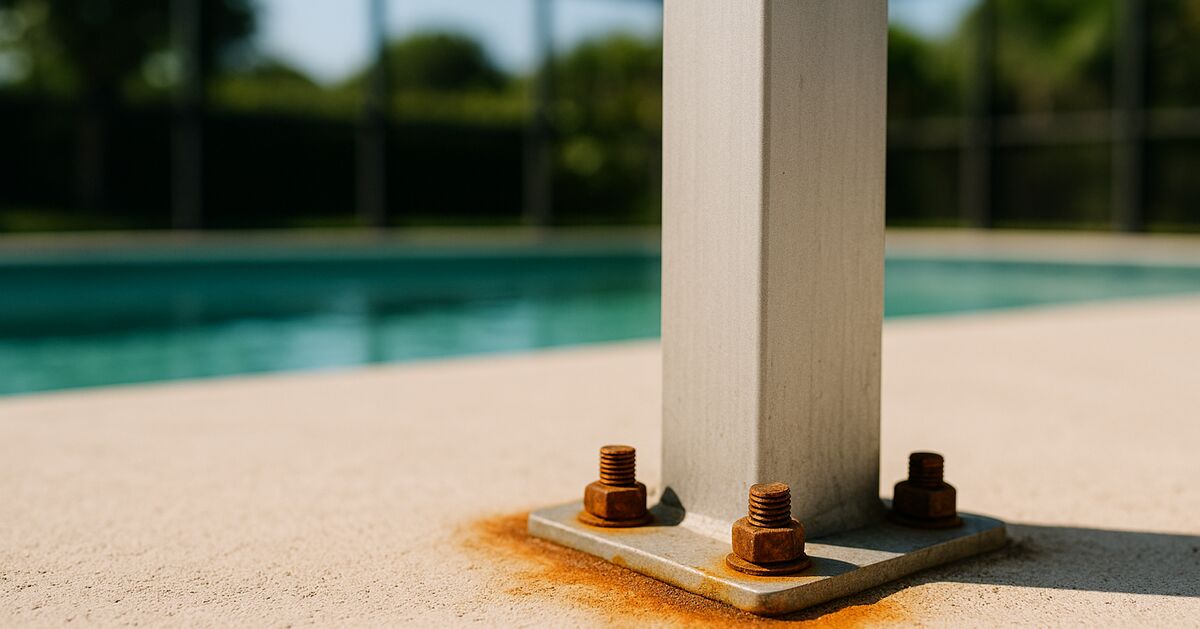
Your pool cage feels like it moves in the wind, and your first instinct is to look at the screen. That instinct is wrong almost every time.
The screen panels in a typical Florida pool enclosure are under tension, but they do not hold the frame together. The frame holds itself together with dozens of fasteners: bolts, screws, rivets, anchor plates, and corner brackets. When those fasteners corrode, loosen, or shear, the whole structure can begin to rack and sway even if every panel of screen looks perfectly fine. Understanding this distinction is the single most important thing a Suncoast homeowner can know about maintaining a pool cage safely.
What "wobbly" is actually telling you
A small amount of flex in a large aluminum structure is normal. Aluminum expands and contracts with temperature, and a cage that spans 20 or 30 feet across a pool deck will move slightly when you push on it. What is not normal is:
- Visible movement at the corner uprights when wind gusts hit
- A sensation of the frame "giving" when you lean on a horizontal beam
- Rattling or clicking sounds during mild breezes
- Corner pieces that visibly shift relative to the beams they connect
- Doors that have started binding, dropping, or refusing to latch properly
Each of those symptoms points to a structural connection that is no longer doing its job. And in every case, the culprit is almost always corrosion at the fastener level, not deterioration of the aluminum extrusions themselves.
Why Florida's climate destroys fasteners so efficiently
Aluminum frames hold up remarkably well in our climate. The anodized or painted finish resists the salt air, the humidity, and the UV that Florida dishes out year-round. But the fasteners that hold the frame together are a different story.
Older enclosures, particularly those installed before roughly the mid-2000s, were often assembled with steel or low-grade zinc-plated hardware. Steel in a Florida coastal environment does not corrode slowly. It corrodes aggressively. A screw that looks fine from four feet away can be reduced to a flaking stub of rust that holds almost no shear load at all. Homeowners in Sarasota, Siesta Key, and anywhere along the barrier islands face this problem faster than inland neighborhoods, because salt-laden air moves through screen mesh with almost no resistance and settles directly on every exposed metal surface inside the cage.
But even inland communities are not immune. Lakewood Ranch, Parrish, and Ellenton all see the same warm, humid air that keeps coastal humidity levels high year-round. Add chlorinated splash-out from the pool itself, and you have a chemical environment that attacks ferrous metal from multiple directions simultaneously. Chlorine residue on a steel screw head does not need salt air to cause rapid oxidation. It manages just fine on its own.
The specific hardware pieces most likely to fail first
Not all fasteners in a pool cage are under equal stress, and not all corrode at the same rate. Knowing which ones to inspect first can save you a lot of time.
Corner gusset bolts and through-bolts. The gusset plates at the corners of the frame, where horizontal beams meet vertical uprights, are the primary structural connections. They are typically held by two to four bolts that pass through overlapping aluminum. When these bolts corrode, the gusset plate can wobble on its fasteners even if the plate itself looks intact. This is one of the most common sources of whole-cage flex.
Anchor bolts at the base plates. The bottom of each upright post sits on a base plate that is anchored to the concrete deck. The anchor bolts set into the concrete are often the first fasteners to show serious corrosion, because water pools at the base of the posts, the concrete itself holds moisture, and the bolts are in constant contact with both. A base plate that has lost its anchor integrity is genuinely dangerous, because the upright it supports cannot resist lateral load.
Purlin screws and beam-to-beam connections. Horizontal purlins (the smaller cross-members that support the roof screen) are attached to the main beams with sheet-metal screws. These screws are small, numerous, and easy to overlook. When they corrode and lose grip, the purlins can drop slightly, putting uneven tension on the roof screen panels and causing the waviness or bubbling that homeowners sometimes mistake for screen stretch.
Hip and ridge connectors. At the peak of a gable-style cage, hip connectors join roof beams at angles. These see significant wind load because they are at the highest point of the structure. Corroded fasteners here are a serious concern, particularly heading into storm season.
Screen-door hinges and strike hardware. Door hardware fails earlier than frame hardware in most cases, because doors cycle constantly and the hinge pins work against their fasteners with every opening and closing. A sagging door is not just an inconvenience; it is an early warning that the hardware throughout the structure deserves a close look.
How to do a basic visual inspection yourself
You do not need a contractor to do a preliminary check. Walk the perimeter of your cage on a bright morning, when the light angle will reveal surface rust and discoloration that you would miss at other times of day.
Bring a small flashlight and a flat-head screwdriver. At each base plate, look for orange rust staining on the concrete and the post. Push gently on the base of each upright with the heel of your hand. There should be no movement at all. If the post rocks even slightly, note it.
At the corner gussets, look for rust streaks running down the aluminum from the bolt holes. Even if the bolt head looks okay, a streak indicates that water has been tracking through and oxidizing the bolt shank inside the connection. Probe the underside of any surface that looks stained: corroded metal will often flake away from a gentle prod with the screwdriver tip.
On the roof, stand in the cage and look up at the purlins. If any are visibly bowing downward between their connection points, the screws at one or both ends may have lost grip.
Finally, operate every door. It should swing smoothly, latch fully, and stay in position without drifting open on its own. If it does not, the hinges or the frame of the door itself have shifted, and further investigation is warranted.
Why this problem is so easy to miss until it is serious
Pool cages are large structures, and most of their fasteners are above eye level or in shaded corners. Homeowners naturally focus on the screen, because screen damage is visible from across the yard. A torn panel is obvious. A corroded bolt head 12 feet in the air, stained the same amber color as the aluminum it is mounted to, is not.
This is one of the reasons our screen-enclosure maintenance checklist for Suncoast homeowners includes fastener inspection as a separate step from screen inspection. They require different eyes and different tools, and they reveal different categories of risk.
The other reason the problem hides is that aluminum is a forgiving material. A cage with several compromised fasteners will not collapse suddenly on a calm day. It will flex more than it should, make sounds it did not used to make, and slowly transfer load to adjacent connections. Those adjacent connections then begin to fail, and the process accelerates. By the time the structure feels obviously unsafe to a homeowner, it has often been in a deteriorating state for a year or more.
What a professional repair actually involves
When a screen contractor identifies corroded fasteners as the source of instability, the repair process is straightforward but requires attention to detail.
The first step is a full hardware audit, working methodically around the frame and cataloguing every fastener that shows corrosion, loss of grip, or physical damage. On older cages in coastal areas like Anna Maria Island or Palmetto, it is not unusual to find that a majority of the original steel screws need replacement.
Replacement hardware for Florida pool cages should be stainless steel or aluminum-bodied with stainless fasteners. Grade 316 stainless steel offers the best corrosion resistance in salt-air environments and is worth the modest additional cost over Grade 304 in any location within a few miles of the Gulf. For anchor bolts into concrete, stainless-steel wedge anchors or epoxy-set anchors are the appropriate choice.
In some cases, the aluminum extrusions themselves have been damaged by galvanic corrosion at the contact point between the aluminum and a dissimilar metal fastener. This shows up as white powdery oxidation on the aluminum around the fastener hole, and it can enlarge the hole enough that a same-size replacement fastener will not hold. The correct repair is to step up to a larger fastener diameter or, where that is not feasible, to use a structural epoxy to restore the hole geometry before re-fastening.
After hardware replacement, a good contractor will re-tension any screen panels that were affected by purlin shift, check door alignment, and verify that the cage as a whole is plumb and square before signing off. You can learn more about what these repairs involve and what to expect from our screen and pool-cage repair services page.
When to stop inspecting and call someone
If your inspection turns up any of the following, stop and schedule a professional evaluation before using the pool area normally:
- Any upright post with measurable movement at its base
- Visible bowing or displacement at a corner gusset
- A roof purlin that has dropped noticeably out of plane
- More than two or three rusted-through or missing fasteners in a single section of frame
- Any part of the frame that appears to have shifted since the last time you looked at it
These are not cosmetic concerns. A pool cage that fails during a wind event can injure people and cause significant property damage. The repair cost of addressing fastener corrosion proactively is a fraction of what structural failure and resulting liability can cost.
The geography of risk on the Suncoast
Corrosion risk is not uniform across our service area, and it is worth knowing where your home falls on the spectrum.
Properties on or near the water, from Anna Maria Island down through Longboat Key, Lido Key, and Siesta Key, face the most aggressive corrosion environment. Salt aerosols move inland from the Gulf for several miles, and any cage on these barrier islands or fronting open water should be inspected annually without exception.
Inland communities including Bradenton, Lakewood Ranch, and Parrish are not in a low-risk category; they are simply in a lower-risk category. Humidity is still high, pool chemistry still plays a role, and galvanic corrosion between dissimilar metals happens at the same rate regardless of proximity to the coast. Biennial inspections are a reasonable minimum inland, and annual inspections are still the better choice for any cage that is more than ten years old.
If you are not sure when your cage was last inspected, or if you have never seen it inspected at all, that uncertainty is itself a reason to get someone out to look. Our frequently asked questions page covers what to expect from a cage inspection if you have never been through one before.
A final word on what this costs versus what it prevents
A fastener replacement on a moderately sized cage is not an expensive repair in the context of what a pool cage represents as an investment. Replacing corroded hardware proactively, before a panel of roof screen pulls away from a failing purlin or before a base plate lets go in a storm, preserves the structural value of the whole enclosure.
For anyone getting ready to list their home, this matters especially. A wobbly cage that inspectors can reproduce by pushing on a post is a negotiating liability. A cage with documented recent hardware replacement is a selling point. Our post on getting your pool cage ready before you sell your home goes into this in more detail if that is your situation.
If any of what you have read here sounds familiar when you think about your own enclosure, the next step is simple. Get in touch and we can arrange a time to walk the cage with you, identify what needs attention, and give you an honest picture of what the repair involves. No pressure, no guesswork, just a clear look at what is actually happening with your structure.