No-See-Um Screen: What It Is & When to Upgrade
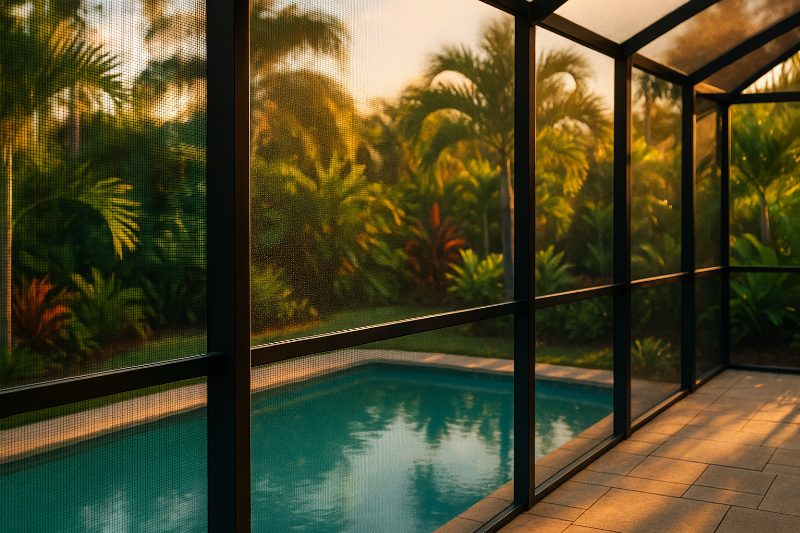
Florida has a lot going for it: year-round sunshine, warm evenings you actually want to spend outside, and backyard pools that feel like a private resort. What it also has - and nobody puts in the tourism brochure - is no-see-ums. These tiny biting midges are small enough to pass straight through a standard 18x14 screen mesh, and if you've ever sat on your lanai at dusk wondering why you're being eaten alive inside a supposedly screened enclosure, now you know why.
No-see-um screen is the fix. But it's not a magic bullet, and understanding what it actually does - and what it can't do - will help you make a smarter choice for your home, your budget, and your comfort.
What exactly is no-see-um screen?
Standard fiberglass pool-cage and lanai screen is woven in an 18x14 mesh pattern: 18 strands per inch horizontally and 14 strands per inch vertically. That produces openings large enough to keep out mosquitoes and most flying insects, but far too large to stop a biting midge (the insect behind the "no-see-um" nickname).
No-see-um screen uses a tighter weave, most commonly 20x20 mesh (20 strands per inch in both directions). Some manufacturers go even finer. The result is a mesh opening roughly one-quarter the area of a standard screen opening. Biting midges, which measure somewhere around 1 to 3 millimeters, can no longer squeeze through. Neither can sand gnats or the other nearly-invisible insects that make Gulf Coast evenings miserable from Anna Maria Island down through Siesta Key and Longboat Key.
The material itself is still fiberglass in most residential applications, coated and heat-set just like standard screen. It sits in the same aluminum spline channel, cuts with the same tools, and installs in the same frame system you already have on your pool cage or lanai enclosure. The upgrade is in the weave density, not in the frame or the installation method.
Why no-see-ums are such a problem along the Gulf Coast
Biting midges thrive in moist, warm environments near bodies of water. That description fits essentially every neighborhood in Bradenton, Palmetto, Ellenton, Parrish, and Sarasota. Salt marshes, tidal flats, stormwater ponds, and even the soil around landscaped lawns all produce ideal midge habitat. Populations peak in the warmer months but in Southwest Florida's mild winters, they never fully disappear.
Unlike mosquitoes, which you can usually see and slap, no-see-ums land and bite before most people realize they're there. The welt is disproportionately large for such a tiny insect - itchy, inflamed, and slow to heal. For families with young children, the elderly, or anyone prone to strong reactions, an infested lanai stops being usable rather than just annoying.
Our post on how to keep no-see-ums out of your screened lanai for good goes deeper into environmental strategies you can layer on top of screen upgrades, but replacing your screen mesh is the single most effective structural step you can take.
The trade-off: airflow and visibility
Here's the honest part most people don't hear until after they've already made their decision: tighter mesh reduces airflow and slightly alters your view.
A 20x20 mesh has noticeably less open area than an 18x14 mesh. In practical terms, this means:
- Airflow drops. On still days you'll feel the difference inside the enclosure. Cross-breeze situations are less affected, but if you rely on natural ventilation to keep a covered lanai comfortable in summer, no-see-um screen makes that harder.
- The view changes slightly. The screen takes on a finer, almost gauze-like appearance. It's not dramatic, and most homeowners adapt quickly, but it's worth knowing before you commit.
- Heat retention. Because less air moves through, enclosures with no-see-um screen can feel warmer on hot, calm days. Homes in Lakewood Ranch and other inland communities, where afternoon heat is more intense than at the beachfront, should weigh this carefully.
These aren't reasons to avoid the upgrade if bugs are genuinely ruining your outdoor time. They're simply factors to consider so you're not surprised by the outcome.
For a closer look at how screen type affects your lanai environment more broadly, the comparison in our post on Florida glass vs. privacy screen for your lanai gives useful context on the spectrum of enclosure options and how to think about the trade-offs.
When does it make sense to upgrade?
Not every homeowner needs no-see-um screen. Standard 18x14 mesh does its job perfectly well against mosquitoes, flying beetles, palmetto bugs, and most common insects. Here are the situations where upgrading genuinely makes sense:
1. You're near water or marshland. Coastal communities like Anna Maria Island, Siesta Key, Lido Key, Nokomis, and Osprey sit in or adjacent to midge habitat. If your property backs up to a canal, a salt marsh, a retention pond, or even a low-lying area that stays damp, your no-see-um pressure is higher than average.
2. You use your lanai in the early morning or evening. Biting midges are most active at dawn and dusk. If you take your coffee outside at sunrise or you like to eat dinner on the lanai around sunset, you're in the prime biting window. Standard screen won't protect you during these hours.
3. Your current screen is due for replacement anyway. Screen doesn't last forever. UV exposure in Southwest Florida degrades fiberglass mesh over time, making it brittle, grey, and prone to tearing. (We explain the exact process in our post on why your screen looks grey and brittle from UV damage.) If you're already facing a rescreening project, upgrading to no-see-um mesh adds very little to the total cost. It's the ideal time to make the switch.
4. You have children or pets that spend significant time in the enclosure. Kids playing in the pool or a dog that naps on the lanai are both low to the ground and slow-moving, which makes them easier targets for midges than adults who are up and moving around. If the littlest members of the household are getting bitten, the upgrade often pays for itself in peace of mind alone.
5. Standard screen with no visible damage is still letting bugs through. This is the clearest diagnostic sign. If you can see intact, undamaged screen mesh and you're still getting bitten inside the enclosure, the mesh opening is the problem - not holes or tears. No amount of patching will fix that.
When the upgrade might not be the right call
If your primary concern is mosquitoes, standard 18x14 screen handles that well as long as the screen is in good repair. Upgrading to no-see-um mesh for mosquito control alone is a solution to a problem you already have solved.
Similarly, if your enclosure runs along an air-conditioned Florida room and airflow isn't a concern because you're climate-controlling the space anyway, the airflow trade-off is less relevant. But if your pool cage is open-air and you depend on breezes to keep it comfortable, weigh that carefully.
What the installation actually involves
No-see-um screen installs exactly like standard screen. A technician removes the old spline, pulls out the worn mesh, cuts fresh no-see-um material to size, rolls it into the frame channel, and presses new spline in to hold it tight. The frame itself doesn't need to change.
If your frame is in good condition, a rescreening with no-see-um mesh is straightforward. If the aluminum frame shows corrosion, bent sections, or compromised connectors, those issues should be addressed at the same time. Our overview of how a pool cage frame, screen, spline, and hardware work together walks through the relationship between these components so you understand what you're looking at during an inspection.
For homeowners across Bradenton and Lakewood Ranch, the typical rescreening project takes one to two days depending on the size of the enclosure. Coastal properties on Siesta Key or Anna Maria Island may have logistical considerations (access, HOA requirements, salt-air corrosion on existing hardware) that add a little time, but the core process is the same.
What to budget for
The material cost difference between standard fiberglass screen and no-see-um screen is real but modest. The labor is identical. Where the cost adds up is scope: if you're rescreening a full pool cage rather than patching a few panels, you're looking at a meaningful project regardless of which mesh you choose. Choosing no-see-um mesh at that stage costs less than coming back later to do it again.
We don't publish flat-rate pricing here because enclosure sizes, existing frame conditions, and access requirements vary enough that a number without context could mislead more than it helps. The right move is a site visit and a specific quote. You can reach us through our contact page to schedule a free estimate, or browse our frequently asked questions if you want to understand more about the process before we come out.
Choosing the right screen for your situation
No-see-um screen is one of several upgrade options worth knowing about. If privacy is also a concern, heavier-weave privacy screen addresses that differently. If storm protection is on your mind after a rough season, post-hurricane screen inspection and repair is a separate but related topic covered in what to do after a hurricane damages your screen enclosure.
Our full list of screen and pool-cage services covers the range of what we do, and our service area page confirms coverage across all of Manatee and Sarasota counties - from Parrish and Ellenton in the north to Osprey and Nokomis in the south.
The short version
No-see-um screen uses a 20x20 or finer mesh weave to block biting midges that pass through standard 18x14 screen. It costs a bit more in materials, reduces airflow slightly, and changes the look of the mesh just enough to notice. It's the right upgrade when you're near midge habitat, when your current screen is already due for replacement, or when bugs are genuinely keeping you from using your outdoor space.
If any of those conditions fit your situation, you don't need to live with the problem. A rescreening project is one of the more straightforward home improvements available to Florida homeowners, and no-see-um mesh makes it a two-for-one: you solve the aging screen problem and the bug problem at the same time. That's a pretty good outcome for one afternoon of work.