Why properly tensioned screen matters more than you think
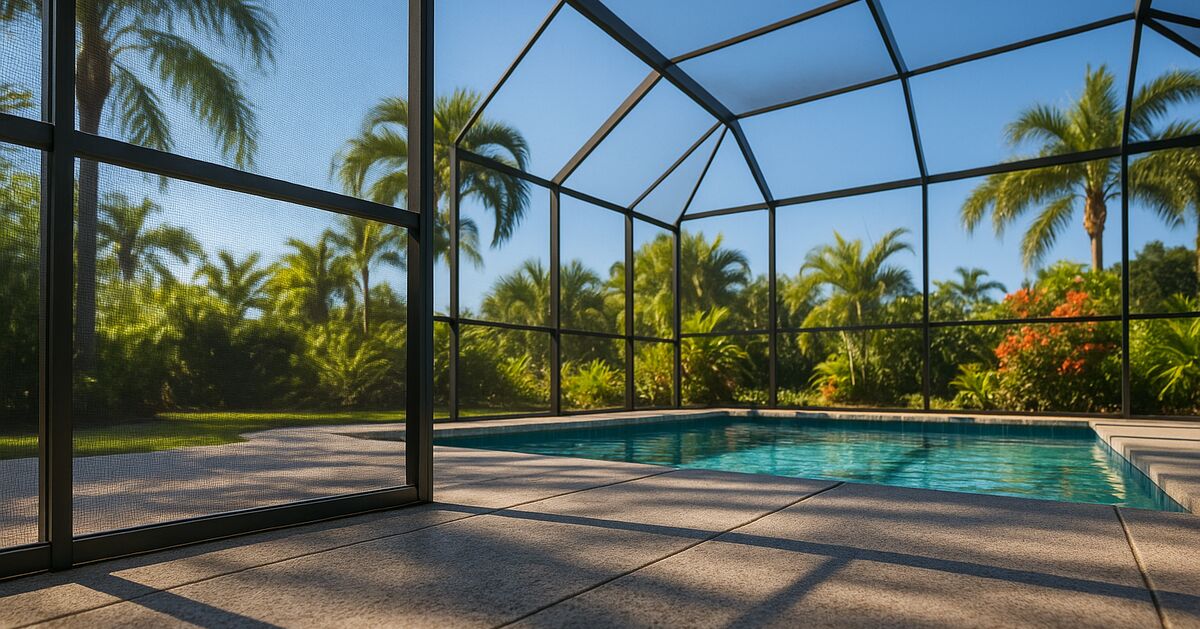
Loose, baggy screen panels are one of the most common sights on lanais and pool cages across Bradenton, Sarasota, and every community in between. Most homeowners shrug and assume it is just cosmetic wear. It is not. Tension is arguably the single most important quality factor in a screen installation, and when it is wrong, every other part of the job suffers for it.
This post breaks down what proper screen tension actually means, why it is so hard to get right, and what happens to your enclosure over time when it is off in either direction.
What "screen tension" actually means
When a screen panel is installed, the mesh is pulled taut across an aluminum frame and locked in place by a vinyl spline that is pressed into a channel running around the panel's perimeter. The final tension of the finished panel depends on three things working together:
- How tightly the mesh was stretched before the spline was set
- The diameter of the spline chosen relative to the channel width
- Whether the mesh was pulled evenly from all four sides
A correctly tensioned panel should feel firm when you push it lightly with your palm. It should not flutter in a breeze, it should not bow inward when a palmetto bug lands on it, and it should not look like a hammock. At the same time, it should not be so drum-tight that it creates stress points at the corners.
Think of it like a window screen on a house up north. When those are done well, you barely notice them. When they are done poorly, the mesh sags into the frame opening or pops out at the corners within a season. The same principle applies here, just at a much larger scale and in a far harsher climate.
Why Florida makes tension especially critical
Our Gulf Coast climate is not kind to screens. The combination of intense UV radiation, high humidity, heavy afternoon rain, and the occasional tropical system puts every panel through cycles of stress that screens in cooler, drier climates simply never experience.
UV exposure causes the fiberglass or polyester mesh to become more brittle over time. You can read a deeper explanation of that process in our post on why your screen looks grey and brittle: UV damage explained. The short version is that a panel already weakened by UV is far less forgiving of poor tension. If it is too loose, wind loads create a flapping, whipping motion that accelerates fiber breakdown. If it is too tight, the already-stiff mesh has nowhere to flex and tears at its weakest point, usually near a corner or along a spline groove.
Salt air communities like Anna Maria Island, Longboat Key, Lido Key, and Siesta Key add another layer of stress. Airborne salt deposits on the mesh, and when combined with heat and humidity it can degrade screen mesh faster than inland locations. A loose panel that traps moisture against the frame channel speeds up corrosion of the aluminum beneath it, which then widens the channel over time and makes future re-screening even harder to tension correctly.
The real consequences of a screen that is too loose
Most homeowners focus on how a loose panel looks. The actual problems run deeper.
Structural stress on the frame. A loose panel vibrates in wind. That vibration transfers to the frame members it is attached to, particularly the cross-members on a pool cage. Over months and years, this loosens the screws and self-tapping fasteners that hold those members together. What starts as a saggy screen can become a frame that rattles and, eventually, one that needs structural repair on top of a re-screen. The anatomy of a pool cage: frame, screen, spline and hardware goes into detail on how all these components depend on each other.
Reduced bug protection. A panel under proper tension sits firmly against the frame channel from edge to edge. A loose panel can gap slightly at the corners or along the sides, especially after a hard rain causes the mesh to temporarily sag further. That gap is all a no-see-um or a mosquito needs. If you have been fighting insects on your lanai despite an intact-looking screen, tension is one of the first things to check.
Faster wear at the spline channel. When a panel flaps repeatedly, the mesh rubs against the edges of the spline channel. Over time that abrasion frays the edge fibers right where they are most concentrated. The panel does not fail in the middle; it separates from the spline and "pops" out of the channel. If your panels have been popping out repeatedly, poor original tension is often the root cause alongside an undersized spline.
Water pooling and staining. On horizontal or near-horizontal roof panels common on many Sarasota and Lakewood Ranch pool cages, a loose panel sags just enough to collect standing water after rain. That water does not drain cleanly. It stains, promotes mildew, and keeps the mesh in a permanently wet state that dramatically shortens its life.
The consequences of a screen that is too tight
Over-tensioning is less common than under-tensioning, but it happens, especially when an installer is rushing or is not experienced with a particular mesh weight.
Corner tears. When mesh is stretched too aggressively before the spline is set, the tension concentrates at the four corners of the panel. Those corners become the failure point. You may notice small diagonal tears radiating outward from a corner within the first year of installation. That is almost always a tension problem, not a defective mesh problem.
Spline blowout. An over-tensioned panel pulls the spline outward from its channel with more force than the channel walls can hold. The spline pops out, usually along one full side, and the panel billows outward. It looks dramatic and happens suddenly, often during the first significant windstorm after installation.
Frame deflection on lighter sections. Not every frame section is built equally. The lighter cross-members on a lanai or screen room have less rigidity than the main vertical and horizontal posts. Extreme over-tension on a large panel can actually bow a mid-span horizontal member inward. Once a frame member is bent, it is much harder to achieve correct tension on future re-screens because the channel geometry has changed.
How a pro achieves correct tension
Good screen installers develop a feel for tension over hundreds of jobs. But feel alone is not enough. There are concrete techniques involved.
The process starts with choosing the right spline diameter. The spline needs to fill the channel completely without forcing the mesh too deep or sitting so shallow it can work loose. Our FAQ page covers some common questions about spline sizing. When the wrong diameter is used, no amount of stretching technique will produce a stable result.
Next, the mesh is pulled from opposite sides before any spline is set, so the tension is balanced. Many shortcuts involve setting one side first and then pulling across, which almost always produces uneven tension and a panel that looks slightly twisted when the light hits it at an angle.
The spline is then rolled in with a spline roller in multiple passes, starting from the center of each side and working toward the corners. This progressive approach avoids bunching and keeps the mesh fibers parallel to the frame edges, which is where their strength is greatest.
Finally, the excess mesh is trimmed cleanly. A ragged trim is a small thing but it matters: rough edges catch wind and debris, and the fraying that starts there can migrate into the panel over time.
If you are weighing whether to tackle a re-screen yourself or call someone in, the honest comparison of tradeoffs is worth reading before you decide: DIY screen repair vs. hiring a pro: an honest comparison.
How to tell if your current panels have a tension problem
You do not need any tools for a basic check.
- Stand back ten feet from your enclosure in the morning when sunlight is raking across the panels at a low angle. Loose panels will show a visible bow or wave. Properly tensioned panels will look flat and uniform.
- Push lightly on the center of a panel with one finger. It should deflect a small amount and spring back immediately. If it deflects several inches or does not spring back, it is too loose.
- Look at the corners closely. Small tears, fraying, or mesh pulling away from the spline channel at the corners suggests over-tension in past work, or that the panels were correctly tensioned but the mesh has aged past its useful life.
- Check whether any spline sections have crept out of the channel on their own. That usually points to under-sized spline or over-tensioned mesh.
If you are unsure what you are seeing, our screen and pool-cage repair services include inspections where we can tell you exactly what is going on before any work is done.
Mesh type affects how tension behaves
Not all mesh behaves the same way when tensioned, and this is worth knowing when you are choosing material for a re-screen. Standard 18x14 fiberglass mesh is forgiving and relatively easy to tension correctly. No-see-um mesh, which has a much finer weave, is stiffer and requires a bit more care during installation to avoid over-tensioning at the corners. Pet-resistant mesh is heavier still and needs a correspondingly heavier spline and a more deliberate pulling technique.
For a full breakdown of how different mesh types perform under Florida conditions, choosing the right screen mesh for your Florida home covers the tradeoffs in detail.
What to ask when you hire someone
Before agreeing to any re-screen work, a few simple questions will tell you a lot about the installer's experience with tension.
Ask what spline diameter they plan to use and why. An experienced tech will have a ready answer and may even show you the channel with a gauge. Ask whether they pull from opposite sides before setting the spline, or whether they set one side first. Ask how they handle corners on large panels. Good answers to those questions do not guarantee a perfect result, but vague or dismissive answers are a genuine warning sign.
At Suncoast Screen we work across the whole Gulf Coast from Parrish and Ellenton in the north down through Bradenton, Lakewood Ranch, Sarasota, Osprey, and Nokomis to the south, and out to the island communities of Anna Maria Island, Longboat Key, Lido Key, and Siesta Key. You can see all the areas we cover on our service locations page. Wherever you are, the standard for proper tension is the same, and it is one we take seriously on every job.
The bottom line
Tension is one of those things that is invisible when it is done right and obvious, in multiple painful ways, when it is done wrong. A correctly tensioned screen panel lasts longer, keeps bugs out more reliably, puts less stress on your frame, and simply looks better. None of that happens by accident. It is the result of the right materials, the right technique, and enough experience to feel the difference between "close enough" and actually correct.
If your panels look tired, saggy, or have been popping out at the corners, tension may be the real issue even if the mesh itself still looks intact. Get in touch with us and we can take a look and give you a straight answer about what your enclosure actually needs.