DIY screen repair vs. hiring a pro: an honest comparison
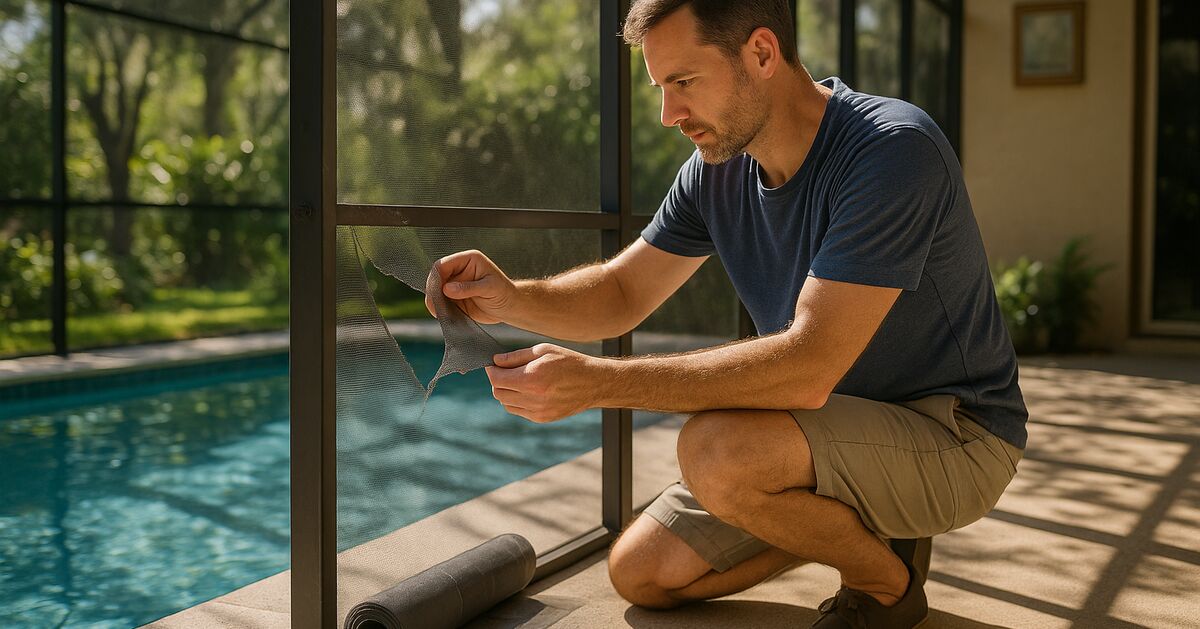
Torn screen on a Friday afternoon, guests arriving Sunday - it is tempting to grab a repair kit at the hardware store and handle it yourself. Sometimes that is exactly the right call. Other times it turns a $150 repair into a $600 one. Knowing which situation you are in before you start is the whole game.
This post gives you an honest, practical breakdown: what DIY screen repair actually involves, what tools and skills you need, where it tends to go wrong, and when calling a professional is simply the smarter move financially and practically. No scare tactics, just straight talk.
What "DIY screen repair" actually means
There is a wide range of repairs that get lumped under the DIY label. At one end you have a small tear in a single panel that you patch with a mesh repair kit. At the other end you have re-screening an entire pool cage with forty-plus panels, a spline roller, and a ladder. These are not the same job, and they do not deserve the same answer.
For the purposes of this comparison, think about three tiers of repair:
- Tier 1 - Small patch or single panel: A hole or tear smaller than a few inches, or one damaged screen panel in a lanai or window enclosure.
- Tier 2 - Multiple panels or a screen door: Several panels that need new screen cloth, or a door that needs re-screening and re-hanging.
- Tier 3 - Full or partial pool-cage re-screen: A significant portion (or all) of a pool cage, typically after storm damage, UV degradation, or age.
DIY is most defensible at Tier 1 and gets progressively less so as you move up.
The honest case for DIY
Let's give credit where it is due. DIY screen repair can genuinely be the right choice in these circumstances:
The damage is small and truly isolated. A single panel with a clean tear, no frame damage, no corroded spline channel - this is a reasonable weekend project for a handy homeowner. Patch kits cost just a few dollars, and a simple panel re-screen with a new roll of fiberglass mesh and a spline roller costs under $30 in materials.
You already have the tools and some experience. Pulling old spline, cutting new mesh with a margin, rolling in new spline without warping or puckering the screen is a learnable skill. If you have done it before and it came out tight and clean, you know what you are doing.
You have time on your side. Re-screening even one panel correctly takes longer than YouTube makes it look. If you are not under time pressure and you enjoy hands-on projects, the learning curve is manageable.
The cost savings are real at small scale. For a single Tier 1 repair, the difference between DIY and a professional service call is real money. If your only damage is one small hole in a window screen, a patch kit and fifteen minutes is a perfectly rational decision.
Where DIY tends to go sideways
Here is where we have to be honest about the failure modes, because they are common and they matter.
Spline selection is harder than it looks. Spline comes in several diameters and two main materials (foam and rubber). Using the wrong diameter is the number one reason screen panels pop back out within weeks. If the channel is worn or the frame is slightly bent, even the right spline will not seat properly. Our post on why screen panels keep popping out and spline basics goes deep on this - it is worth reading before you buy anything at the hardware store.
DIY mesh is usually standard fiberglass. Hardware store rolls are almost always 18x14 standard mesh or 18x16 "insect" mesh. If your enclosure currently has no-see-um screen (a much finer weave, typically 20x20 or finer), or if it has phifer pet-resistant screen, a standard roll replacement will not give you the same performance. You will have sealed the hole but downgraded your enclosure without realizing it.
UV damage is invisible until it is not. Florida sun degrades screen mesh faster than almost anywhere else in the country. If you patch one panel in a cage where the rest of the mesh is brittle from UV, you have not fixed the problem - you have put a new tile in a crumbling bathroom. Understanding UV damage and what it does to screen is key context before deciding whether a patch is worthwhile.
Frame and spline channel damage gets missed. Homeowners focused on the mesh often do not notice that the aluminum channel holding the spline is bent, corroded, or missing its retaining lip. On coastal properties - think Anna Maria Island, Longboat Key, Siesta Key, Lido Key - salt air accelerates aluminum corrosion in ways that are not always obvious until you are trying to roll spline into a channel that no longer grips. A repair over compromised hardware is temporary at best.
Pool cage work involves real height and real risk. Replacing panels near the roof of a pool cage means working on a ladder over concrete or water. Professionals use proper ladders, stabilizers, and often work in teams. A fall risk is not a reason to feel embarrassed about calling someone - it is a legitimate job-site safety consideration.
Tension and appearance matter more than you might expect. Screen that is puckered, wavy, or uneven does not just look bad - it traps moisture at the folds and degrades faster. Getting consistent tension across a panel is a skill that takes practice to develop, and on a full cage, inconsistent tension across dozens of panels becomes very obvious.
The honest case for hiring a professional
A professional screen repair service brings things that are genuinely hard to replicate on a DIY basis:
The right materials for your specific enclosure. A professional will assess what screen is currently installed - mesh count, weight, material - and match it exactly. They carry multiple spline diameters and know by feel which one is correct for a given channel. This alone prevents the most common DIY failure modes.
Speed and equipment. What takes a homeowner a full Saturday afternoon often takes an experienced crew an hour or two. For multi-panel or full-cage work, the time savings are significant.
They see what you do not. A good screen repair tech will notice the bent retainer bead you did not see, the spline channel that is close to failing, or the frame corner that is pulling loose. Catching those issues early is worth the service call by itself.
Warranty on the work. Most reputable screen repair services back their labor. If a panel pops out or pulls loose within a reasonable period, they come back. There is no equivalent safety net on a DIY job.
Insurance and storm-damage situations. If your screen damage is storm-related and you are considering filing a claim, having professional documentation of the damage and a proper repair receipt matters. A patch job with a kit from a big-box store does not support an insurance claim the way a professional assessment and repair invoice does. For more on this, the guide to filing a screen-damage insurance claim in Florida is essential reading before you do anything.
The hidden cost of a failed DIY repair
The math on DIY looks straightforward: materials cost less than labor. But that math only works if the repair holds. When it does not, you pay for materials twice, you pay for professional labor to redo the work, and sometimes you pay extra because the professional now has to deal with mismatched mesh, wrong-diameter spline that has damaged the channel, or incorrectly trimmed screen that left burrs in the retaining groove.
Across Bradenton, Lakewood Ranch, Parrish, and Palmetto, we see this pattern regularly - a homeowner with good intentions and a $25 repair kit ends up with a panel that looks fine for three weeks and then sags or pops out entirely. The redo costs more than the original repair would have.
This is not an argument against DIY in every case. It is an argument for being clear-eyed about your actual skill level and the actual complexity of the job before you start.
A practical decision framework
Use this as a quick guide:
- One small panel, intact frame, standard mesh, you have done it before: DIY is fine.
- One small panel but you have never done it before: DIY is worth trying - just buy the right spline diameter and watch a good tutorial first. The cost of failure is low.
- Multiple panels, no prior experience: Lean toward a professional. The margin for error multiplies with each panel.
- Any pool cage panels, especially at height: Get a professional quote. The safety and quality arguments both point the same direction.
- Storm damage, possible insurance claim: Call a professional first, before any repairs. Documentation matters.
- Coastal property (Anna Maria Island, Siesta Key, Longboat Key, Osprey, Nokomis, Sarasota barrier islands): Have a professional assess the frame and hardware at the same time. Salt-air corrosion makes frame assessment critical.
- Unclear what mesh type you have: Call before buying. Using the wrong replacement mesh defeats the purpose.
What to expect from a professional repair visit
If you do decide to call a pro, here is what a typical visit looks like so there are no surprises.
The technician will assess not just the damaged panels but the condition of the surrounding frame, spline channels, and fasteners. They will match your existing mesh type and source the correct spline. On a standard multi-panel lanai repair, most jobs are completed in a single visit. Pool cage work depends on panel count but a partial re-screen of a damaged section is typically a half-day job.
You will get a look at the full range of screen and pool-cage repair services before any work starts, so you know exactly what is being done and why. Good technicians explain what they found, not just what they fixed.
For homeowners across our service area - from Bradenton and Lakewood Ranch to Sarasota and Siesta Key - repair visits are typically straightforward to schedule, and most jobs do not require leaving equipment behind overnight.
The bottom line
DIY screen repair is genuinely worth doing for small, simple, low-stakes jobs where you have the right materials and some prior experience. It is genuinely not worth doing when the job is complex, the enclosure is large, the property is coastal, or when there is any chance an insurance claim is involved.
The goal is not to talk you out of doing it yourself when that makes sense. The goal is to make sure that when you decide, you are deciding with accurate information rather than optimism.
If you are not sure which category your repair falls into, the easiest first step is a quick conversation. Our FAQ page covers the most common questions homeowners have before booking, and you can always reach out directly to describe what you are seeing - a short description is usually enough to tell you whether this is a Saturday afternoon project or a job to hand off.