Lido Key rentals: why screen enclosures need more checks
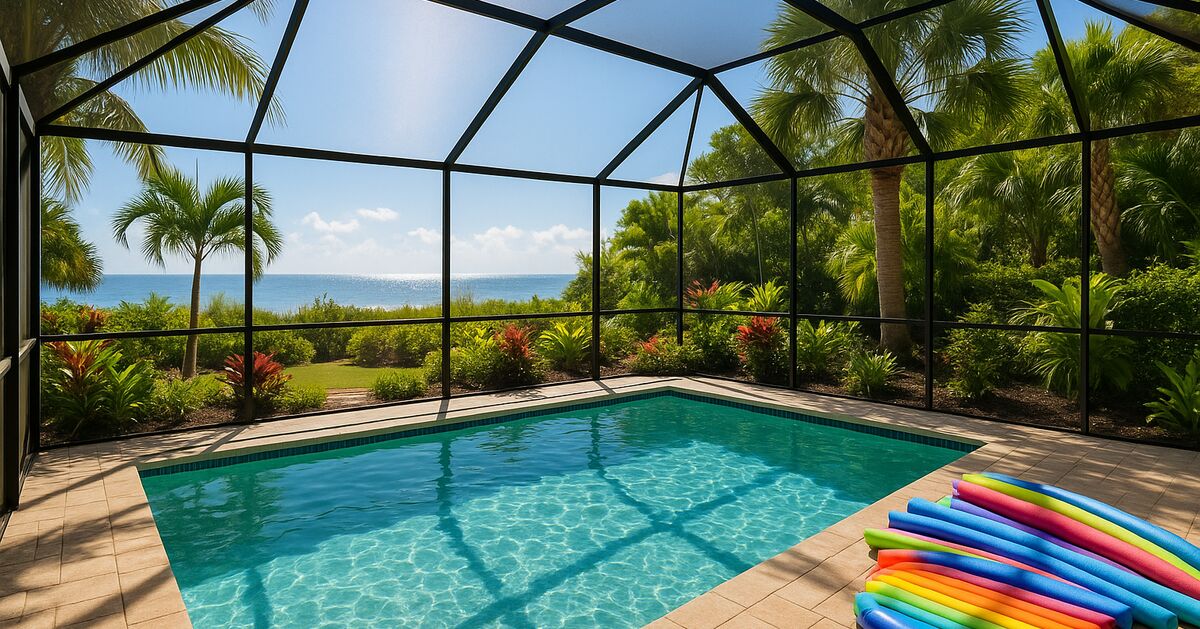
Screen enclosures at short-term rental properties age faster than almost any other residential structure on the Suncoast. That is not an exaggeration or a sales pitch; it is a straightforward consequence of how those properties are used. A Lido Key vacation home that hosts 30 or 40 guest groups a year sees more door slams, more furniture dragged across spline channels, more sunscreen-covered hands grabbing screen panels, and more pool toys bouncing off mesh than a comparable owner-occupied home sees in five years. The wear is real, it compounds quickly, and it shows up in ways that guests notice immediately.
This post walks through exactly why that accelerated wear happens, what the failure points are, how to build an inspection cycle that actually keeps pace with rental traffic, and what the consequences are when you fall behind.
Why rental traffic hits screen enclosures harder than owner use
A full-time resident knows the enclosure. They know which door sticks, which bottom panel is already a little loose, and which spline channel has been re-seated twice. Guests do not know any of that. They push harder on doors that resist, they lean against panels that look solid, and they let children run at full speed through the space without thinking twice about what a screen edge is or is not designed to handle.
The specific behaviors that show up again and again in high-turnover rental properties include:
- Screen doors opened too fast and allowed to bang against the frame. Door closers take a beating. The spring tension degrades, the pin wears, and eventually the door hangs crooked in the frame. A crooked door is also a door with a gap at the threshold, which lets insects in.
- Furniture repositioned across spline channels. Patio chairs and loungers dragged across the base channel of a screen panel can dislodge the spline from its groove or pinch the screen at the bottom edge, creating a small tear that grows within a season.
- Pool toys and sports equipment thrown or bounced near panels. The fiberglass mesh used in standard pool-cage screening is not designed to absorb repeated impact. A foam noodle bouncing off a panel sounds harmless; do it 200 times over a rental season and the mesh fibers fatigue at the frame edge.
- Sunscreen and tanning oil transferred to the frame and mesh. Many commercial sunscreens contain oxybenzone and other chemical compounds that are not just harmful to coral reefs (a concern the EPA has raised in its research on reef-safe sunscreen formulations) but that also degrade the plasticizers in vinyl spline over time. Greasy residue also holds dust and organic matter that feeds mildew.
- Occupancy overlap during peak season. On Lido Key, rental turnovers can happen the same day. One group leaves, the property is cleaned, and another group arrives within hours. There is no window for the manager to walk the enclosure and catch a torn panel before the next guests arrive.
The specific failure points to check between every four to six guest stays
If you manage a Lido Key property and you are currently inspecting the enclosure once a season, or only when a guest complains, you are behind the curve. A reasonable cadence for high-turnover rentals is a visual inspection every four to six guest stays, with a hands-on structural check once a month during peak season (roughly November through April on Lido) and once every six weeks during summer.
Here is what each type of inspection should cover.
Visual inspection (between stays)
Walk the entire perimeter of the enclosure from inside and outside. You are looking for:
- Tears or holes in any panel, including small ones near the corners and along the bottom edge. Corner tears are a known weak point because the spline makes a 90-degree bend there and stress concentrates at that joint.
- Gaps at screen door thresholds. Get down low and look for daylight between the door sweep and the threshold. A gap you can see is a gap mosquitoes and no-see-ums can find. Our post on screen door threshold gaps and the pests they let in covers exactly what to look for.
- Visible spline that has ridden up out of its channel. This often happens at the base of bottom panels and at door frames.
- Rust or white oxidation streaks on the aluminum frame. The salt air coming off Sarasota Bay and the Gulf is relentless, and a rental property that sits closer to the waterfront sees heavier chloride loading than inland properties in Lakewood Ranch or Parrish. Streaks indicate that the anodizing or paint layer has been compromised.
Monthly structural check
This is the check that most rental property managers skip because it takes longer. It should not be skipped.
- Test every screen door through its full range of motion. Open it, let it self-close, and listen for any squeal, catch, or bang. Check the latch engagement and the closer tension.
- Press gently on each screen panel with an open palm. A properly tensioned panel should resist and spring back. A panel that deflects easily or crinkles at the edge has lost tension, which means the spline is loose or the mesh has stretched. Our article on what re-tensioning actually fixes and what it cannot is a useful reference here.
- Crouch at the base of the enclosure and inspect the bottom rail and the lowest panel in each bay. Bottom panels fail disproportionately often in rental settings because of foot traffic, chair dragging, and water pooling. The reasons why bottom pool-cage panels fail first apply with extra force at high-use rental properties.
- Check the anchor bolts at the base of each vertical post if you can see them. Loose anchors are a structural concern. Our detailed guide on how to check pool-cage anchors for signs of failure walks through this step by step.
The salt-air factor on Lido Key specifically
Lido Key sits between Sarasota Bay to the east and the Gulf of Mexico to the west. There is essentially no buffer from salt-laden air regardless of which direction the wind is blowing, which means the aluminum frame and all the fasteners are exposed to chloride corrosion 365 days a year. For an owner-occupied home, that is a slow process that can be managed with regular cleaning and prompt repair of any breach in the frame coating. For a rental property where cleaning is focused on the interior and the pool, and the enclosure frame rarely gets deliberately washed down, the corrosion accelerates.
What this means practically: on a Lido Key rental, the hardware (door hinges, closer pins, latch bodies, spline retainer clips) needs inspection every month, not every season. Corroded hinges cause doors to hang unevenly. Unevenly hung doors develop threshold gaps. Threshold gaps let insects in, guests complain, and your review ratings take a hit that has nothing to do with the quality of your interior furnishings.
Rinsing the frame with fresh water during the regular pool-deck wash-down is a simple habit that slows corrosion significantly. It is not a replacement for professional inspection, but it buys time between service visits.
What deferred maintenance costs a rental property owner
There is a straightforward business case for staying ahead of screen enclosure maintenance on a rental property, and it goes beyond the cost of the repair itself.
Guest experience and reviews. A visible tear in a screen panel, a mosquito that found its way through a threshold gap, or a door that will not latch are the kinds of things guests photograph and mention in reviews. On platforms where star ratings directly affect booking rates, a cluster of comments about maintenance issues is expensive.
Platform liability exposure. Short-term rental platforms typically ask hosts to keep listings accurate and properties in good repair, so an untended enclosure can become a listing problem. A pool enclosure described as "fully screened" that has multiple torn panels is a misrepresentation, even if it was accurate when the photos were taken.
Repair cost escalation. A small corner tear caught early costs very little to fix. Left through another rental season, that tear propagates to the full panel, and if water gets behind the frame at the point of tear, it accelerates corrosion in the channel. What was a one-panel re-screen becomes a frame repair. Our overview of screen and pool-cage repair services explains the range of work involved.
Insurance complications. Florida homeowner policies covering wind or storm damage to screen enclosures may require reasonable upkeep, so it's worth checking your policy language. A claim filed on a structure with documented deferred maintenance can be complicated. Keeping a maintenance log with dated photographs helps establish that the property has been properly cared for.
Building a realistic inspection schedule
For a Lido Key property running at high occupancy during the November-to-April season, here is a realistic schedule:
- Between every four to six stays: visual walk-through of the entire enclosure, inside and out. Five minutes. Look for tears, threshold gaps, and anything physically disturbed.
- Monthly during peak season: hands-on structural check as described above. Thirty minutes for an average-sized pool cage. Check hardware, test doors, press panels, inspect anchors.
- Once at the start of peak season (October): professional inspection and any deferred repairs before your busiest months. This is the appointment that prevents the emergency call in January when you have a guest arriving in two days.
- Once at the end of peak season (May): post-season check to catch anything that accumulated through the busy months before the summer storms arrive. Summer on the Suncoast brings daily afternoon thunderstorms that stress screen panels, and a panel that is already loose will not survive the first line of storms.
- After any named storm or tropical event: a full structural inspection regardless of where it falls in the calendar. Even storms that pass well offshore can produce wind gusts and debris that damage panels without causing the kind of obvious damage that would make you think to check.
Properties in other barrier-island locations face similar pressures. Our locations page shows the full range of communities we serve, and if you manage properties on Siesta Key, screen-enclosure work on Siesta Key involves similar salt-air and high-turnover considerations.
Who should do the inspections?
The between-stay visual checks can be done by a property manager or a cleaning crew that has been trained on what to look for. The monthly structural checks require someone who understands how spline, screen tension, and door hardware interact. The start-of-season and end-of-season professional inspections should be done by a contractor who works on pool cages and screen enclosures regularly, not a general handyman.
The reason for that distinction is that screen enclosure problems are often interconnected. A door that is hanging wrong may look like a hinge problem but actually trace back to a twisted frame section. A panel that keeps popping its spline may look like a spline problem but actually trace back to a frame rail that has moved because an anchor is loose. A general handyman fixes the symptom. A screen enclosure specialist diagnoses the system.
For Lido Key rental property owners who do not live locally, building a relationship with a reliable local contractor before you need emergency service is worth doing now, not after a guest reports a problem. You can reach us through our contact page to talk through a maintenance plan for your property.
A word on documentation
Whatever inspection schedule you adopt, keep a log. Date, what was inspected, what was found, what was repaired, who did the work, and photographs before and after. This serves multiple purposes: it helps you see patterns (the same panel tearing repeatedly may indicate a frame issue), it satisfies any insurance maintenance requirements, and it is useful documentation if a guest makes a claim about a condition at the property.
A simple shared folder with dated photos takes five minutes to maintain and has real value. Property management software that allows you to attach maintenance records to the property file is even better.
Screen enclosures are not a set-and-forget feature on any Florida home, but on a Lido Key short-term rental that cycles through dozens of guest groups a year, the standard owner-occupied inspection cadence simply does not keep pace with the wear. Building a schedule around your actual rental volume, staying on top of the salt-air hardware corrosion specific to Lido's location, and catching small problems before they grow into large ones is both good property management and good business. If you want a professional set of eyes on your enclosure before the season gets underway, get in touch and we will set something up.
Sources & further reading
- Reef-Safe Sunscreen Research and Oxybenzone Chemical Concerns (U.S. Environmental Protection Agency)
- Florida Building Code - Residential Structures and Enclosures (Florida Department of Business and Professional Regulation)
- Coastal Corrosion and Aluminum Alloy Degradation in Marine Environments (NACE International (now AMPP))
- Short-Term Rental Regulation and Property Standards in Florida (Florida Department of Business and Professional Regulation)
- Florida Climate and Seasonal Storm Data for Sarasota County (National Weather Service)
Claim-by-claim audit (7 checked)
- “Many commercial sunscreens contain oxybenzone and other chemical compounds that are not just harmful to coral reefs (a concern the EPA has raised in its research on reef-safe sunsc…” (reasoning shown in the article)
- “The salt air coming off Sarasota Bay and the Gulf is relentless, and a rental property that sits closer to the waterfront sees heavier chloride loading than inland properties in La…” (cited → nace.org)
- “Lido Key sits between Sarasota Bay to the east and the Gulf of Mexico to the west. There is essentially no buffer from salt-laden air regardless of which direction the wind is blow…” (cited → nace.org)
- “Summer on the Suncoast brings daily afternoon thunderstorms that stress screen panels, and a panel that is already loose will not survive the first line of storms.” (cited → weather.gov)
- “Short-term rental platforms typically ask hosts to keep listings accurate and properties in good repair, so an untended enclosure can become a listing problem.” (rewritten to what the article can stand behind)
- “Florida homeowner policies covering wind or storm damage to screen enclosures may require reasonable upkeep, so it's worth checking your policy language.” (rewritten to what the article can stand behind)
- “A claim filed on a structure with documented deferred maintenance can be complicated.” (reasoning shown in the article)