Is your pool-cage anchor failing? How to check
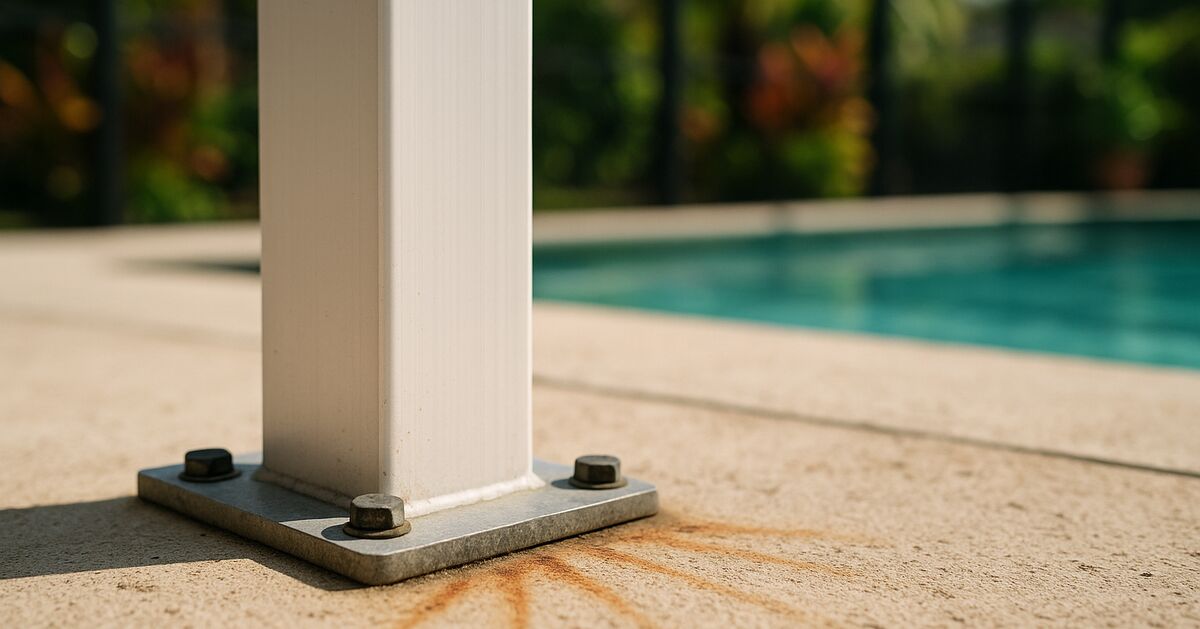
Concrete anchors are one of the most load-bearing parts of your pool cage, but they often don't get looked at until something goes visibly wrong. By the time a frame starts to lean, the anchor has usually been failing for months, sometimes longer. Learning to read the earlier, subtler signs is the cheapest form of insurance a Gulf-coast homeowner can buy.
Why concrete anchors matter more than most owners realize
Every vertical post in your pool cage is fastened to the surrounding concrete deck or a separate footing through a base plate and one or more anchor bolts set into the concrete. Those bolts transfer every wind load, every dead load from the frame, and every dynamic load from slamming screen doors into the ground below. When they hold, the whole structure is stable. When they begin to fail, the cage can rack, panels can pop, and in a severe storm the frame can lift or tip.
Florida's combination of high humidity, occasional freeze-thaw cycles in northern Manatee County, salt air from the Gulf, and the very wet-dry cycle that characterizes our summers puts anchor systems under stress that homeowners in drier climates simply do not face. If you live on Anna Maria Island or anywhere along the Longboat Key and Lido Key shoreline, salt-laden air accelerates corrosion of the anchor bolts themselves, often from the inside out, before the surface shows a single rust spot.
Understanding what is happening underground and at the slab surface lets you catch the problem before it becomes structural.
What "anchor failure" actually means
Anchor failure is not a single event. It is a progression that moves through roughly three stages.
Stage one: Chemical and mechanical loosening. Moisture wicks into the annular gap between the bolt and the concrete. On the Gulf coast, that moisture is often lightly saline. The bolt begins to oxidize beneath the surface. As rust forms, it expands, which actually widens the gap and speeds up moisture infiltration. Simultaneously, the hundreds of small vibrations from wind, foot traffic, and pool pump operation slowly work the bolt, just as a screw slowly works loose in a wall that gets bumped repeatedly.
Stage two: Reduced clamping force. The base plate is no longer pulled tight against the concrete. A small gap opens, invisible at first, sometimes filled with algae or debris. The frame still looks straight, but it has lost the friction that resisted lateral movement.
Stage three: Visible movement. The post rocks, the frame racks, mitered corners open up, and eventually the whole cage shifts. This is the stage when most homeowners call for help. By then, the repair is substantially more involved than it would have been at stage one or two.
Our screen and pool-cage repair services address all three stages, but catching the problem early keeps costs and disruption low.
The seven signs to look for right now
Walk your pool-cage perimeter with fresh eyes and check each of these in order.
1. Rust staining that fans out from the base plate
A rust stain directly beneath a base plate, especially one that fans outward across the concrete in a triangle pattern, is a reliable indicator that water is sitting at the bolt-to-concrete interface and oxidizing the fastener. Do not confuse this with surface rust from a nearby lawn tool or fertilizer spill. The telltale shape is radial, centered on the bolt location, and often appears even when the bolt head itself looks intact.
On properties in Palmetto and Ellenton where irrigation water has higher mineral content, the staining can be orange-brown even without significant corrosion, so probe further before concluding it is benign.
2. Lifted or cracked concrete directly at the base plate
Bolt corrosion causes expansion. If the bolt is set shallowly or the surrounding concrete is thin (a common issue on older decks that were poured at minimum thickness), that expansion can crack or slightly heave the concrete around the bolt. Run your finger across the base plate edge. If you feel the plate is sitting proud of the slab on one side, or if you see a hairline crack radiating from one of the bolt holes, take it seriously.
3. A base plate that can be rocked by hand
Grip the lowest point of the vertical post and apply gentle lateral pressure, roughly the amount a strong gust would supply. A properly set anchor should feel completely rigid. Any perceptible rock, even a millimeter or two, means the clamping force is gone. At that point the frame is being held by friction alone, and friction disappears under sustained wind load.
This test is one of the simplest and most informative things you can do in about twenty minutes. Walk every post. Do not skip the corner posts; they carry disproportionate load.
4. Gaps between the base plate and the concrete surface
Crouch down and look across the base plate at a low angle, the way you would check whether a table is level. Any visible gap, even one you can barely slide a business card into, is significant. The plate should be in full contact with the concrete. A gap means either the anchor pulled up or the concrete beneath it spalled away.
Gaps are especially telling when they appear on the windward side of the post but not the leeward side. That asymmetry means the post has already begun to tip under prevailing wind load.
5. Spalling or hollow-sounding concrete around the bolt
Tap the concrete immediately around the base plate with a screwdriver handle. Solid concrete returns a sharp, dense sound. Concrete that has delaminated internally from freeze-thaw cycling or from expanding bolt corrosion returns a hollow thud. Spalling (visible surface flaking or pitting) near the anchor is a secondary confirmation.
Homeowners in Parrish and northern Manatee County occasionally see this pattern from mild winter freeze events that do not affect coastal properties as often.
6. Frame members that no longer align at the corners
A cage whose anchors are all holding will keep its geometry. When one or more anchors loosen, the frame can rack, meaning opposite corners move in opposite directions. Look at the mitered joints at the top of the corner posts. If the two members meeting at the miter have opened even slightly, look down: the problem often traces to an anchor at or near that corner.
This kind of secondary damage is worth understanding in context. The frame and fastener issues that make a cage feel wobbly are frequently downstream effects of an anchor problem, not independent failures.
7. Screen panels that repeatedly pop out near the base
Screen panels that keep popping their spline near the bottom rail of the cage, even after re-screening, are sometimes trying to tell you that the bottom rail is moving. A rail that shifts even a small amount under wind load puts the spline under shear stress it was not designed to handle. If you have had the same lower panels re-done more than once in a short period, add an anchor inspection to your next service call.
Our post on what happens to an unrepaired spline over a Florida summer explains why repeated panel failures deserve a root-cause look rather than just another screen replacement.
Why Gulf-coast conditions accelerate anchor deterioration
The chemistry is straightforward: salt acts as an electrolyte, and an electrolyte speeds up the electrochemical reactions that constitute corrosion. Properties within a mile of open water, which includes most of Sarasota, Siesta Key, Nokomis, Osprey, and the barrier islands, see measurably faster anchor bolt corrosion than inland properties.
Beyond chemistry, the wet-dry cycle matters. Florida's summer rainy season saturates the concrete around the bolts. The dry season that follows causes that concrete to shrink slightly. Over years, this cycling works the bond between bolt and concrete the way flexing a wire back and forth eventually breaks it.
Per guidance from the Florida Building Code (which references ASCE 7 for wind load calculations), anchor systems for screen enclosures must be engineered to resist specific uplift and lateral forces based on local wind speeds. Manatee and Sarasota counties fall within wind zones that require meaningful anchor capacity. An anchor that has lost even a portion of its designed holding strength represents a code-compliance gap as well as a safety concern.
The U.S. Department of Housing and Urban Development's guidelines on corrosion-resistant fasteners and the American Concrete Institute's standards for anchorage to concrete both recognize that bolt-to-concrete interfaces in humid, corrosive environments require periodic inspection, precisely because the failure mode is hidden until it is advanced.
How a professional evaluates anchors
When a qualified technician inspects your cage anchors, the process goes beyond the visual and tactile checks you can do yourself. Common professional steps include:
- Torque testing. A calibrated torque wrench is applied to each anchor bolt nut. A bolt that spins or that accepts torque far below specification has lost its grip.
- Pull testing. For anchors that are suspected to have lost embedment, a pull test applies a measured tensile force. This is the definitive test for uplift capacity.
- Core sampling or borescope inspection. When the concrete itself is suspect, a small core or camera inspection reveals the condition of the embedment zone.
- Base plate fastener inspection. Some cages use through-bolts; others use screw anchors or epoxy-set rods. Each type has different failure signatures and different repair options.
If you are unsure whether your cage has been inspected recently, the FAQ page covers what a standard service visit typically includes and what questions to ask before scheduling.
What repair looks like at each stage
Catching the problem early is not just about peace of mind. It directly affects cost and complexity.
At stage one (loosening, minimal corrosion): often the bolt can be re-torqued or replaced in kind, and any gap at the base plate can be addressed with appropriate grout or caulk to prevent further moisture intrusion. This is a fast, relatively low-cost intervention.
At stage two (reduced clamping force, some concrete damage): the bolt may need to be removed, the hole re-drilled or reamed to a larger diameter, and a new anchor epoxy-set or mechanically fastened. The base plate may also need shimming or replacement.
At stage three (visible movement, cracked concrete, racked frame): the repair expands to include not just the anchor but potentially the base plate, the lower sections of affected posts, and any screen panels or hardware damaged by the racking. This is where a problem that could have been fixed at a service call becomes a larger project.
The progression described above is consistent with what the American Concrete Institute's guidelines on post-installed anchors describe as the typical deterioration sequence for fasteners in outdoor, high-humidity environments.
How often should you check?
A visual walk-around using the seven-sign checklist above takes less than half an hour and is worth doing once a year, ideally before hurricane season begins in June. If your cage is older than fifteen years, or if it was built on a deck that has been resurfaced or overlaid, add a professional torque check to your annual pool-cage maintenance.
Properties in Lakewood Ranch and Bradenton that back up to retention ponds or have consistent irrigation runoff across the deck surface should consider inspecting more frequently, because standing water at the base plates dramatically shortens the inspection interval that makes sense.
After any named storm or tropical system that produces sustained winds above 50 mph, add an anchor walk-around to your post-storm checklist regardless of whether you see visible damage to the screens or frame. Uplift forces during a storm can partially loosen an anchor that looks perfectly fine in calm conditions.
A note on DIY versus professional inspection
The visual and tactile checks described here are genuinely useful and homeowner-accessible. You do not need specialized tools to notice rust staining, a rocking post, or a gap under the base plate. What you do need a professional for is anything that involves applying load to the anchor to quantify its remaining capacity, epoxy-setting a new anchor into existing concrete, or evaluating whether the concrete itself is sound enough to re-anchor into.
If you find signs that concern you, the right next step is to have a qualified technician document what they find before the issue progresses. You can reach out through our contact page to schedule an inspection, or browse our full list of service areas to confirm we cover your neighborhood.
Anchor problems are fixable at every stage. The only variable is how much work is involved, and that variable is almost entirely within your control if you start looking before the frame starts to lean.
Sources & further reading
- Florida Building Code - Structural provisions and ASCE 7 wind load references (Florida Department of Business and Professional Regulation)
- ACI 318: Building Code Requirements for Structural Concrete (anchorage to concrete) (American Concrete Institute)
- ASCE 7 Minimum Design Loads and Associated Criteria for Buildings and Other Structures (American Society of Civil Engineers)
- Corrosion of Embedded Metals in Concrete - guidance on bolt and anchor deterioration (Portland Cement Association)
- HUD Guidelines on Corrosion-Resistant Fasteners in Residential Construction (U.S. Department of Housing and Urban Development)
Claim-by-claim audit (5 checked)
- “Properties within a mile of open water, which includes most of Sarasota, Siesta Key, Nokomis, Osprey, and the barrier islands, are generally expected to see faster anchor bolt corr…” (rewritten to what the article can stand behind)
- “Per guidance from the Florida Building Code (which references ASCE 7 for wind load calculations), anchor systems for screen enclosures must be engineered to resist specific uplift …” (cited → floridabuilding.org)
- “The U.S. Department of Housing and Urban Development's guidelines on corrosion-resistant fasteners and the American Concrete Institute's standards for anchorage to concrete both re…” (cited → hud.gov)
- “The progression described above is consistent with what the American Concrete Institute's guidelines on post-installed anchors describe as the typical deterioration sequence for fa…” (cited → concrete.org)
- “Uplift forces during a storm can partially loosen an anchor that looks perfectly fine in calm conditions.” (reasoning shown in the article)