What happens to an unrepaired spline over a Florida summer: the month-by-month breakdown
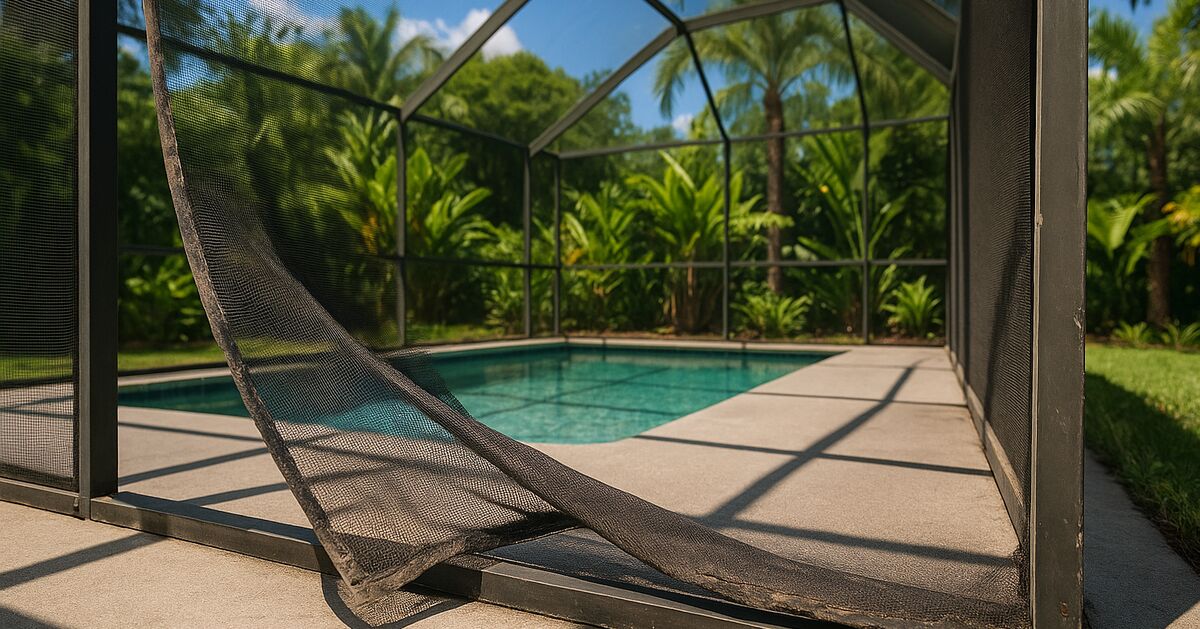
A single damaged spline is easy to ignore. It sits in a groove you barely notice, holds a screen panel you take for granted, and costs very little to fix when caught early. Ignore it through one Florida summer, though, and that small strip of rubber quietly triggers a chain of damage that can turn a $40 repair into a $400 bill before hurricane season is even over.
This post walks through what actually happens - month by month, from the first hot days of May through the tail end of storm season in October - so you can see exactly why timing matters so much on the Suncoast.
First, a quick reminder about what a spline actually does
The spline is a flexible rubber cord pressed into a channel (the spline groove) that runs around the inside edge of each screen frame. It is what locks the screen mesh in place. Without adequate pressure from the spline, the mesh has nothing holding it taut. Pull the spline out, and the screen falls right away.
A healthy spline is pliable, fills the groove completely, and creates even tension across the whole panel. A damaged one - cracked, shrunken, pulled loose at a corner, or simply hardened from UV exposure - no longer seals that groove. And in Florida's climate, "no longer sealing the groove" is not a stable condition. It gets worse, fast.
If you want a deeper look at how spline fits into the anatomy of a pool cage, our post on screen repair vs. replacement and the role of spline in keeping panels secure covers the mechanics in plain terms.
May: the damage is subtle, but the clock starts now
May on the Suncoast is when daily temperatures start regularly hitting the upper 80s and the UV index climbs toward its summer peak. If your spline was already compromised coming out of winter - dried, cracked, or partially lifted from the groove - May is when those small flaws start to accelerate.
What is happening inside the groove:
- Rubber spline expands and contracts with daily temperature swings. A groove that was holding a cracked spline "just enough" in cooler months starts to lose its grip as the material softens and shifts.
- UV radiation bakes the exposed top edge of the spline, accelerating the hardening and brittleness that probably started last summer.
- Where the spline has already pulled away from a corner, that gap begins to widen as the frame itself expands slightly in the heat.
At this stage, the damage is still invisible from ten feet away. The screen panel still looks mostly taut. But if you run your finger along the spline groove and feel a section that is raised, crumbling, or gaps at a corner, the process is underway.
What a repair costs in May: A spline replacement on a single panel at this stage is a quick, inexpensive fix. The mesh itself is almost certainly fine and does not need to be replaced.
June: rain and humidity join the equation
Florida's rainy season typically arrives in earnest by mid-June, and the combination of daily afternoon storms, sustained high humidity, and heat creates conditions that are genuinely hard on screen enclosures. This is when an unrepaired spline starts causing visible damage to the screen mesh.
Here is the chain reaction:
When the spline no longer holds the mesh under proper tension, the screen is free to shift. Wind from afternoon thunderstorms - even moderate gusts of 20 to 30 mph that come with a typical summer storm - pushes against a loose panel. A properly tensioned screen deflects that load and springs back. A panel with a failed spline billows, strains against the frame edge, and can develop small tears at the corners or along the bottom rail where the mesh is rubbing against bare aluminum.
Rain gets into the open spline groove. The groove itself is aluminum, and while most pool-cage frames are anodized or powder-coated, a groove that repeatedly holds standing water - especially in areas near the coast from Anna Maria Island to Siesta Key where salt content in the air is higher - is a groove that is being set up for corrosion.
By the end of June, you may notice:
- One or more small tears in the screen mesh near the corners where the spline has pulled away.
- A panel that visibly sags or has a slight wave in the middle.
- In coastal properties, a faint chalky residue or staining beginning inside the spline groove.
July: heat peaks, mesh begins to fail
July is the cruelest month for a compromised screen enclosure on the Suncoast. Daily highs routinely sit at 92 to 94 degrees Fahrenheit, and the UV index regularly hits 11 or higher. The screen mesh itself - whether standard fiberglass or aluminum - is under thermal stress every single day.
A properly seated spline holds the mesh under consistent tension, which actually helps the mesh handle thermal expansion. The panel knows where its edges are. A panel with a failed spline has no such constraint. The mesh expands and contracts freely, which causes it to develop stress concentrations at whatever points it is still in contact with the frame or spline remnants.
What this looks like by mid-July:
- Tears that were pinhole-sized in June are now fingertip-sized or larger. Florida insects, including the no-see-ums that make outdoor living miserable, can fit through any hole larger than about 20 mesh openings, so even a small tear compromises the whole purpose of the enclosure.
- On panels where the spline has failed along a full side (rather than just a corner), the mesh may have partially or fully pulled away from the frame. At this point, the panel is providing essentially zero protection from insects or debris.
- The aluminum spline groove may show surface oxidation in spots where rainwater has been sitting repeatedly.
It is worth noting here that if you have pets, a loose panel is also a pet escape or injury hazard. Our services page covers pet-resistant screen options for households where that is a concern.
August: secondary damage compounds the primary problem
By August, a spline that was damaged in the spring has now had three months to cause cascading problems. This is where what started as a single spline repair starts to look like a re-screen job.
The compounding factors:
- Mesh damage is now widespread on the affected panel. Tears that began at corners have propagated along the edges. The mesh may also have developed brittleness from sustained UV exposure, so it tears more easily than fresh mesh would.
- Neighboring panels may be affected. When one panel loses tension and moves freely in wind, it can abrade or push against adjacent panels. Frames are connected, and repeated flex at one point puts stress on nearby connections.
- Hardware and frame fasteners are under additional stress. A panel that has been flopping in wind all summer puts lateral loads on the frame members it is attached to. This can loosen existing fasteners and, in older cages, accelerate corrosion at connection points. The relationship between loose hardware and structural integrity is something we cover in detail on our post about why wobbly pool cages are usually a fastener problem, not a screen problem.
- Algae and mildew move in. A torn or loose panel allows more moisture and organic debris into the enclosure. Combined with reduced airflow patterns (a loose panel changes how air moves through the cage), August creates prime conditions for algae and mildew to establish on both the screen and the frame. Once mildew is in the spline groove, it accelerates rubber degradation on any nearby spline that was still intact.
If you are in Lakewood Ranch or Parrish where afternoon storms frequently include heavier winds than coastal areas due to open terrain, August storm damage to a compromised enclosure is a real risk. Homeowners in those inland communities sometimes see panels blow out entirely during strong squalls.
September: storm season stress-tests everything
September sits squarely in the peak of Atlantic hurricane season. Even without a named storm making landfall, the Suncoast routinely sees tropical moisture events, squall lines, and outer-band winds that push 40 to 60 mph for sustained periods. An enclosure that entered summer with a failed spline and has had four months of progressive damage is not ready for any of this.
The realistic scenarios by September:
- A panel that has been partially detached since July blows out completely in a tropical storm event. Replacing a full panel after storm damage involves not just new mesh and spline but often bent frame sections and additional labor.
- The open spline groove, now corroded, crumbles when a technician tries to replace just the spline. At that point, the frame section itself needs repair or replacement, a significantly more expensive outcome than early spline replacement would have been.
- Multiple adjacent panels are damaged, because the structural integrity of a cage depends on all panels working together. One failure point in a storm can propagate.
Homeowners on barrier islands - Longboat Key, Lido Key, Anna Maria Island - face additional wind exposure that makes this scenario more likely. The difference in storm risk between a coastal property and an inland one is substantial, and our post on how wind exposure should shape your screen enclosure choices goes into that in detail.
October: assessing the real cost of waiting
By the time October arrives and the weather begins to moderate, a homeowner who ignored a damaged spline in May is looking at a very different repair estimate than they would have seen in spring.
Here is a rough comparison of what that progression typically means in practice:
- May (spline only, mesh intact): Replacement of spline on one or two panels. Quick visit, minimal cost.
- July (spline plus mesh damage): Full re-screen of one or two panels, plus new spline. More material, more labor, but still contained.
- September/October (multiple panels, possible frame damage): Partial or full cage re-screen, potential frame repair, possible hardware replacement. The cost can be four to ten times what early intervention would have run.
None of those later numbers are invented for effect. They reflect the straightforward reality that mesh, frame sections, and hardware all cost more than spline cord, and labor to address multiple issues simultaneously takes longer than a single focused visit.
What to do right now if you have a spline that needs attention
The practical takeaway is simple: a compromised spline is not a stable condition in a Florida summer. It is the beginning of a process, and that process moves faster than most homeowners expect when heat, UV, humidity, and wind are all working together.
A few things to check today:
- Walk the perimeter of your enclosure and press lightly on each screen panel. A properly tensioned panel should feel firm and spring back. A soft, billowy, or rattling panel has tension issues.
- Run your fingers along the spline groove on accessible panels. Raised sections, crumbling rubber, or gaps at the corners are all signs of failure.
- Look at the corners of each panel, since that is where spline failure almost always starts. Small tears near the corners are a reliable indicator.
- Check the bottom rails, which are closest to the ground and exposed to the most moisture. Spline at the base of panels often degrades before spline on the sides or top.
If you find something that concerns you, the right next step is a professional assessment before the summer has a chance to compound the damage. Our frequently asked questions page addresses a lot of the common concerns homeowners have about what a repair visit involves, and you can always reach out to us directly to describe what you are seeing and get a straight answer.
We serve homeowners across the Suncoast from Bradenton and Palmetto in the north down through Sarasota, Osprey, and Nokomis in the south, as well as the barrier islands and communities like Ellenton and Parrish. If you are not sure whether what you are seeing warrants a call, the honest answer is that in Florida's summer climate, it almost always does. A spline that looked "okay enough" in April rarely looks okay enough by August.
Catching it early is genuinely one of the most cost-effective things you can do for a screen enclosure. The rubber cord itself is cheap. Everything it protects is not.