Longboat Key vs. Lakewood Ranch: how wind exposure should shape your screen enclosure choices
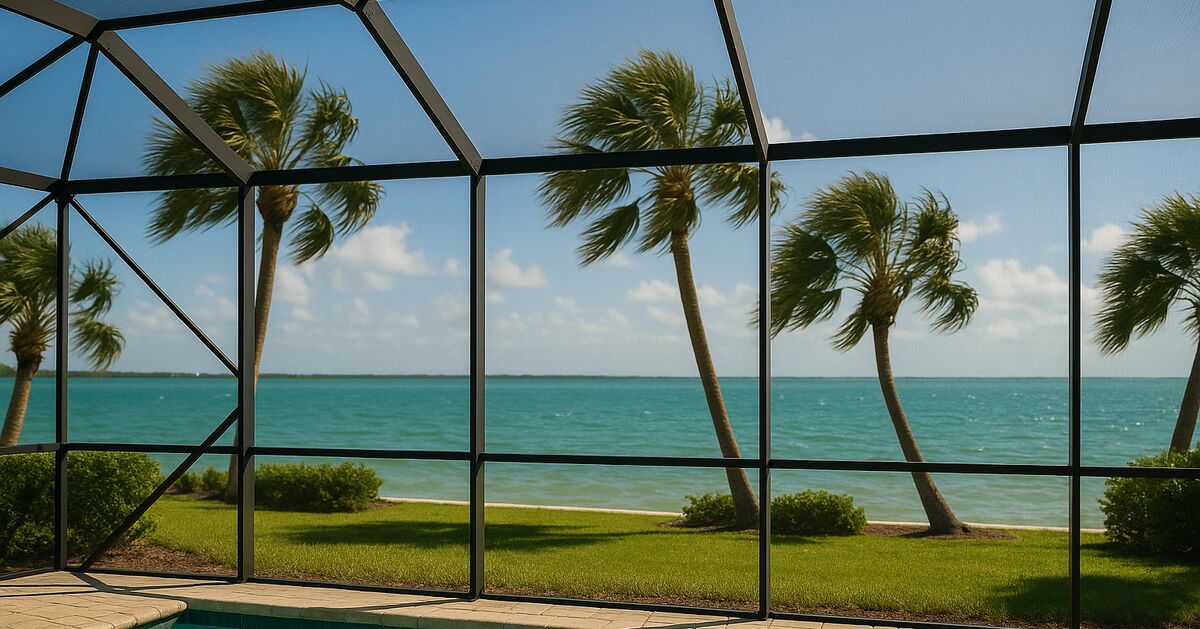
Picking the wrong screen mesh for your location is one of the quietest ways to waste money on a screen enclosure - you won't notice until panels are failing years ahead of schedule. Where your home sits on the Suncoast map matters far more than most homeowners realize, and the difference between a barrier-island property on Longboat Key and a sheltered subdivision in Lakewood Ranch is not subtle.
This post gets into the practical specifics: what wind exposure actually does to mesh and frames, what to prioritize when you inspect your enclosure, and how to make choices that keep your investment lasting as long as it should.
Why geography is the first factor, not the last
Screen enclosures fail for a handful of reasons - UV degradation, spline shrinkage, frame corrosion, fastener failure - but the rate at which all of those problems develop is strongly influenced by one thing: how much wind, and what kind, your enclosure faces on a regular basis.
Wind is not a single variable. There is sustained wind speed, which determines how much constant tension a screen panel bears. There is wind-driven rain, which forces salt and contaminants into frame joints and mesh fibers at pressure. And there is wind direction, which determines which faces of your enclosure take the brunt of the load, season after season.
On Longboat Key screen and pool-cage repair jobs, the dominant exposure is almost always the Gulf-facing side of the property, with southwest breezes in summer and occasional north-northwest winds during winter cold fronts. That means certain panels and certain frame joints are working far harder than others on a year-round basis. Inland at Lakewood Ranch, the wind still blows - Florida is not a gentle state - but there is no saltwater saturation in the air, prevailing winds are partially broken by tree canopy and neighboring structures, and sustained gust events are meaningfully shorter in duration than what the barrier islands experience.
These are not small differences. They translate directly into how you should spec your materials and what you should look at first when you inspect.
Mesh weight: what it means and why it matters on the coast
Screen mesh is sold by thread diameter and weave count, which together determine how much airflow you get versus how much debris and wind load resistance you have. Most residential enclosures in Florida are built with 18x14 fiberglass mesh, which is a solid everyday choice for sheltered locations.
But mesh weight is not one-size-fits-all.
On Longboat Key and other barrier-island exposures, a heavier mesh - often referred to as a "super screen" or high-tensile polyester weave - does several things that standard fiberglass cannot match as well:
- It resists the flutter stress that comes from consistent, salt-laden wind. Standard fiberglass mesh flexes and recovers, but repeated flexing under salt exposure accelerates fiber degradation at the weave intersections.
- Heavier mesh holds tension in the spline channel better under gusting conditions, which means panels are less likely to pop out when a squall hits.
- Coarser, denser weave patterns shed wind-driven rain more efficiently off the screen face, reducing the amount of salt water that gets forced through the mesh and into your framing.
Inland at Lakewood Ranch, the calculus shifts. There is still UV degradation to plan for (Florida sun is relentless everywhere), and storm-season wind events are real. But the salt saturation that hammers coastal mesh simply is not present at the same level. A quality standard fiberglass or a mid-weight polyester mesh will often serve inland homeowners well and at a lower cost, provided the frame is in good shape to begin with. The upgrade to heavy-duty mesh is still available and sometimes chosen for peace of mind, but it is not as clearly the default move that it is on Longboat Key or Lido Key.
If you are unsure where your property falls on the exposure spectrum, our screen repair and pool-cage services page covers the material options we carry and can help frame the conversation before we visit.
Frame inspection priorities: the coastal sequence vs. the inland sequence
Not all parts of a pool cage or lanai frame wear at the same rate, and your inspection priorities should reflect your exposure pattern, not just a generic checklist.
On Longboat Key and other Gulf-facing properties
Start with the windward corners. Corners are where two planes of framing meet, and they are the hinge points under lateral wind load. Salt-laden air infiltrates corner connections through the tiniest gaps, and over time the galvanic interaction between aluminum extrusions and stainless or galvanized fasteners creates corrosion at exactly the points where you most need structural integrity. Look for paint bubbling, white oxidation chalking, or any soft spots in the metal around corner brackets.
Next, check the horizontal sill beams. These low rails sit closest to the deck surface where wind-driven water pools and evaporates, concentrating salt residue. Sill beams on the Gulf-facing side of a Longboat Key enclosure often show corrosion years before the upper framing does. Probe with a fingernail: the metal should feel solid, not gritty or flaky.
Then inspect the windward spline channels. The spline - the rubber or vinyl rope that locks screen mesh into the frame groove - takes constant flex loading on the face pointing into the prevailing wind. Coastal UV plus salt dries and shrinks spline faster than inland conditions. If a panel on the southwest face is looser than panels on the sheltered sides, that is the spline telling you something, not the screen itself.
Finally, look at your screen door hardware. Hinges, closers, and latch hardware on coastal properties corrode significantly faster than the main framing. A door that seemed fine a year ago can develop a stiff or dragging action once hinge pins begin to seize from salt exposure.
Inland at Lakewood Ranch, Parrish, and Ellenton
The inland inspection sequence is still methodical, but the priorities shift.
Start with the roof panels. Inland homes, especially in neighborhoods with mature oak and pine canopy, tend to have more organic debris accumulation on top of the enclosure. Wet leaf matter and tree pollen hold moisture against the screen and frame for longer than salt mist does, and that sustained moisture is the primary corrosion driver inland. Look for dark staining along the upper frame rails and discolored patches on roof panels where debris has been sitting.
Check fasteners at post bases. In Lakewood Ranch and Parrish subdivisions, many pool cages were installed on concrete pool decks using post-base anchors. These are the fasteners closest to the ground and the most exposed to irrigation overspray and lawn-care runoff, both of which introduce fertilizer salts and chemicals that accelerate corrosion even without Gulf proximity. Loose or corroded post-base anchors are one of the more common issues we find in inland enclosures, and they matter because a loose base allows the whole post to rock slightly under wind load, which transfers stress upward into the frame.
Then look at screening tension across all panels uniformly. Inland enclosures tend to wear more evenly across all faces because there is no single dominant wind direction loading one side far more than others. Uneven tension - one saggy panel while neighbors look tight - usually points to a specific spline failure or a prior poorly done repair rather than systematic directional wear.
Finally, inspect screen door alignment. Inland doors are less prone to hardware corrosion but more prone to alignment shifts caused by deck movement. Florida's clay-heavy soils in parts of Lakewood Ranch and Parrish can create minor seasonal settlement that nudges door frames slightly out of square, causing sticking or incomplete closure.
The overlap zone: what homes in Palmetto, Ellenton, and Bradenton experience
Many homeowners think of the coast-versus-inland divide as binary, but there is a broad middle band that includes Palmetto, Ellenton, and the western parts of Bradenton. These communities sit near the Manatee River corridor and can pick up salt-air influence during strong onshore flow events, while also experiencing the organic debris loading that affects inland properties.
For enclosures in this zone, a hybrid approach to both mesh selection and inspection is sensible. A mid-weight polyester mesh performs better than standard 18x14 fiberglass on the southwestern faces, where Gulf wind has an unobstructed corridor up the river. Inspection should cover the coastal checklist items for windward corners and sill beams, combined with the inland checklist emphasis on roof panels and post-base anchors.
The honest answer for any middle-zone property is that a qualified technician needs to walk the enclosure and observe how the surrounding landscape funnels or shelters the wind before making final material recommendations.
Seasonal timing: when to inspect based on your exposure
Longboat Key homeowners should plan one inspection in late spring (April or May), before the hurricane season adds serious wind events to the stress your enclosure already carries, and a follow-up inspection or simple visual check after any named storm passes through. The goal of the spring inspection is to find weakened spline, loose fasteners, and early frame corrosion before storm season tests them properly.
Lakewood Ranch, Parrish, and other inland communities benefit most from a post-summer inspection in October or November, after the wet season has done its work. Sustained summer humidity and afternoon thunderstorm downpours create the moisture-loading conditions that organic debris turns into a slow frame corrosion problem. Catching it in fall gives you time to address issues before the snowbird season when you want everything looking and functioning its best.
What a good contractor should tell you at the quote stage
If someone quotes you a re-screen job and never asks which direction your enclosure faces, or never walks the perimeter to look at what each face is exposed to, that is worth noting. The material choice and the inspection depth should be informed by your specific exposure, not just the square footage.
Our frequently asked questions page covers some of the common questions homeowners have about mesh grades and frame materials, and it is a good starting point if you want to understand the vocabulary before a technician arrives.
A post we wrote on lanai vs. pool cage re-screening considerations also goes into why the same materials and methods do not always make sense even within a single property, which is closely related to the directional exposure question.
Practical decisions you can make right now
Whether you are on Longboat Key or in a Lakewood Ranch subdivision, here are the concrete steps that will serve you best:
- Note which face of your enclosure takes the most wind and weather. Stand inside during a good rain and watch where the driven water hits hardest. That panel or frame section deserves the most frequent attention.
- Check spline on windward panels every 12 to 18 months. Gently press on the panel face. It should feel taut with minimal deflection. Significant give means the spline has relaxed.
- Clean frame corners and sill beams at least twice a year. A garden hose rinse removes the salt and debris accumulation before it has months to work into joints. Coastal properties benefit from more frequent rinsing.
- Do not ignore a single popped panel. A panel that has come loose from its spline channel is a flag that the spline in adjacent panels on the same face may be close behind. It is worth a full inspection of that face rather than a spot repair and moving on.
- If you are planning a full re-screen, read about whether a screen care plan before or after that re-screen makes sense for your situation. The answer depends on how hard your location works the new material.
Our team works across the full range of Suncoast communities, from barrier islands to inland subdivisions, and the advice we give on material selection reflects where your home actually sits in this landscape. If you are ready to have someone walk your enclosure and give you an honest assessment, reach out through our contact page and we will set up a time.
Getting the mesh weight and inspection priorities right for your specific location is not complicated, but it does require treating your enclosure as a product of its environment rather than a generic structure. The homeowners who do that consistently are the ones who get decades out of their enclosures instead of a frustrating cycle of repeated repairs.