Should you add a screen care plan before or after a full re-screen?
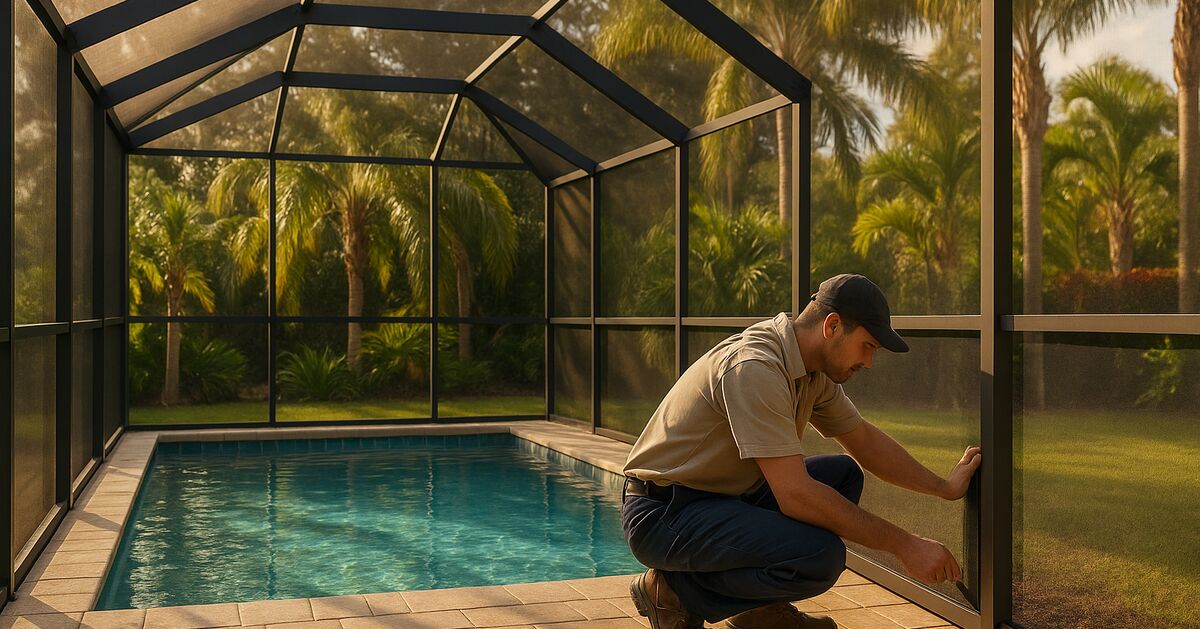
Good timing turns a routine maintenance decision into real savings - and nowhere is that more obvious than when you are weighing a screen care plan against an upcoming full re-screen of your pool cage or lanai.
If you lock into a care plan just before a full re-screen, you may be paying to maintain mesh that is about to be ripped out anyway. Lock in too long after the re-screen and you miss the window where consistent upkeep would have done the most good on brand-new material. Neither is a catastrophe, but getting the sequence right lets you stretch the life of your investment and avoid double-spending. Here is how to think through it.
What a screen care plan actually includes
Before timing anything, it helps to know what you are timing. A screen care plan - sometimes called a maintenance agreement or a service plan - typically bundles regular inspections, minor repairs (small holes, popped spline, loose door hardware), and a rinse or cleaning of the frame and mesh on a set schedule, usually every six to twelve months.
The core value is catching small problems before they become expensive ones. A tiny tear at a corner seam, left alone through a Florida summer, can spread across an entire panel by the time the next storm season arrives. A care plan means someone with trained eyes looks at your enclosure on a schedule rather than waiting for you to notice something is wrong.
If you want a full breakdown of what ongoing service looks like, our screen and pool-cage repair services page lays it out clearly.
Why re-screening is its own separate conversation
A full re-screen is not maintenance. It is replacement. Every panel of mesh in your enclosure is pulled out, new screen is stretched and splined in, and you essentially start the clock over on that material.
Full re-screens are warranted when:
- The mesh is generally brittle, gray, or heavily UV-degraded across most panels
- You have widespread small holes rather than one or two isolated tears
- The existing screen is mismatched from prior patchwork repairs
- You are upgrading to a different mesh type (no-see-um, pet-resistant, solar screen, etc.)
If only a panel or two is damaged, spot repairs almost always make more financial sense than a full re-screen. The decision tree between those two paths is worth understanding in detail before you spend money on either - our FAQ page addresses the most common questions homeowners ask about this.
The three timing scenarios and what each one means for your wallet
Scenario 1: You add a care plan before a full re-screen you know is coming
This is usually the least cost-effective sequence - but "least cost-effective" does not mean "never do it."
If your mesh is genuinely at end-of-life but you are planning to re-screen in, say, four to six months because you want to time it around a home sale or a budget cycle, a care plan during that waiting period mostly protects you from emergency call-outs. The mesh will not be improved by inspections, but a plan can keep minor structural issues (loose hardware, a failing door latch, a popped corner spline) from escalating into bigger frame problems before the re-screen happens.
The honest take: if you are within about three months of a confirmed re-screen, skip the care plan and just schedule a single pre-re-screen inspection instead. You get the professional eyes without paying for ongoing coverage on mesh you are about to replace.
If you are four to six months or more out, a short-term plan can still be worth it because it keeps the frame in good shape. The frame outlasts the mesh by many years, and neglecting it during a "we're going to re-screen soon anyway" period can mean hidden corrosion or fastener problems that add cost to the re-screen project itself. Speaking of which - loose frames and wobbly cages are often a fastener issue rather than a screen issue, and that distinction matters whether or not new mesh is in your plans. Our post on why wobbly pool cages are usually a fastener problem, not a screen problem explains the difference in plain language.
Scenario 2: You add a care plan immediately after a full re-screen
This is the sweet spot for most Suncoast homeowners, and here is why.
Brand-new mesh is at peak tension and integrity the day it is installed. The spline is seated correctly, every panel is taut, and there are no existing weak points. What damages new screen is not age in the first year or two - it is debris impact, biological buildup, and the slow work of UV radiation plus humidity. A care plan started right after re-screening addresses all three:
- Scheduled inspections catch the first signs of UV stress before brittleness spreads
- Cleaning visits remove algae, mildew, and bird droppings that eat through coated fiberglass mesh faster than most homeowners expect
- Minor repairs on contact mean a small hole from a falling branch gets fixed before it tears across the panel during the next thunderstorm
Biologically, the Suncoast environment is brutal on screen. Homeowners near the water in areas like Anna Maria Island, Siesta Key, or Longboat Key face salt-laden air that accelerates corrosion on aluminum frames and degrades spline elasticity faster than inland addresses in Parrish or Lakewood Ranch. A care plan calibrated to your location's specific stressors - coastal salt, interior humidity, heavy tree canopy - is more valuable than a generic national maintenance contract. More on the specific challenges for coastal properties: what Anna Maria Island homeowners need to know about screen enclosures in a coastal flood zone.
Starting a care plan at the point of re-screen also creates a clean maintenance record, which matters if you sell the home. Documented upkeep is a tangible selling point and can support the condition of your enclosure during a buyer's inspection.
Scenario 3: You have had new mesh for a while and are now considering a care plan
This is the most common situation. You re-screened a year or two ago, life got busy, and now you are wondering if a care plan is still worth starting.
The short answer is yes, as long as the mesh is not already at the point where it needs replacing again. An inspection first is smart here: have a professional assess the current condition, note any problem areas, and then layer in the care plan so you know what baseline you are starting from.
The risk in waiting too long to start maintenance is that compounding minor issues become a full re-screen sooner than necessary. Fiberglass mesh in Florida typically lasts somewhere between seven and twelve years depending on the environment, mesh type, and how well it is maintained. A homeowner who cleans and inspects regularly can often get toward the higher end of that range; one who waits for visible failures tends to end up at the lower end. The math on care plan cost versus early re-screen cost almost always favors the plan.
What about the cost of a care plan versus not having one?
We do not publish flat-rate prices here because care plan costs vary based on the size of your enclosure, how many screen panels it has, your location, and what specific services are bundled in. What we can say honestly is that the cost of a single emergency panel replacement or a door rehang - unplanned, urgent, mid-summer - is almost always more than several months of care plan fees. You are not buying maintenance; you are buying price predictability and the ability to fix things while they are cheap.
If you want a real number for your specific enclosure, the most useful step is a free quote. You can reach us through the contact page, and we can look at what you have and give you a straight answer.
Location matters more than most homeowners realize
Florida is not one climate. The difference between maintaining a screen enclosure in Ellenton or Palmetto - where inland humidity and tree canopy are the main enemies - and maintaining one on Siesta Key or Lido Key, where salt air, sand, and occasional coastal flooding are the real stressors, is significant enough to change what a good care plan looks like.
Inland homes in Bradenton and Lakewood Ranch typically deal with:
- Heavy pollen and organic debris buildup in spring
- Storm-season impact from falling fronds and branches
- Algae and mildew growth driven by humidity and shade
Coastal and island properties add:
- Salt corrosion on aluminum extrusions and fasteners
- Higher wind-load stress on panels and spline
- Flood-zone considerations that affect which enclosure products are appropriate
A good care plan accounts for these differences. If a contractor offers you the exact same plan regardless of whether you are in Parrish or on Anna Maria Island, that is a signal to ask more questions. Our locations page covers the full range of communities we serve, and the local context genuinely changes the work.
How to have a productive conversation with your contractor about timing
When you are ready to talk to a screen professional about sequencing a care plan and a re-screen, a few questions will help you get useful answers:
- "Given the current condition of my screen, how long do I realistically have before a full re-screen is unavoidable?" A good contractor will give you an honest range rather than push you toward replacement if spot repairs would serve you just as well.
- "If I start a care plan now and need a full re-screen in two years, how does that affect the plan?" Some contractors will prorate or credit plan fees toward a re-screen. Know this before you sign.
- "What does the first inspection include, and will you give me a written condition report?" A written baseline is useful for insurance purposes and for tracking changes over time.
- "What mesh type should I re-screen with when the time comes, given my location and how I use the space?" The answer should vary depending on whether you are dealing with no-see-ums, pets, sun exposure, or privacy needs. The way those factors interact is something our post on lanai vs. pool cage re-screening covers in useful detail.
The bottom line on timing
If a full re-screen is imminent (within about three months), skip the care plan and put that money toward the re-screen itself or a one-time inspection of the frame.
If a full re-screen is six or more months away on a worn enclosure, a short-term care plan protects the frame and keeps emergency costs down while you wait.
If you have recently re-screened, starting a care plan at that moment is the highest-value timing. You protect fresh mesh when it matters most, create a maintenance record, and give yourself the best shot at reaching the upper end of your screen's usable lifespan.
If you re-screened a year or two ago and have not started a plan yet, start now after an initial inspection to establish a baseline. It is not too late, and the compounding benefit of consistent upkeep still applies.
Suncoast homeowners from Bradenton to Sarasota, from Nokomis up to Parrish, share one thing in common: the environment is relentless on screen enclosures. The mesh does not care whether you had a busy year. Consistent, well-timed care is the one lever homeowners actually control. Use it.
For more practical guidance on keeping your enclosure in good shape, browse the rest of our blog or head to our home page to learn more about what we do.