What Anna Maria Island homeowners need to know about screen enclosures in a coastal flood zone
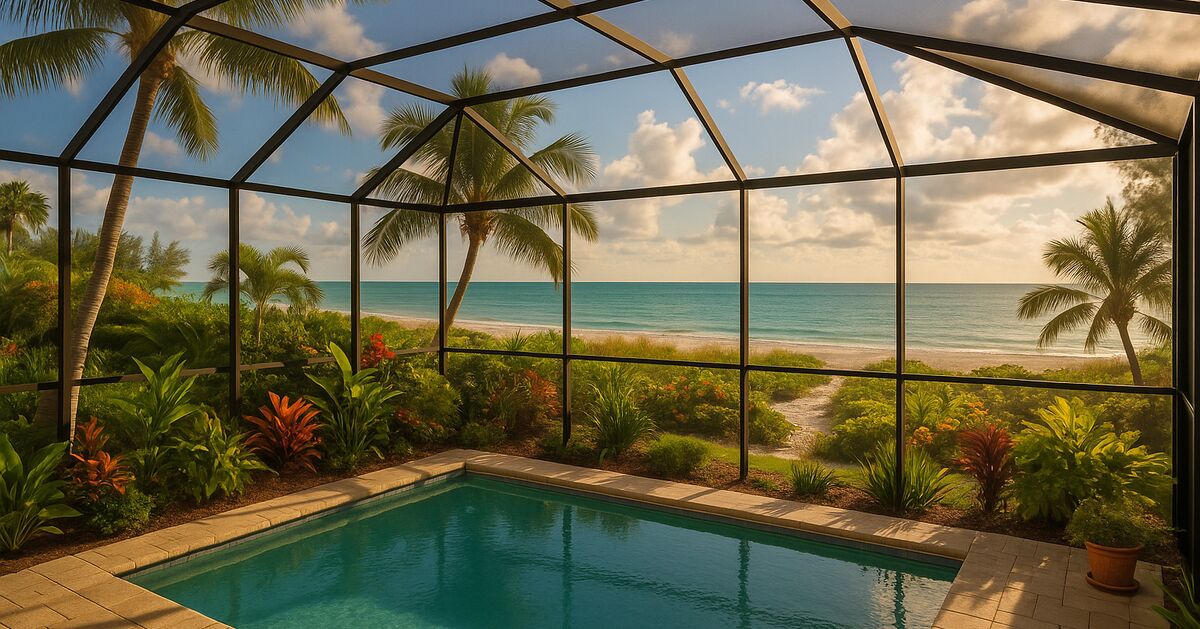
Salt air rolls in off the Gulf every single day on Anna Maria Island, and the rules governing what you can build, how high it can sit, and how it must survive a storm are nothing like what your cousin in Lakewood Ranch or Parrish deals with. If you own a screened lanai or pool cage on the Island, you are playing a different game, and the sooner you understand the specific pressures at work, the better your enclosure will hold up, and the fewer surprise repair bills you will face.
The flood zone reality on Anna Maria Island
Most of Anna Maria Island sits in FEMA Special Flood Hazard Areas, which means properties are subject to Base Flood Elevation (BFE) requirements. In plain language, the lowest finished floor of your home must be elevated to a certain height above sea level. That requirement affects your screen enclosure in ways most homeowners never think about until they are staring at a permit denial.
When a pool cage or lanai enclosure is attached to a home, its foundation, footings, and tie-in points all have to meet the same flood-zone standards that govern the main structure. If you are replacing an old cage with a new one, or making structural repairs that exceed a certain cost threshold, the county may require the new work to bring the enclosure into current flood-zone compliance. This can mean deeper footings, break-away wall panels, or specific anchoring systems, none of which are cheap, but all of which matter for safety and insurability.
The takeaway: a repair job on Anna Maria Island is sometimes more involved than the same job in Bradenton or Sarasota simply because of where you are on the map. A contractor who works the Island regularly will know this. One who does not may quote you a price that does not survive contact with the permit office.
Why "break-away" construction matters for screen enclosures
Flood-zone building codes often require what engineers call break-away construction for structures below the BFE. The idea is counterintuitive at first: you actually want certain parts of the structure to fail under storm surge pressure, so the surge passes through rather than pushing the whole building off its foundation.
For screen enclosures, this plays out in a few specific ways:
- Screen itself acts as a break-away surface. Standard fiberglass or aluminum screen is designed to tear out of its spline under pressure. That is not a flaw; in a coastal flood zone, it is by design.
- Lower wall panels may need to be designed for release. If your enclosure has solid knee walls or lower panels below BFE, those may need to be engineered to give way.
- Over-engineering can create liability. Ironically, making an enclosure too rigid below the flood line can cause more structural damage to the home itself when surge hits.
This is why you cannot simply grab the heaviest-gauge screen mesh available and call it an upgrade. What works brilliantly for a Sarasota or Siesta Key homeowner who mainly wants privacy or pet resistance may actually be the wrong call for the section of your Anna Maria enclosure that sits below BFE. Your contractor and your structural engineer need to be in the same conversation.
Salt air corrosion: it is faster here than almost anywhere else
Even compared to other Gulf Coast communities we serve, Anna Maria Island's exposure level is extreme. The Island is narrow, ocean surrounds it on multiple sides, and the salt-laden breeze has nowhere to dissipate. Aluminum frames that might last 15 years in an inland neighborhood like Ellenton or Palmetto can show significant oxidation and pitting in half that time on the Island.
What salt air corrosion actually does to a pool cage:
- It attacks the anodized or painted finish on aluminum framing, exposing raw metal underneath.
- Once the coating is breached, pitting begins. Pitted aluminum is structurally weaker and provides a rough surface where mildew and algae get a foothold.
- Screws, bolts, and hardware corrode even faster than the frame because they are often made of different metals, and dissimilar-metal contact in a salt environment accelerates galvanic corrosion.
- Screen mesh anchored by corroded spline and into pitted channels starts to loosen and pop out more frequently.
The practical implication: on Anna Maria Island, annual inspection of your hardware is not optional. Stainless-steel fasteners are worth the premium. And when a frame section looks "a little rough," it is almost always further along the corrosion path than it appears from the ground. Our post on rust on your pool cage, its causes, cures, and prevention goes deeper on what to look for and what the repair options are when corrosion has set in.
Permitting on Anna Maria Island: expect more steps, not fewer
Manatee County issues permits for most work on the Island, and the City of Anna Maria, Holmes Beach, or Bradenton Beach may have additional local requirements layered on top depending on your exact address. Screen enclosure repairs that are purely cosmetic (replacing a torn screen panel, for example) generally do not require a permit. But structural work almost always does, and the flood-zone overlay adds review steps that are not present on inland jobs.
Things that typically require a permit on the Island:
- Replacing or adding frame members
- Installing a new enclosure where none existed
- Rebuilding after storm damage beyond a defined damage percentage
- Changing the footprint or height of an existing structure
Things that generally do not require a permit:
- Re-screening individual panels in an otherwise sound frame
- Replacing hardware like door hinges and closers
- Routine cleaning and maintenance
If you are unsure which category your project falls into, ask before you start. Unpermitted structural work in a flood zone can complicate your homeowner's insurance and create serious headaches when you try to sell. Our frequently asked questions page covers some of the general permit questions we hear most often.
Choosing the right screen mesh for coastal conditions
Screen mesh choice on Anna Maria Island involves a different set of trade-offs than it does for inland homeowners. You are balancing salt-air durability, airflow (which matters a great deal on a narrow barrier island with variable breezes), insect protection, and the flood-zone break-away considerations discussed above.
A few mesh types worth understanding:
Standard fiberglass mesh (18x14 or 18x16) is the most common and the most affordable. It handles the break-away requirement naturally, filters most insects, and is easy to replace. On the Island, expect to re-screen more frequently than the manufacturer's typical lifespan estimates, because UV and salt air both shorten the service window.
No-see-um mesh (20x20) has a tighter weave that blocks the tiny biting midges that are a genuine nuisance near the water. It reduces airflow somewhat, which is worth weighing if your lanai relies on the Gulf breeze for natural cooling. For beachside homes, many homeowners find the trade-off is worth it.
Aluminum screen mesh is more durable against physical damage than fiberglass, but it can corrode in a salt environment. If you go this route, make sure the mesh is treated or coated for marine use.
Solar or privacy screen blocks significantly more light and reduces airflow more than standard mesh. For an open, beachside setting, this can make a lanai feel stuffy. It is better suited to situations where privacy or sun control is the primary goal.
For most Anna Maria Island pool cages, we steer toward quality fiberglass no-see-um mesh as the best overall balance. It is break-away compliant, handles insects well, and is affordable enough that replacing it on the schedule the environment demands does not feel like a crisis.
Storm prep is different when you live on a barrier island
The general advice about storm prep for screen enclosures applies everywhere, but the calculus is different on a barrier island. Evacuation orders for Manatee County's barrier islands come early in a storm track, which means you often have less time to prep than mainland homeowners do. You also cannot get back onto the Island until officials lift the closure, so whatever state your enclosure is in when you leave is the state it is in when the storm arrives.
A few Island-specific habits that experienced homeowners develop:
- Keep your enclosure in good repair year-round so there is nothing loose to become a projectile. A torn screen panel that has been flapping for two weeks is more likely to cause frame damage in a storm than a sound, tight one.
- Know your contractor's emergency contact situation. After a storm, Island access is restricted and demand for repair services spikes. Homeowners who have an existing relationship with a contractor that knows the Island tend to get scheduled faster.
- Document your enclosure's condition before storm season with photos. If you need to file an insurance claim, a before-and-after record is invaluable.
- Consider whether your enclosure's lower panels are genuinely break-away compliant. If a previous owner or contractor reinforced them in a way that made them rigid, that is worth discussing with a professional before the next named storm.
Our screen and pool-cage repair services are available across the Island and throughout the surrounding communities, and we understand the access and permitting realities that come with barrier-island work.
What to do after a flood or surge event
If storm surge or significant flooding has touched your enclosure, treat it as a structural inspection situation, not just a cleaning job. Here is a reasonable sequence:
- Wait for the all-clear. Do not get back on the Island before officials lift the closure, and do not wade into standing water around your structure.
- Document everything before you touch it. Photos and video serve your insurance claim and help your contractor assess what happened.
- Look at the frame connections first. Surge moves horizontal loads through the frame in ways that wind alone does not. Check where the frame meets the slab or footer, and where it ties into the house structure.
- Check the spline channels. Surge deposits sand and debris deep into screen channels, accelerating corrosion. A rinse and inspection right after a surge event can add years to the frame's life.
- Get a professional assessment before making decisions. What looks like cosmetic damage sometimes conceals loosened footings or bent frame members. And what looks alarming (most screens blown out, some frame sections bent) is sometimes straightforward to repair once a pro is on site.
For homeowners across our service area, the screen repair and pool-cage services we provide on Anna Maria Island cover everything from post-storm panel replacement to full frame inspections.
Working with a contractor who knows the Island
Not every screen contractor is comfortable working on Anna Maria Island. The permitting process is more involved, access during busy season and after storms is genuinely complicated, and the pace of corrosion demands better-quality materials and more careful workmanship than a one-size-fits-all approach delivers.
When you are evaluating contractors, ask specifically whether they have done work on the Island before and whether they are familiar with Manatee County's flood-zone overlay requirements. A contractor who hedges or looks blank at those questions is probably not the right fit for your project, even if their pricing looks attractive.
It is also worth reading our broader post on how to choose the right screen-enclosure contractor in Manatee and Sarasota County before you start making calls. The criteria we lay out there apply everywhere, but they matter even more in a coastal flood zone where the consequences of cutting corners are amplified.
The bottom line for Island homeowners
A screen enclosure on Anna Maria Island is worth having. It extends your outdoor living season, keeps insects out, and adds genuine value to a home that is already in one of the most desirable spots on the Gulf Coast. But it operates in one of the most demanding environments in the region, and it requires an owner, and a contractor, who understands that.
Stay on top of annual hardware inspections. Use materials rated for marine or coastal exposure. Understand your flood-zone obligations before you start any structural work. Keep a relationship with a contractor who knows the Island. And when something needs repair, address it promptly, because on a barrier island, small problems have a way of becoming large ones faster than you expect.
If you have questions about your specific enclosure or want to schedule an inspection, get in touch with us and we will work with you from there.