Rust on your pool cage: causes, cures, and prevention
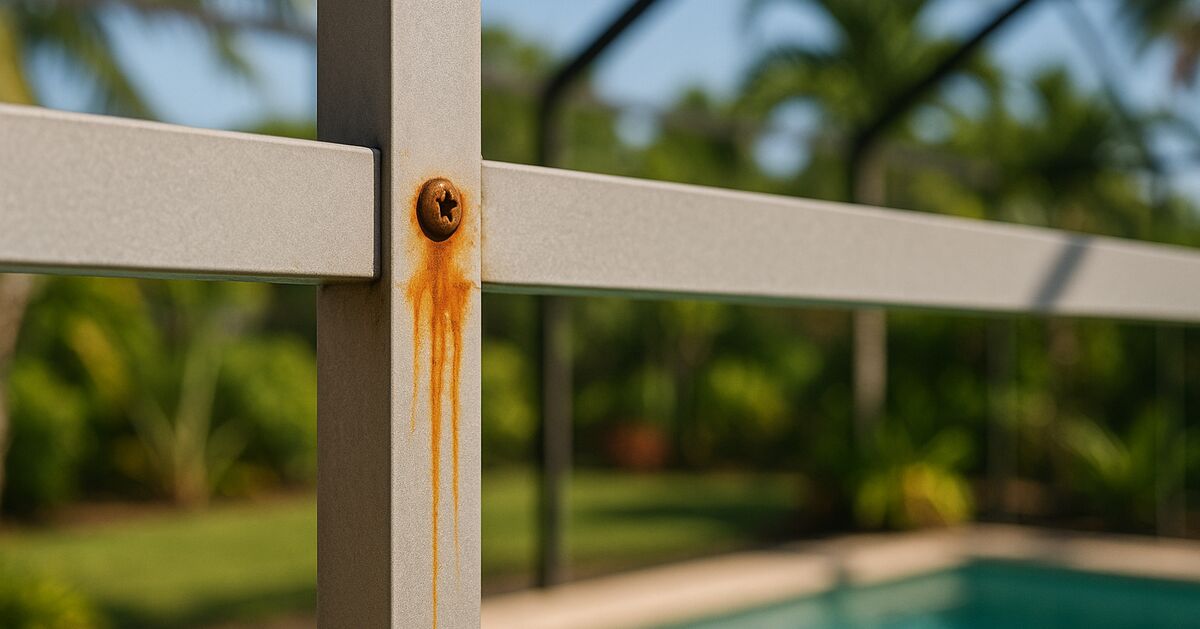
Rust on a pool cage frame is one of those problems homeowners notice on a Saturday morning and then quietly ignore for another six months. That is a costly habit in Florida.
The warm, humid, salt-tinged air along the Gulf Coast accelerates corrosion at a rate that surprises people who moved here from drier climates. What looks like a cosmetic orange smear on the aluminum today can quietly hollow out a frame section, weaken the anchoring points at the concrete footer, and turn a straightforward touch-up into a structural repair. Understanding why rust happens, what the different stages actually mean, and which fixes hold up in our climate will save you real money over the life of your enclosure.
Why pool cages rust in Florida in the first place
Most pool cages are built from aluminum, and pure aluminum does not rust the way steel does. So when you see that orange-brown staining, something more specific is going on. There are three main culprits.
Galvanic corrosion at mixed-metal fasteners. When aluminum sits in contact with a dissimilar metal, such as a steel screw, a zinc die-cast bracket, or even a stainless fastener with a slightly different alloy, an electrical current passes between them in the presence of moisture. That current eats away the less noble metal. In Florida, moisture is essentially a permanent condition. Steel screws driven into aluminum extrusions are the single most common source of the orange rust stains you see running down a frame member like a rust waterfall.
Coating failure and bare aluminum oxidation. New pool cages come with a baked-on paint or anodized finish. That coating is the cage's primary armor. Scratches from a ladder, a pressure washer held too close, a branch scraping across the frame, or simply years of UV exposure will eventually break the coating's bond. Once bare aluminum is exposed to our salt-laden air, it develops a white chalky oxidation first, followed by pitting. If steel fasteners are nearby, the classic orange rust stains bleed into the surrounding frame.
Salt air from the Gulf. Homes on or near Anna Maria Island, Longboat Key, Lido Key, Siesta Key, and anywhere within a mile or two of open water face an accelerated version of everything described above. Salt particles are hygroscopic, meaning they pull moisture out of the air and hold it against metal surfaces around the clock. A pool cage two blocks from the water in Bradenton Beach can show corrosion in two or three years that an inland cage in Parrish or Lakewood Ranch might not develop for a decade. This is not a manufacturing defect; it is just physics operating in a tough environment.
Reading the stages of rust damage
Not all rust is equally serious. Learning to read what you are seeing helps you decide whether you are dealing with a cleaning job, a hardware replacement job, or a call to a professional.
Stage 1: Surface staining only. Orange streaks on the frame surface, usually running down from a screw head, with no pitting or soft spots in the metal underneath. The frame itself is structurally fine. This is purely cosmetic, but it is a warning sign that the fastener below is corroding and should be replaced before it progresses.
Stage 2: Pitting in the aluminum. The surface coating has failed over a patch and the bare aluminum has begun to corrode into small divots. Run your finger over the area: if it feels rough or cratered rather than smooth, pitting has started. The metal is thinner there than it should be, and the structural integrity of that section is reduced. Panels near a pitted frame section may start pulling away from the spline channel because the channel itself is deforming.
Stage 3: Section failure and joint weakness. The corrosion has progressed deep enough that a frame section is soft, crumbly at the edges, or visibly bent or cracked along a corroded line. Joints where two frame members meet may feel loose or rock when you push them. At this stage the enclosure needs more than cosmetic attention. Structural repairs, including partial frame replacement, are necessary before re-screening makes sense. Screening over a compromised frame is a waste of money because the frame will continue to deteriorate underneath.
Stage 4: Footer and base-plate corrosion. The worst and most overlooked stage. The base plates and anchor bolts that attach the vertical frame members to the concrete deck are often mild steel, painted over or sitting in a plastic sleeve. Once moisture works its way in, these anchors corrode, expand, and crack the concrete around them. A cage that rocks slightly when you push a corner post probably has compromised anchor points. This is a safety issue, not just a cosmetic one, especially in a storm.
Cleaning and treating rust you can handle yourself
For Stage 1 staining, a few products and a little elbow grease go a long way.
- White vinegar or oxalic acid cleaner applied with a soft brush and left to dwell for 10 to 15 minutes dissolves light rust staining from aluminum without damaging the coating if rinsed promptly.
- Bar Keepers Friend (the powder version) made into a paste works on stubborn staining around screw heads.
- Rinse thoroughly. Leaving acidic cleaner on the frame defeats the purpose.
- After cleaning, touch up any bare aluminum with a self-etching primer and a color-matched exterior enamel. The goal is to seal the bare metal from air and moisture.
What you should not do: do not pressure wash a pool cage at high pressure. The force strips the factory coating from the extrusions, damages spline channels, and pushes water deep into joints where it cannot dry out. A garden-hose rinse is fine. A soft-wash service is fine. A 2,500-PSI wand held 6 inches from the frame is not.
Replacing corroded hardware: the real fix for Stage 1 and Stage 2
Cleaning the stain without replacing the corroding fastener underneath is like painting over a slow leak. The screw continues to rust, the staining returns within months, and the galvanic damage to the surrounding aluminum continues.
The correct fix is to remove the corroded screw or bolt, clean the area, and replace it with the right hardware. For aluminum pool cages, that means either aluminum pop rivets, 18-8 or 316 stainless steel screws (not the hardware-store variety of "stainless" that is actually zinc-plated), or, in very corrosive coastal environments on Anna Maria Island or Longboat Key, marine-grade fasteners designed for saltwater exposure.
Rubber-gasketed or neoprene-washered fasteners add another layer of protection by preventing direct metal-to-metal contact at the fastener head. They also stop water from wicking down the threads into the joint.
Our services page covers the full range of frame and hardware repairs we perform, including fastener replacement and joint re-sealing, for homeowners across the Suncoast who want this done correctly the first time.
When to call a professional: Stage 3 and Stage 4
Replacing a screw is within reach for most homeowners. Replacing a corroded frame section is not, and trying to do it without the right tools and knowledge usually creates more problems than it solves.
Frame extrusions on a pool cage interlock in a specific sequence. Removing a mid-span horizontal or a corner upright without understanding that sequence can cause adjacent sections to collapse or put stress on the screen panels in ways that are not immediately obvious. Understanding the anatomy of a pool cage, including how frame members, spline channels, and hardware all connect, is genuinely helpful background before you decide how to approach a structural repair.
Corroded anchor points at the footer level almost always require a professional, both because the fix involves concrete work and because the repair needs to meet local building code requirements. In Manatee and Sarasota counties, permitted enclosures have engineering requirements for anchoring. A repair that looks solid but does not restore the original anchoring strength is a liability in hurricane season.
We work throughout the area, from Bradenton and Parrish inland to Sarasota and the barrier islands. If you are unsure which stage your cage is at, a visual inspection by an experienced technician takes only a few minutes and takes the guesswork out of your decision.
Preventing rust from coming back
Treatment is only half the job. Prevention is what keeps you from repeating it every few years.
Rinse the cage regularly. A monthly rinse with a garden hose, paying attention to the joints and base plates, removes salt and chlorine deposits before they have time to work. This is especially important within a few miles of the water in Ellenton, Palmetto, or along the Sarasota bayfront.
Watch for pool chemistry splash-out. Chlorinated water splashing onto the frame from an active pool introduces both chlorine and mineral deposits. Rinse the lower portions of the frame and the base plates after any splash-heavy activity.
Inspect fasteners annually. Walk the perimeter of your cage once a year and look at every visible screw head. Orange staining directly around a fastener means it is already corroding. Deal with it then, not two years later when the surrounding aluminum is pitted.
Touch up coating damage promptly. A scratch or chip in the powder coat is not an emergency, but it should not sit bare over a Gulf Coast summer. A can of self-etching primer and matching enamel costs a few dollars and takes fifteen minutes.
Consider a corrosion-inhibiting spray on hardware. Products like Boeshield T-9 or a similar wax-based corrosion inhibitor applied to fasteners and joints after cleaning give an extra barrier against moisture in high-exposure areas. This is especially worth doing on frames near salt water.
Do not ignore small tears near corroded frame sections. A torn screen panel adjacent to a corroding frame member is not a coincidence. The degrading spline channel loses its grip as the aluminum pits, and screens pop out or tear at the edges. Addressing the frame and re-screening that section together is more efficient than patching the screen and coming back for the frame later. Our post on what a tear in the corner of your cage really means covers that connection in more detail.
A note on "rust-proofing" coatings sold at big-box stores
You will find spray-on rust converters and rubberized coatings at home improvement stores marketed as all-purpose rust solutions. Some of these work well on steel. On aluminum pool cage frames they range from ineffective to counterproductive.
Rust converter chemistry is designed for ferrous (iron-containing) metals. It reacts with iron oxide to form a stable compound. There is no iron oxide on bare aluminum, so the converter has nothing to react with and simply sits on the surface as a poor-quality coating. Rubberized spray-on coatings can trap moisture against the aluminum and speed up the pitting they were meant to prevent.
Stick with products formulated for aluminum: self-etching primer, two-part epoxy primers, and quality exterior enamel are your real options for coating repairs.
The bigger picture: a well-maintained cage lasts decades
A pool cage that is cleaned, inspected, and repaired incrementally can last 20 to 30 years or more in Florida's climate. The frames that fail prematurely almost always have one thing in common: small problems that were ignored until they became large ones.
Rust on a pool cage is neither rare nor catastrophic on its own. It is a signal from the material that the environment is doing its job, and that you need to do yours. Catch it at Stage 1, replace the offending hardware, touch up the coating, and you have bought yourself years. Let it reach Stage 3 or 4, and the repair bill climbs sharply, as does the safety risk.
If you have questions about what you are seeing on your own cage, our FAQ page covers many of the most common rust and corrosion questions, and you are always welcome to get in touch with us directly for a straight answer. We serve homeowners across Bradenton, Lakewood Ranch, Parrish, Palmetto, Ellenton, Anna Maria Island, Sarasota, Siesta Key, Longboat Key, Lido Key, Osprey, and Nokomis, and we are happy to take a look before a small problem becomes a big one.