What that tear in the corner of your cage really means
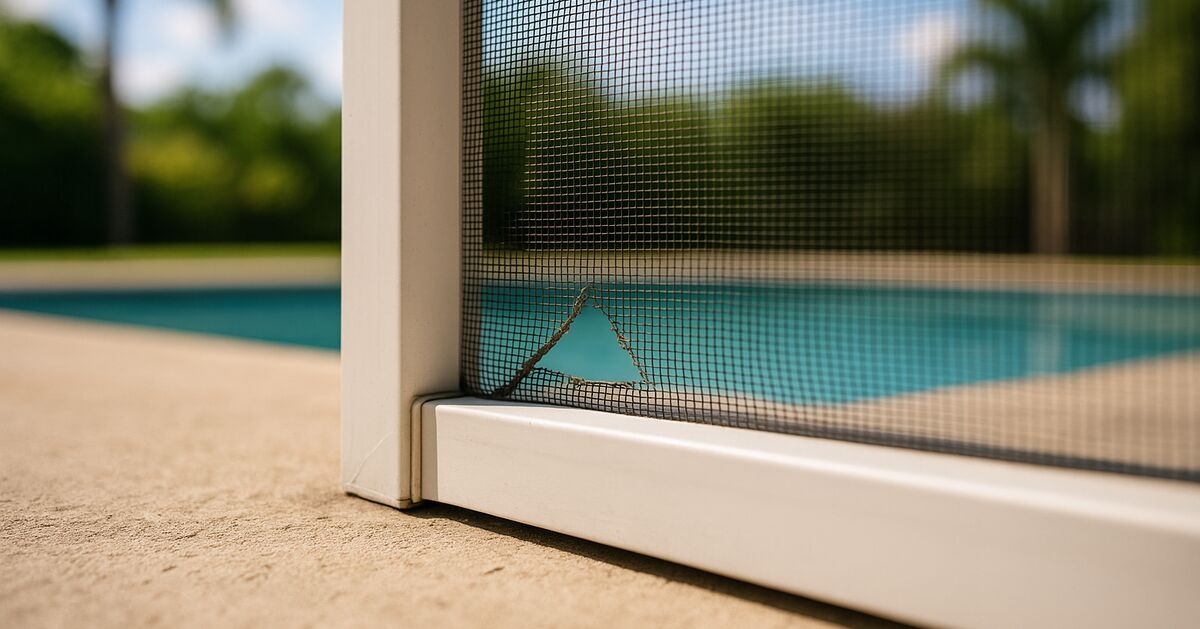
Corner tears are one of those things you notice, mentally file away, and then forget about for three months. They look small. They look like a bug problem, maybe a little cosmetic issue, something you'll get to eventually. But a tear in the corner of a pool cage screen panel is almost never just about that one spot of mesh. It's a signal, and the sooner you learn to read it, the less money you'll spend fixing what comes next.
Why corners tear first
Screen mesh is held in place by a rubber or vinyl spline that gets pressed into a channel running around the perimeter of each frame bay. The corners of that frame are where the tension in the mesh concentrates. Think of it like pulling the corners of a bedsheet tight: the stress radiates outward from the center, but it lands hardest right at the corners where two sides meet.
When the spline ages and shrinks (which it does in Florida heat, often faster than people expect), the mesh starts to work its way loose. The corners go first because that's where the holding force is already fighting the most resistance. UV radiation makes mesh fibers brittle over time, and a brittle fiber under constant tension will crack along its weakest line. In a rectangular panel, that weakest line is a corner.
So when you see a clean diagonal tear starting from a corner, or a section where the screen has pulled away from the frame channel right at the corner, you're not looking at a random accident. You're looking at a system that has reached the end of its holding capacity in the most stressed location.
The frame itself might be telling you something
Here's where it gets more important. Sometimes a corner tear isn't caused by old mesh or bad spline. It's caused by a frame that has shifted.
Pool cage frames settle. They're anchored to a concrete deck that expands and contracts with temperature swings. In areas like Bradenton and Sarasota, where we see both intense summer heat and occasional cold snaps, concrete decks can develop small movements over time. When the deck shifts, the vertical uprights that support the cage can go slightly out of plumb. When those uprights shift, the rectangular bay frames they support become subtly out of square. A frame that's out of square puts uneven tension on the mesh, and uneven tension tears mesh at corners.
You can check for this yourself by looking at the shape of the bay around the torn corner. Does it look like a true rectangle, or does it look slightly rhombus-shaped, with one corner a bit tighter than the opposite? Run your hand along the top spline channel and the side spline channel near the tear. Do they feel flush and even, or is there a slight buckle or gap where the frame members meet?
If the frame itself is distorted, replacing just the screen panel is a short-term fix. The new mesh will tear in the same corner within a season or two because the root cause hasn't been addressed.
When a corner tear points to spline failure across the whole cage
One torn corner is a localized event. Two or three torn corners, especially in different bays and different areas of the cage, means the spline throughout your enclosure is on its way out at the same time. This is actually very common. If your cage was last re-screened as a whole project, all the spline went in at the same time. All of it ages at roughly the same rate. So when the corners start to go, they tend to go in clusters over one or two seasons.
This matters for how you plan the repair. Patching individual corner tears when the spline is globally failing is a bit like replacing one wiper blade when both are streaking. You'll be back on the roof (or calling someone back out) in short order.
Our post on why properly tensioned screen matters more than you think goes into more detail on how spline condition affects the whole panel, not just the corner. It's worth reading alongside this one because the two issues are closely connected.
What a "corner blow-out" tells you versus a "corner pull"
There are two distinct types of corner damage worth distinguishing:
Corner blow-out: The mesh has actually torn, meaning the fibers have broken and there's a hole. This happens when something physically hit the screen (a branch, a ball, an animal), or when the mesh became so brittle from UV exposure that normal wind pressure caused it to rupture. In older mesh, even the air pressure difference during a storm can do it.
Corner pull: The mesh is still intact but it has separated from the frame channel, meaning the spline has lost its grip and the mesh has peeled away. No hole, but a gap between the mesh edge and the frame. In humid coastal areas like Anna Maria Island and Siesta Key, salt air accelerates the degradation of both the spline material and the aluminum frame's finish, which can allow the spline channel walls to widen slightly and release their grip sooner than you'd expect inland.
A corner pull is actually the more informative of the two. It almost always means the spline is the problem. A corner blow-out requires a closer look at the mesh age and the frame condition before you can say what's really going on.
What to look for on the frame members near the tear
Walk up to the corner tear and look at the aluminum frame members that form that corner, specifically the horizontal rail and the vertical upright that meet there. Look for:
- Corrosion pitting: Small pocked or powdery areas on the aluminum surface, especially near the spline channel. This is common in homes closer to the water in places like Longboat Key and Lido Key and indicates the frame has begun oxidizing.
- Bent or crimped channel walls: If the channel that holds the spline has been bent inward or outward, the spline can't seat properly. This sometimes happens after a heavy branch falls across a bay, as covered in detail in our piece on protecting your pool screen from falling branches and debris.
- Loose frame connections: At the corner junction, two frame members are joined by an internal connector or a self-tapping screw. If that connection has worked loose, the corner of the bay can shift independently. Grab the two frame members at the corner and see if there's any play between them. There shouldn't be any at all.
- Spline that crumbles or flattens when you press it: Old spline loses its round cross-section and becomes brittle. You can test it with your fingernail. Good spline is springy and round. Bad spline is flat, chalky, or breaks apart.
How this connects to what's happening across the whole enclosure
A corner tear is a convenient entry point for a broader inspection. While you're looking at that corner, take ten minutes to walk the entire perimeter of the cage and check every bay at all four corners. Note which bays have corner pulls or tears, which ones have mesh that looks chalky or grey (a sign of UV breakdown), and which frame members look corroded or bent.
If you're in Lakewood Ranch or Parrish or Ellenton, where newer communities have pool cages that are often 10 to 15 years old now, this kind of walk-around inspection every couple of years is genuinely worth doing. Enclosures in that age range are frequently hitting the point where spline is aging out and mesh UV resistance is declining at the same time.
Our frequently asked questions page has a section on how often to expect re-screening, which can give you a realistic benchmark for your enclosure's age.
The mistake people make most often
The single most common mistake homeowners make with corner tears is patching the hole with a screen repair kit from the hardware store and calling it done. These kits work fine for a small mid-panel puncture where the frame and spline are healthy. But a corner tear almost always involves compromised spline or a frame issue, neither of which a patch kit addresses. The patch covers the symptom while the underlying cause continues to progress.
Within a season, the screen will pull away again, either right next to the patch or in the adjacent corner of the same bay. Now you have two problems and an ugly patch.
The better approach is to pull the spline from the affected bay, inspect the channel and the frame corner connection, install fresh spline and new mesh for that bay, and then assess whether the surrounding bays are showing the same early signs. That's the fix that actually holds.
When to call someone versus handle it yourself
If the damage is limited to one or two bays, the frame members are straight and solidly connected, and there's no corrosion on the channels, a confident DIYer can re-screen individual panels. Our post on DIY screen repair vs. hiring a pro walks through that decision honestly, including the tools you'd need and where the process tends to go wrong for first-timers.
If the frame is out of square, there's corrosion at the connections, or three or more bays are showing corner damage, call a professional. Frame straightening and connection repairs require tools and technique that go beyond a re-screening project. Getting those repairs wrong can compromise the structural integrity of the whole enclosure.
Our team serves homeowners across the Suncoast from Parrish and Palmetto in the north down through Bradenton, Lakewood Ranch, Sarasota, Osprey, and Nokomis. You can see the full list of areas we cover on our service locations page or take a look at our screen and pool-cage repair services to understand what a full inspection and repair involves.
The bottom line on corner tears
A corner tear is the cage's way of flagging that something has reached the end of its service life, whether that's the mesh, the spline, the frame corner connection, or some combination of all three. Treat it as information, not just damage. Take ten minutes to look at the frame, press the spline, check adjacent bays, and look for corrosion. What you find in that ten-minute inspection will tell you whether you're looking at a one-bay fix or the beginning of a broader project.
The earlier you act on what that corner tear is telling you, the less expensive and disruptive the repair will be. Left alone, a compromised corner bay expands. Mesh that's free to flutter in the wind wears down faster. Spline that's already failing in one channel is failing in the others. And a frame corner that's working loose puts lateral stress on the uprights it's connected to.
If you're not sure what you're looking at, reach out and we'll take a look. A quick assessment is always better than a season of watching it get worse.