Protecting your pool screen from falling branches and debris
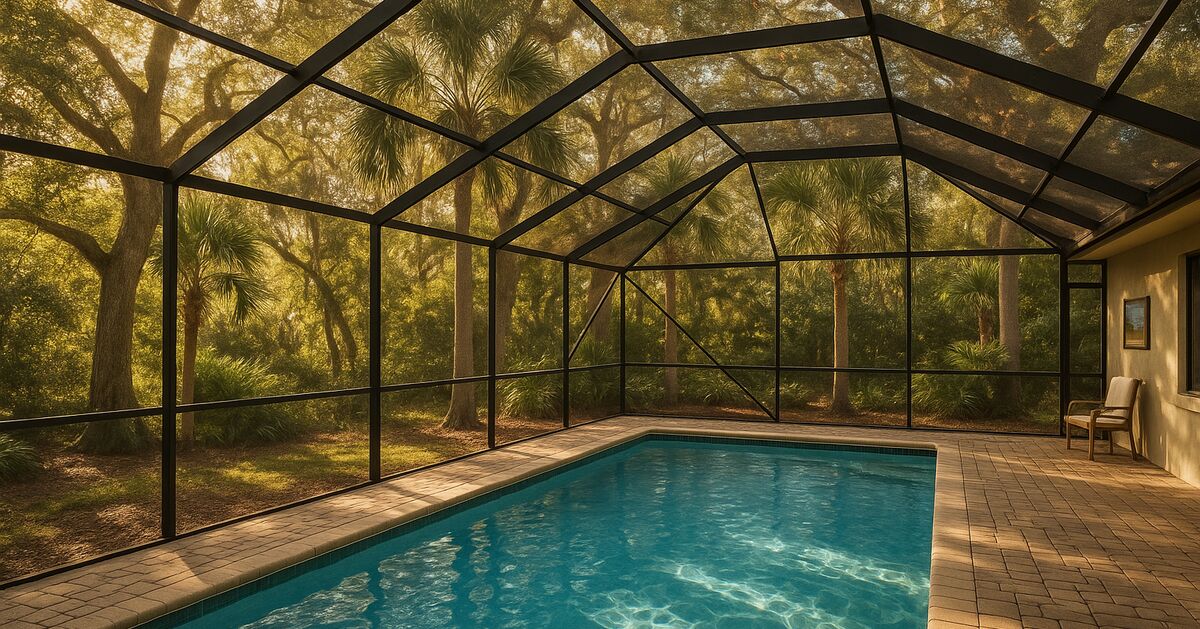
Every homeowner with a screened pool enclosure eventually hears it: a dull thud, a ripping sound, and the sinking feeling that a branch just punched straight through a panel. On Florida's Suncoast, from Parrish and Palmetto down through Bradenton, Sarasota, and out to the barrier islands, falling branches and windblown debris are probably the single most common cause of sudden, dramatic screen damage. The good news is that a lot of this damage is preventable, or at least manageable, if you understand what is really happening and take a few practical steps before the next storm season.
Why trees and pool cages are a complicated relationship
Florida landscaping is lush almost by definition. Mature live oaks, slash pines, queen palms, and bougainvillea are beautiful, they provide shade that cuts pool-deck temperatures significantly, and they add real value to a property. The problem is that every one of those trees puts organic material directly above or beside a structure whose entire purpose is to keep debris out. That contradiction only gets worse in summer thunderstorm season and during named storms, when gusts can accelerate a branch from "slowly dying" to "projectile" in seconds.
Screen enclosures are not designed to catch heavy falling objects. The aluminum frame is surprisingly sturdy for its weight, but the screen mesh itself is a thin, open fabric. Even heavy-duty pet-resistant or super-screen products will not stop a two-inch-diameter branch dropping from thirty feet. Standard 18x14 or no-see-um mesh tears easily under point-load impact. The frame corners and horizontal members can bend under the sudden weight, and once a frame member bends, it no longer holds screen tension correctly.
Understanding the anatomy of a pool-cage frame, screen, spline, and hardware helps here. The frame is a grid of interlocking aluminum extrusions. When a branch lands across two or more panels, it spreads force to multiple joints simultaneously, potentially bending several verticals and popping spline out of channels across a wide area, not just in one tidy hole.
The biggest culprits by tree type
Not all trees create equal risk. Knowing what you have in your yard helps you prioritize.
- Live oaks shed small branches and twigs constantly, and large limbs can fail with very little warning. The wood is dense and heavy, so even a mid-size branch does serious damage.
- Slash pines and longleaf pines shed bark, cones, and needles year-round. Needles alone clog the gutter channels along the base of your enclosure, holding moisture and accelerating corrosion on the frame. Dead pine branches, called "widow makers," can be substantial and fall without storm conditions.
- Palms are mostly safe from a branch-fall standpoint because fronds attach to a single trunk with no true lateral branching. However, dead fronds and coconuts (if you have a coconut palm) are heavy and can fall straight down through a roof panel.
- Ficus and strangler figs grow fast and shed large sections of canopy unpredictably.
- Bougainvillea and other vines are a slow, insidious threat. They climb frame verticals, push spline out of channels, and add weight to the structure that it was never designed to carry.
If you live in Lakewood Ranch or Parrish, where newer communities often have young trees that are growing fast, check overhead clearance every year because canopies expand quickly. On Anna Maria Island and Siesta Key, salt-air corrosion already weakens frame joints, so additional impact force from debris does more damage there than it would on an inland cage in perfect condition.
Trimming: the most effective protection you have
Tree trimming is not glamorous, but it is hands-down the most effective thing you can do to protect your enclosure. The goal is to eliminate any branch that, if it fell, could reach your screen structure. That means looking not just straight up, but at every branch within arc range of the structure.
A few practical guidelines:
- Maintain a minimum 10 - 12 foot clearance between the nearest branches and the roof plane of your enclosure. This sounds generous, but a branch can swing outward as it falls.
- Trim before June, when the Atlantic hurricane season officially begins. Tree services in Bradenton and Sarasota are very busy once storm threats appear; booking early gets you better scheduling and often better rates.
- Hire a licensed arborist for anything over 15 feet. DIY trimming of large live oaks or pines near a structure can send a limb exactly where you do not want it.
- Remove dead wood first. A live branch bends; a dead one snaps and falls straight. Dead wood removal is the highest-priority task every spring.
- Check after major storms. What looks like an attached branch after a hurricane may actually be a widow maker held in place by surrounding foliage. A post-storm walk-around of your property before resuming normal pool use is always worthwhile.
Keeping the enclosure itself in good repair
A well-maintained enclosure handles debris impact better than a neglected one. This is not just common sense; it is physics. A frame with straight members, secure corner brackets, and properly seated spline distributes point loads more effectively than a frame with already-bent verticals and loose spline channels.
Spline deserves special attention here. Spline is the vinyl cord that locks screen fabric into the frame channel. When spline gets old and brittle, it releases under impact, causing the screen to "blow out" of the channel rather than absorbing and containing the tear. Keeping spline in good condition is one of the under-appreciated maintenance tasks that homeowners often overlook until a branch proves the point dramatically. Why properly tensioned screen matters more than you think covers this in more detail, but the short version is: loose or poorly seated screen makes a bad impact result worse.
Walk the perimeter of your enclosure every few months and look for:
- Panels that are visibly saggy or loose
- Spline that has crept partially out of channels
- Bent frame verticals, even minor bends
- Rust-stained screw holes or brackets showing white oxidation
- Any area where a vine or plant is contacting the screen
Catching these issues early is far less expensive than addressing them after a branch accelerates the damage.
What to do when a branch comes through anyway
Despite every precaution, debris impact happens. Here is a level-headed response sequence.
First, do not panic. Screen damage, even significant damage, is almost always repairable. Very rarely does falling debris damage the pool itself or create a safety emergency, though if you see bent or collapsed roof sections over the pool, keep people out of the water until you have assessed the structure.
Second, remove the debris carefully. Dragging a branch out through a torn panel can widen the tear and bend spline channels that are still intact. Lift straight up if you can, and cut the branch into smaller sections with a handsaw if it is too large to lift cleanly.
Third, document everything. Photograph the damage from multiple angles before you touch anything else. This matters both for scheduling a repair and, if you carry the right homeowner's insurance endorsement, for a potential claim.
Fourth, cover exposed openings temporarily. A torn panel is an open invitation to insects, frogs, and debris. A loose tarp or even a piece of shade cloth clipped to the frame is enough to keep the pool usable while you wait for repair. Avoid duct-taping directly to screen mesh, because removing the tape later pulls the mesh out of the spline channel.
Fifth, get a professional assessment. One visible torn panel sometimes conceals two or three bent frame members that you will not notice until the next panel pops out a week later. A trained eye can identify whether the damage is isolated or systemic. You can learn more about our screen and pool-cage repair services to understand what a professional inspection covers.
Choosing the right screen for debris-prone situations
If you are under a large tree canopy and debris impact is a recurring issue, choosing the right screen mesh for your Florida home becomes a practical, money-saving decision rather than an aesthetic one. Standard 18x14 fiberglass mesh is economical and perfectly adequate for typical conditions. However, if you have a pine or oak with significant overhang, a heavier product makes sense.
Super Screen (also marketed as HD or heavy-duty screen) is roughly three times the thickness of standard mesh and resists tearing from small to medium debris significantly better. It will not stop a large branch, but it handles pine cones, twigs, small fronds, and wind-driven seed pods much more effectively. The tradeoff is slightly reduced airflow and a modest cost increase per panel. For most homeowners under heavy tree canopy, that tradeoff is clearly worth it.
Pet-resistant screen, designed to resist claw punctures, also handles small debris better than standard mesh for similar reasons: the strands are thicker and more tightly woven. If you have both dogs and overhanging trees, this product solves two problems at once.
Gutter and base maintenance: the slow damage you do not see
Debris damage is not always sudden. Leaves, pine needles, and seed pods accumulate in the horizontal frame channels along the base of your enclosure and in any gutter lip along the roofline. This packed organic material holds moisture against the aluminum constantly, even in dry weather, because it decomposes slowly and retains humidity. Over months and years, this accelerates corrosion at the base of frame verticals, loosens spline, and eventually compromises the structural integrity of the lower panels.
The fix is simple but requires consistency:
- Blow or sweep accumulated debris from base channels after every significant wind event
- Check gutter channels along the roof edge at least twice a year
- Rinse the entire enclosure frame with a garden hose two or three times a year to flush fine debris and organic residue from channels
This maintenance matters more in areas close to heavy vegetation and near the coast. Homeowners in Osprey, Nokomis, and Longboat Key deal with both salt air and significant tree canopy in many neighborhoods, making the combination of corrosion and debris accumulation especially important to address together.
When to call a professional
Some situations are clearly DIY-friendly: a single panel with a clean tear, spline that has simply slipped out of a channel, or a small hole from a wind-blown stick. Our frequently asked questions page covers many of the common repair scenarios homeowners ask about.
Other situations warrant a professional assessment:
- Any bent or bowed frame vertical or horizontal member
- Multiple adjacent panels damaged at once
- Damage to roof panels (working at height on a screen roof is genuinely hazardous without the right equipment)
- Any impact that involved a branch large enough that you could not remove it by hand
- Damage to door hardware, hinges, or the frame around the door opening
If you are in Bradenton, Lakewood Ranch, or anywhere else on the Suncoast and you are not sure whether what you are looking at is a simple DIY fix or something that needs professional attention, a quick call or message usually settles the question without committing you to anything. You can always get in touch with us to describe what you are seeing and get a straight answer.
Building a prevention routine
The homeowners who deal with the least debris damage are not necessarily the ones with the fewest trees. They are the ones with a consistent, low-effort maintenance routine. Here is a simple annual schedule that works well for most Suncoast properties.
Late April / early May:
- Hire a tree service to trim anything within fall range of the enclosure
- Walk the full perimeter and note any spline, frame, or mesh issues
- Schedule repairs before storm season, while service providers are less busy
After each major thunderstorm:
- Quick visual check of all panels from outside the cage
- Remove any debris from base channels
- Check that no branches have been partly broken and left hanging above the structure
October / November (post-hurricane season):
- Full inspection of spline around the entire enclosure
- Check all frame corner brackets and anchor screws
- Consider upgrading any standard-mesh panels that are under heavy canopy to a heavier product before next year
This is genuinely simple maintenance. It takes more time to read about it than to actually do it each season. The payoff is a longer-lived enclosure, lower repair costs over time, and the confidence that your pool cage will handle whatever the Florida summer throws at it.