How to choose the right screen-enclosure contractor in Manatee and Sarasota County
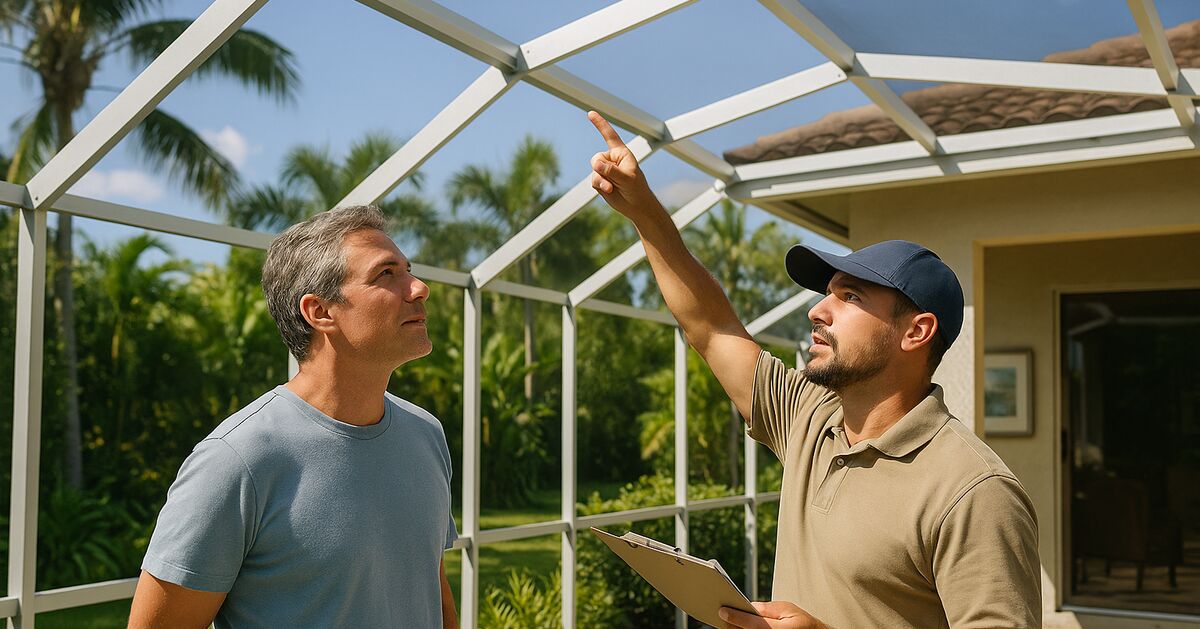
Hiring the wrong contractor for your screen enclosure can cost you far more than the repair itself, and in Manatee and Sarasota County that is not a hypothetical. Every storm season brings a wave of out-of-town crews looking to cash in on wind-damaged lanais and pool cages, and even some local operators cut corners that do not show up until months later. This guide gives you the exact checklist you need before you sign anything.
Why the stakes are higher than you might think
A screen enclosure is not a simple handyman task. The aluminum framing, anchor points, and screen tension all work together as a system, and a mistake in any one area ripples through the rest. Improperly re-screened panels pop out at the spline the next time a strong gust comes through. Frames that are not re-anchored correctly can collapse under the weight of pooled water after a heavy rain. Hardware installed with the wrong fasteners will rust out within a year in the salt-laden air that rolls in off the Gulf, especially for homeowners on Anna Maria Island, Longboat Key, Lido Key, and Siesta Key.
Beyond the structural issues, poor workmanship can affect your homeowner's insurance claim and even the resale value of your property. If you are thinking about that angle, the post Getting your pool cage ready before you sell your home covers what buyers and inspectors actually look at.
The good news is that a quality contractor is not hard to identify once you know what to look for.
The license question: what Florida actually requires
Florida law requires any contractor performing structural work on a screen enclosure to hold a state-issued license. Here is what that means in practice.
Contractor license types to ask about:
- A Swimming Pool/Spa Contractor license (CPC) covers pool cage and enclosure work when it is connected to a pool structure.
- A Building Contractor license (CBC) or General Contractor license (CGC) covers structural enclosure work more broadly.
- Some enclosure specialists hold a Specialty Structure Contractor registration, which is valid for screen rooms and pool cages in Florida.
Ask the contractor for their license number before the conversation goes any further. Then verify it yourself. The Florida Department of Business and Professional Regulation (DBPR) has a free online lookup at myfloridalicense.com where you can confirm the license is active, covers the right scope, and has no disciplinary history. This takes about two minutes and it is the single most important step you will take.
In addition to a state license, contractors working in Manatee County or Sarasota County may need a local competency card or to be registered with the county building department. Ask whether they will pull a permit if the scope of work requires one. Any enclosure repair that involves structural framing typically does. A contractor who suggests skipping the permit to "save you money" is actually shifting all the risk onto you.
Insurance: the two policies you must confirm
A licensed contractor should carry two types of insurance and should provide current certificates without hesitation.
General liability insurance covers damage to your property that occurs during the work. Ask for a certificate of insurance (COI) that names your address or at least lists coverage in Manatee and Sarasota County. Minimum coverage for this type of work should be $1 million per occurrence, though reputable firms often carry more.
Workers' compensation insurance covers the crew members themselves if someone is injured on your property. In Florida, if a contractor does not carry workers' comp and a worker is hurt on your job, you as the homeowner can be held liable. Some sole operators are legally exempt from carrying it for themselves, but the moment they have employees on site, coverage is required. Ask for the certificate and check the effective date.
Do not accept verbal assurances. Certificates of insurance are one-page documents that take 60 seconds to email. If a contractor stalls or makes excuses, move on.
The questions worth asking before you hire
Once you have confirmed licensing and insurance, these questions will tell you a great deal about how a contractor actually operates.
How long have you been working specifically with screen enclosures in this area? General construction experience does not transfer automatically to screen-enclosure work. The materials, the hardware, the spline sizes, the screen types, and the aluminum alloys used in Florida's climate are a specialty. Look for someone who works on enclosures regularly, not as an occasional side job.
Do you have references from jobs in my area? A contractor who has done solid work in Bradenton, Lakewood Ranch, Parrish, Palmetto, or Ellenton should be able to point you to a few recent customers you can actually call. Online reviews matter, but a direct conversation with a homeowner who lives ten minutes away is more valuable. Ask that homeowner whether the crew showed up on time, cleaned up after themselves, and whether the work has held up since.
What screen material do you recommend for my situation, and why? A knowledgeable contractor will ask questions back: Do you have pets? Are you close to the water? Do no-see-ums get through your current screen? The answer should change depending on your situation, your location, and your budget. If the answer is always "whatever you want" with no guidance, that is a sign of inexperience or indifference. Our services page gives a sense of the options that professionals in this area typically work with.
Who will actually be doing the work? Some contractors sell the job and then subcontract it to whoever is available. That is not automatically a problem, but you deserve to know. Ask whether the crew who shows up will be employees of the company or subs, and whether the licensed contractor will be on site during the job.
What is your process if something goes wrong after the work is done? A contractor who stands behind their work will have a clear answer here: a warranty period, a phone number that gets answered, and a willingness to come back. Vague answers like "we always make it right" without any specifics are worth pushing on.
Will you provide the quote in writing before work begins? The quote should detail the scope of work, the materials being used (screen type, frame materials, hardware), the timeline, and the total cost. Anything agreed verbally should be in the written document. A handshake deal that turns into a dispute is unfortunately common in this industry.
Red flags that should stop you cold
Some warning signs are subtle. Others are not. Here are the ones that should make you pause or walk away entirely.
Door-to-door solicitation after a storm. Legitimate local contractors do not typically drive neighborhoods looking for damaged cages the week after a hurricane. Solicitors who show up unsolicited and pressure you to sign quickly are almost always either unlicensed, uninsured, or both. Take your time. Storm season prep matters, but so does choosing carefully after damage happens.
A request for a large upfront deposit. Materials for a screen repair or re-screening project are not so costly that a contractor needs 50 percent or more in advance. A reasonable deposit for scheduling and materials is understandable. A demand for full payment before any work is done is a serious warning sign.
No physical business address. A Google search that turns up only a phone number and a Facebook page with three reviews is not reassuring. A contractor who has been operating legitimately in the area will have a traceable business presence. Check the DBPR lookup, the Better Business Bureau, and Google Maps for any listed address.
Pressure to skip the permit. As mentioned above, permits exist to protect you. An inspector who reviews the work is a layer of accountability that benefits the homeowner, not the contractor. Any suggestion to skip it deserves serious skepticism.
Estimates that are dramatically lower than everyone else's. Price matters, but a quote that is 40 or 50 percent below the others usually signals that something is being left out. It might be lower-grade screen material, it might be skipping the permit, or it might mean the contractor is in financial trouble and needs cash flow more than they need to do quality work.
Reluctance to put anything in writing. If a contractor resists providing a written scope of work, that tells you everything about how a dispute would go.
What a thorough site visit looks like
Before any reputable contractor gives you a quote, they should come to your property and look at the enclosure in person. A phone quote or a quote based on photos alone is a rough estimate at best. Here is what a professional assessment of your pool cage or lanai enclosure should include.
- Walking the full perimeter of the frame to check for bent or cracked extrusions.
- Inspecting the anchor points at the slab level where the frame meets the concrete.
- Checking the screen tension in multiple panels (not just the visible torn ones).
- Looking at the spline condition in the channels, not just the screen itself. A post we have on what that tear in the corner of your cage really means explains why the screen and the spline are really one system.
- Examining the door hardware, hinges, and closers.
- Noting any rust staining or corrosion on the frame, which in coastal communities like Sarasota, Siesta Key, or Anna Maria Island can indicate deeper structural concerns.
A contractor who does all of this before quoting is giving you a real estimate. One who glances at the torn panel and names a price in two minutes is guessing.
Local knowledge matters more than you might expect
The Suncoast is not a monolithic environment. A pool cage in Parrish sits in a different microclimate than one on Longboat Key. Inland communities like Lakewood Ranch and Ellenton see more debris impact from surrounding tree canopy, while barrier island properties deal with constant salt air, higher wind exposure, and more demanding hardware requirements. A contractor with real local experience understands these differences and specifies materials accordingly.
Our locations page covers the full service area and gives a sense of the geographic range involved. If a contractor tells you their work is the same regardless of where you live, ask them to explain why. The answer should demonstrate either knowledge or the willingness to learn. Either is acceptable. Indifference is not.
Bringing it all together: your pre-hire checklist
Before you sign with any screen-enclosure contractor in Manatee or Sarasota County, run through this list.
- License verified on DBPR myfloridalicense.com (active, correct scope, no violations).
- Certificate of general liability insurance received and dated.
- Certificate of workers' compensation received (or legal exemption confirmed in writing).
- Local references provided and at least one contacted.
- Written, itemized quote in hand.
- Permit discussed and addressed for the scope of work.
- Clear warranty or callback policy explained.
- No pressure to decide immediately.
If every box on that list is checked, you are in good shape. If you are still comparing contractors and want a sense of what a professional repair process actually looks like end to end, our FAQ page covers many of the common questions homeowners ask before committing.
And if you are ready to talk through what your enclosure needs, get in touch and we will schedule a proper site visit. No pressure, no phone-based guesswork, and no surprises in the written quote.