Lanai vs. pool cage re-screening: why the same mesh and method don't always work for both
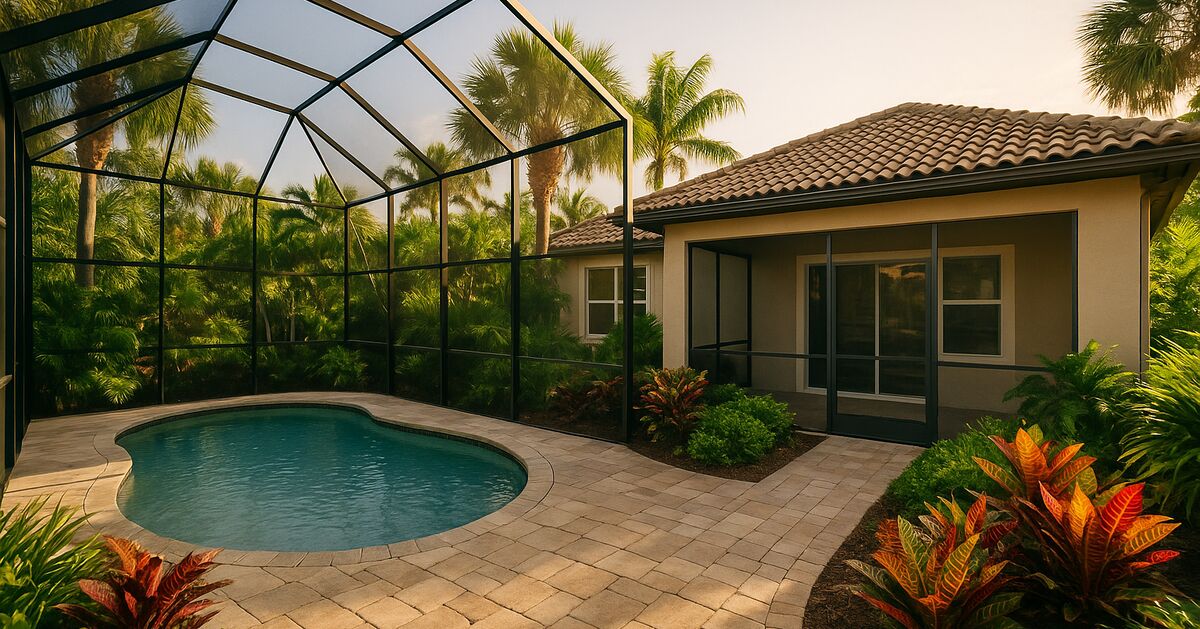
Your lanai and your pool cage look like cousins, and in a lot of ways they are. Both have aluminum frames. Both use spline to lock screen into channels. Both keep bugs out and let the Gulf breeze in. But the moment you dig into a re-screening job, the differences start to matter, and choosing the wrong mesh weight, spline diameter, or tensioning approach for the wrong structure can mean a repair that fails in a season instead of lasting a decade.
This post walks through exactly where lanais and pool cages diverge, why those differences drive different material and method choices, and what to watch for if you are getting quotes on either type of job.
Why the two structures are not interchangeable
A pool cage is typically a tall, freestanding aluminum structure that rises eight to fourteen feet above the deck, sometimes higher. It has to span wide, open bays. The frame bears significant load from wind, rain, and occasionally falling debris. Because the screen panels are large and exposed on all sides, they experience a tremendous amount of lateral wind pressure, especially during storm season along the Gulf Coast.
A lanai enclosure is usually attached to the house itself. It is lower, often has a solid roof or a screen-only roof, and the bays tend to be narrower because the house wall and nearby columns break up the span. The structural dynamics are genuinely different. Wind hits a pool cage from every direction. A lanai is sheltered on at least one side, and sometimes two or three sides if it wraps a corner of the house.
That difference in wind exposure is the single biggest reason you cannot simply order "the same screen and spline" and call it done.
Mesh weight: heavier is not always better
Screen mesh is rated by the number of strands per inch (the weave count) and by the thickness of the individual fibers. Heavier mesh is stiffer and more resistant to punctures, but it also catches more wind.
For a pool cage, most contractors in Manatee and Sarasota County install 18x14 fiberglass mesh as the baseline. The 18 strands per inch in one direction and 14 in the other hits a reasonable balance between visibility, airflow, and durability. Homeowners who want finer no-see-um protection often step up to 20x20 mesh, which is denser and blocks those tiny biting insects that are a real problem around waterways in Parrish, Palmetto, and along the Manatee River corridor.
Here is the catch with denser mesh on a pool cage: the tighter the weave, the more wind resistance the panel creates. A tall pool cage with 20x20 no-see-um screen on every bay is acting like a partial sail in a 60 mph gust. That puts serious stress on the frame corners and on the spline itself. Contractors who know pool cages account for this. Some choose a hybrid approach, putting no-see-um mesh on the lower panels where insects are most likely to enter and standard 18x14 or 18x16 on the roof bays and upper walls where airflow matters more.
A lanai, by contrast, has less exposed surface area and the house provides some wind buffering. The trade-off between airflow and insect protection plays out differently there. A homeowner on Siesta Key who wants total no-see-um protection on a wrap-around lanai can often do the whole enclosure in 20x20 mesh without the wind-load concerns that would apply to a freestanding cage. Our screen and pool-cage repair services page explains the mesh options we carry if you want to compare before your appointment.
Spline diameter and channel depth: the hidden variable
Spline is the soft vinyl rope that presses the screen into the aluminum channel and holds the whole panel taut. It sounds simple. In practice, getting the spline diameter wrong is one of the most common reasons a freshly re-screened panel pops out within weeks or sags in the middle.
Pool cage frame channels were manufactured in different eras, and the channel depth varies by builder and by how old the cage is. Older cages in Bradenton's established neighborhoods often have shallower channels than newer frames you find in Lakewood Ranch. Shallower channels require thinner spline, usually 0.140 or 0.160 inch. Deeper channels need 0.175 or even 0.200 inch spline to grip properly. Use spline that is too thin and the screen works itself loose. Use spline that is too fat and you cannot fully seat it, which leaves a gap at the edge where bugs get in and where the panel can tear under tension.
Lanai frames, especially those attached to newer construction in Ellenton or Parrish, often have different extrusion profiles than standalone pool cages. Some lanai frames use a wider, shallower channel designed for a specific vinyl spline size that is different from what is standard on pool cages. A contractor who does only pool cages and then crosses over to lanai work needs to measure the channel before ordering materials, not after.
If you want a deeper explanation of how spline and frame interact, our post on why your screen panels keep popping out covers the mechanics in detail.
Tensioning technique and panel size
Getting the screen panel tight enough is as much craft as science. A loose panel flaps in the wind, wears at the edges, and looks sloppy. An over-tensioned panel can distort the frame or pull the spline groove open over time.
Pool cage panels are often very large. A single bay on a cage over a big pool might be five feet wide and eight or ten feet tall. Stretching that panel evenly without introducing a diagonal bow requires experience. Professionals typically start at one corner, set the top edge with spline, then work down one side before pulling across the bottom. The order matters because screen is woven and will distort if you go out of sequence.
Lanai panels tend to be narrower in one dimension because the horizontal rails (called "mid-rails") are more common in lanai construction than in pool cage construction. A mid-rail at the four-foot height breaks a tall bay into two manageable sections. That is actually an advantage for tensioning because shorter panels are easier to get right. It is also a maintenance consideration: when a lanai screen tears, you may only need to replace one half-bay rather than an entire tall pool-cage panel.
Roof screens: pool cages have them, most lanais don't
This is where the structural difference becomes most significant. A pool cage has screen on the roof. A screened lanai almost always has a solid roof, whether that is a standard shingle extension, a pan-tile section, or a corrugated aluminum patio cover.
Roof screening on a pool cage is technically demanding work. The panels are overhead, so installation requires scaffolding, ladders, or a lift, and the material sits horizontally rather than vertically. Rain hits roof screen directly and pools slightly before draining, which means the screen is under intermittent downward pressure in addition to wind. Algae and mildew grow faster on roof panels because they stay damp longer. Our post on bird droppings, algae, and mildew damaging pool-cage screens explains why roof panels usually deteriorate first and need re-screening more often than the wall panels.
If you are pricing out a full pool cage re-screen, know that the roof is the most labor-intensive part of the job, both because of the access required and because tensioning overhead panels correctly takes more time than vertical wall panels. A quote that seems very low for a full cage often turns out to have underestimated the roof or to be using lighter-duty mesh on that portion.
For lanai work, none of this roof-screen complexity applies, which is one reason lanai re-screening is generally faster and sometimes less expensive per square foot than pool cage work.
Local climate factors that affect both, but differently
On the Gulf Coast, salt air, UV intensity, and humidity affect every outdoor screen. But they do not affect pool cage screens and lanai screens in exactly the same way.
A pool cage sits directly over chlorinated water. Chlorine off-gassing is mild but real, and combined with the constant moisture from the pool surface, the screen near water level tends to degrade from the inside-out as well as from sun exposure on the outside. Over time, fiberglass strands become brittle faster near the water line than on panels higher up or further from the pool.
Homeowners on Anna Maria Island or Longboat Key are dealing with elevated salt exposure on top of everything else. Salt crystals in the air accelerate corrosion on aluminum frames and on the metal components of screen doors. The screen mesh itself is not as directly affected by salt as the hardware is, but in a heavily salt-exposed environment it makes sense to prioritize heavy-duty coated frames and hardware rather than upgrading mesh weight. Our detailed guide on screen enclosures in Anna Maria Island's coastal flood zone goes further into what coastal homeowners should prioritize.
For inland lanais in Lakewood Ranch, Parrish, or Ellenton, salt air is much less of a concern. UV degradation is the primary enemy. Screen on a lanai that faces southwest gets the worst of the afternoon sun and will fade and weaken faster than panels on the north or east side of the same structure.
Permit and code considerations
Pool cage re-screening is generally considered maintenance and does not require a permit in Manatee or Sarasota County, as long as you are not changing the frame or the footprint. However, some situations do trigger permit requirements, particularly if the pool cage was damaged in a storm and repairs cross a cost threshold, or if any frame members are being replaced rather than just screen.
Lanai additions, meaning adding a new screened enclosure to a home that did not previously have one, almost always require a permit. But re-screening an existing lanai enclosure is typically permit-free maintenance, the same as pool cage re-screening.
If you are ever unsure, a reputable contractor will tell you upfront what requires a permit and what does not. Our FAQ page covers permit questions along with other common concerns we hear from homeowners across our service area.
What to tell your contractor before they arrive
Whether you are scheduling a lanai or pool cage re-screening, giving your contractor a little information in advance saves time and helps ensure the right materials show up.
For either job:
- Note the approximate age of the structure and the builder if you know it
- Measure or estimate the number and approximate size of screen panels that need replacement
- Mention any existing screen type you want to keep or change (standard, no-see-um, pet-resistant, solar)
- Flag any frame damage, bent rails, or loose spline channels you have already noticed
For pool cages specifically:
- Let them know if you have had recurring pop-out problems with spline, because that suggests the channel depth needs to be checked
- Mention if there are roof panels involved, since those require different equipment
- Note any waterline panels that look more degraded than others
For lanais specifically:
- Clarify whether you have a mid-rail design or full-height panels
- Mention any screen door hardware issues, since those are easier to address during a re-screen
- Tell them which direction the lanai faces so they can note which panels get the most UV
A good contractor serving Bradenton or Lakewood Ranch will ask most of these questions anyway. But having the answers ready moves the job along.
The bottom line
Lanais and pool cages share a lot of DNA, but re-screening one is not the same job as re-screening the other. Mesh weight, spline diameter, panel size, tensioning technique, roof panel access, and the specific climate factors at your property all shape the right approach. Using pool-cage methods and materials on a lanai, or vice versa, is one of the most common ways a re-screen job ends up looking wrong or failing early.
If you want to understand exactly what your specific structure needs, the best first step is talking to someone who works on both types regularly in your area. You can browse our service area locations or head straight to our contact page to get a straightforward quote with no obligation. We cover everything from Parrish and Palmetto down through Sarasota, Siesta Key, and Osprey, and we are happy to look at your enclosure before recommending anything.