Bird droppings, algae, and mildew: how they wreck your pool-cage screen faster than you think
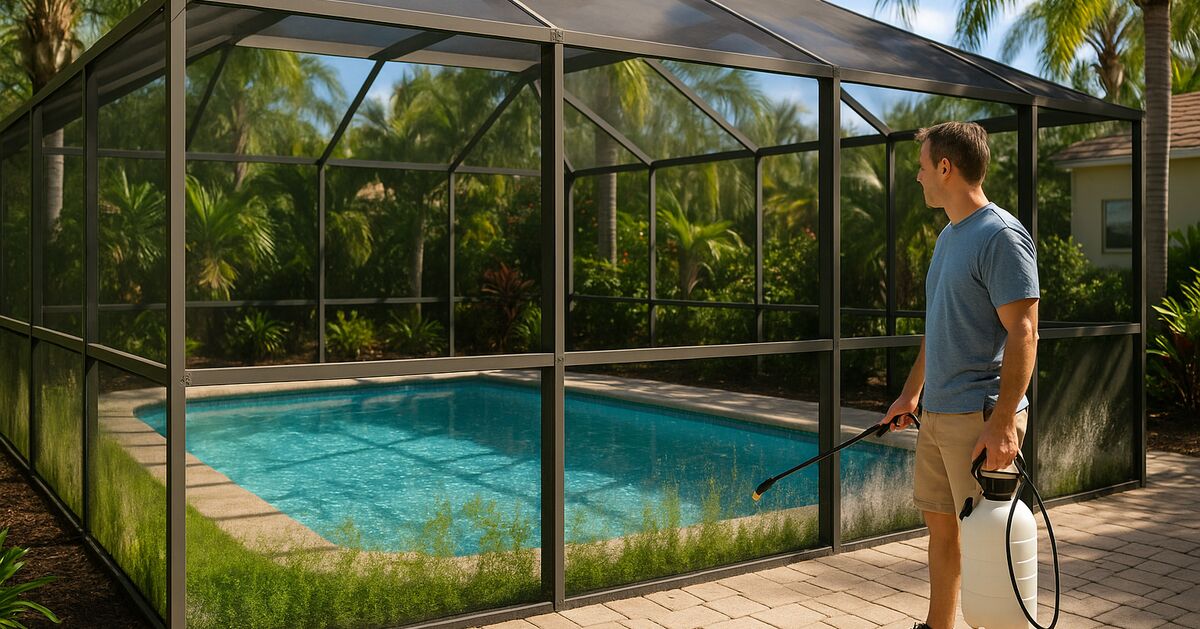
Every pool-cage owner on the Suncoast has stared up at those chalky white streaks, fuzzy green patches, and orange-brown stains clinging to the screen mesh and thought, "I'll get to that eventually." The problem is that "eventually" costs you more than a weekend afternoon with a garden hose. These three culprits, bird droppings, algae, and mildew, are actively breaking down your screen right now, and the damage compounds fast in our Florida climate.
This post explains exactly what is happening to your mesh at a molecular level (without the chemistry lecture), how to clean each contaminant safely, and what mistakes to avoid so you do not end up with a fresh tear where there was once just a stain.
Why bird droppings are worse than they look
A single splatter of bird waste looks cosmetic. A colony of ibis roosting on your roof ridge above the cage every evening for a summer is a different story entirely.
Bird droppings contain uric acid, the same compound that gives them that white, paste-like quality. Uric acid is corrosive. On aluminum framing it etches the anodized surface and creates microscopic pits where moisture hides and rust begins (a process we cover in detail in our post on rust on your pool cage: causes, cures, and prevention). On fiberglass screen mesh, uric acid gradually degrades the vinyl coating that holds the woven strands together and gives the mesh its flexibility. On aluminum wire-mesh screens, it accelerates oxidation at each intersection of the weave.
What you notice first is that the area around a dropping becomes stiff. The coating hardens and gets brittle. Then, when the mesh flexes during a wind gust or when you brush it lightly with a leaf blower, the brittle strands crack. A tiny crack in one strand becomes a hole. A hole in a corner panel can turn into a full panel failure faster than you would expect, especially if birds use the same spot repeatedly.
Homeowners in Bradenton, Parrish, and along the bayfront in Palmetto deal with ibis, grackles, and cormorants in particular. On Anna Maria Island, herons and pelicans are frequent offenders. The volume of droppings from a single great blue heron sitting on your cage peak for an hour is enough to leave half a dozen acidic deposits across two or three panels.
The key takeaway: never let bird droppings dry and bake onto the screen. A fresh dropping cleans off with minimal risk. A calcified, sun-baked dropping that has been sitting through two weeks of July heat requires significantly more effort and carries a real risk of screen damage if you handle it wrong.
What algae is actually doing to your mesh
That bright green fuzz that creeps across the lower third of your cage panels is not passive. Algae is a living organism, and it is anchoring itself to your screen with root-like structures called rhizoids. Those tiny anchors work their way into the weave of the mesh and, over time, pull at the vinyl coating and the strand intersections.
Florida's heat, humidity, and brief daily rain showers make the Suncoast practically ideal for algae growth. Cages that face north or that sit under a heavy canopy of oaks or palms, common in communities throughout Lakewood Ranch, Osprey, and Nokomis, see the worst algae because shade prevents surfaces from drying out between showers.
Algae also traps moisture against the screen surface and against the frame, creating the exact micro-environment that accelerates corrosion in the aluminum. When you add the gentle flex of a screen panel in a breeze, algae-colonized mesh becomes progressively weaker at each anchor point. The mesh does not snap all at once. It simply becomes more and more susceptible to the stresses that eventually cause a tear.
A secondary problem: algae makes your screen opaque. A screen that blocks your sightlines into the pool area is a safety issue, not just an aesthetic one.
Why mildew is the sneakiest of the three
Mildew is a surface fungus, a lighter, early-stage relative of mold, and it thrives on virtually any porous or semi-porous surface that stays damp. On pool-cage screen, mildew does not damage the mesh as aggressively as uric acid or algae root structures. Its primary damage is to the spline, the rubber gasket that holds the screen in the frame channel.
Spline is typically made of flexible PVC or foam-rubber materials. Mildew secretes enzymes that slowly degrade organic and semi-organic polymers. A spline that is perpetually colonized by mildew becomes dry, crumbly, and loose far ahead of its normal service life. Once spline loses its grip, the screen panel loses tension, and a panel without proper tension is far more likely to sag, buckle, and eventually pop out of the frame or tear along the edges. (We wrote a full explainer on why properly tensioned screen matters, and it covers this failure mode in detail.)
Mildew also stains. Those gray-black speckled patches are not just dirty; they are colonizing the surface. And they release spores into the enclosed space of your lanai, which is the opposite of what you built a screen enclosure to achieve.
How to clean bird droppings safely
What you will need:
- A pump garden sprayer or a low-pressure hose nozzle (not a pressure washer)
- A bucket of warm water with a few drops of dish soap
- A soft-bristle brush, the kind sold for washing cars
- White distilled vinegar (for stubborn, dried deposits)
- Safety glasses
The process:
- Wet the affected panel thoroughly with plain water first. This softens the deposit and protects the surrounding mesh from direct chemical contact.
- Apply a small amount of soapy water directly to the dropping and let it sit for two to three minutes.
- Using the soft-bristle brush, work from the outside of the dropping inward with very light circular motions. Do not scrub outward; you risk dragging the acidic material across more mesh area.
- Rinse thoroughly with low-pressure water from outside the cage, letting gravity carry the rinse water down and away.
- For a baked-on deposit that will not loosen with soap and water, soak a cloth in diluted white vinegar (one part vinegar to two parts water), lay it against the deposit for five minutes, then repeat the soft brush process. Vinegar is mildly acidic, so rinse the panel completely afterward.
What not to do: Never use a pressure washer on screen mesh. The pressure required to dislodge a hardened dropping is many times greater than the pressure your screen is designed to handle. A pressure washer will blow out a panel or shred the mesh around the deposit. We see this mistake frequently during our work across Sarasota, Siesta Key, and Longboat Key, and the result is always a repair call that could have been avoided.
How to clean algae safely
Algae requires a slightly different approach because you need to kill the organism, not just remove the visible mass.
The cleaning solution:
Mix one part household bleach with ten parts water. This concentration is strong enough to kill algae without being harsh enough to degrade vinyl-coated mesh if rinsed promptly. Add a small squirt of dish soap to help the solution cling to vertical surfaces.
The process:
- Wet the entire panel with plain water.
- Apply the bleach solution with a garden sprayer, working from the top of the panel down.
- Let it dwell for five to ten minutes. You will see the algae begin to pale and die.
- Rinse thoroughly with low-pressure water, again from outside the cage working top to bottom.
- For heavy algae colonization, a second application is often necessary.
Protect your pool water: cover the pool before you apply bleach solution, or do this work at a time when you can run the pump and skim the surface immediately afterward. Even a diluted bleach rinse running into pool water will affect your chlorine balance.
Clean algae at least twice per year in the Sarasota and Manatee County area. If your cage is in heavy shade, consider quarterly cleanings.
How to clean mildew safely
Because mildew lives on the spline and frame as much as on the mesh itself, your cleaning approach needs to reach into the frame channels.
The same diluted bleach solution described for algae works well on mildew. The additional step is to use a small detail brush (an old toothbrush works perfectly) to work the solution into the channel where the spline sits. This is tedious but important. Mildew that survives in the channel will re-colonize the panel surface within weeks of your cleaning the face of the screen.
After cleaning, inspect the spline itself. If it crumbles when you press it gently, or if it has pulled away from the channel in sections, it needs to be replaced. No amount of cleaning will restore a degraded spline's grip. Our screen and pool-cage repair services include spline replacement as a standalone job, and it makes a significant difference in how long a cleaned screen stays in good shape.
A word on cleaning tools: what is safe and what is not
The most common damage we see that is caused by homeowners cleaning their own screens:
- Pressure washer damage. Already mentioned, but worth repeating. Even on the "fan" setting, a pressure washer can punch holes in standard 18x14 fiberglass mesh. Some homeowners aim it at a 45-degree angle thinking this will reduce impact; it does not reduce it enough.
- Stiff-bristle brushes. A deck scrub brush with stiff nylon bristles is too aggressive for screen mesh. It does not take much friction to fray a strand, and a frayed strand is a future tear.
- Undiluted bleach. Straight bleach applied to a dry screen can bleach and weaken the vinyl coating faster than you would expect. Always dilute and always pre-wet.
- Scrapers or putty knives. Sometimes used to chip off dried droppings. This will cut the mesh. Use the vinegar-soak method instead.
If you are unsure whether a panel is strong enough to handle even gentle cleaning, check our frequently asked questions or take a look at our post on five signs it is time to call a screen-repair pro. If the mesh is already discolored, brittle, or has small tears forming, cleaning will not save it, and a gentle scrub could accelerate the failure.
How often should you be doing this?
In Manatee and Sarasota counties, most cages need a thorough cleaning at minimum twice a year, before storm season begins in June and after it ends in November. Cages with heavy bird activity or significant shade may need quarterly attention.
The November cleaning is especially useful because it removes the biological load that built up over the wet summer, gives you a clear view of the structural condition of the screen going into the drier months, and makes it easy to spot any small tears before they become large ones over the winter.
Properties on or near the water, including those on Anna Maria Island, Lido Key, and Longboat Key, face additional challenges from salt-laden air that makes biological growth stickier and harder to remove and that accelerates corrosion in the frame wherever droppings or algae have compromised the anodized surface.
When cleaning reveals a bigger problem
Sometimes what looks like a stain is actually a tear that has been partially covered by algae growth or a crust of bird waste. Cleaning a panel thoroughly is genuinely useful diagnostic work. If you find tears, popped spline, or soft, spongy areas in the mesh after cleaning, those panels need repair, not just maintenance.
You can find a realistic overview of what the repair process looks like in our guide on how long a screen repair actually takes. The short version: a single-panel repair handled by a professional is usually a same-day job, and addressing it early costs far less than waiting for a small failure to spread.
We serve homeowners throughout the Suncoast, from Bradenton and Lakewood Ranch to Parrish, Ellenton, Palmetto, Sarasota, Siesta Key, and all the way out to the island communities. If you would like a professional eye on what your cage needs after a cleaning, reach out and we will come take a look.
A clean cage is not just a nicer-looking cage. It is a cage that will last longer, perform better, and protect your family from insects, debris, and the elements the way it was designed to. That is worth an afternoon with a garden sprayer and a soft brush, twice a year, without fail.