Why bottom pool-cage panels fail first and how to stop it
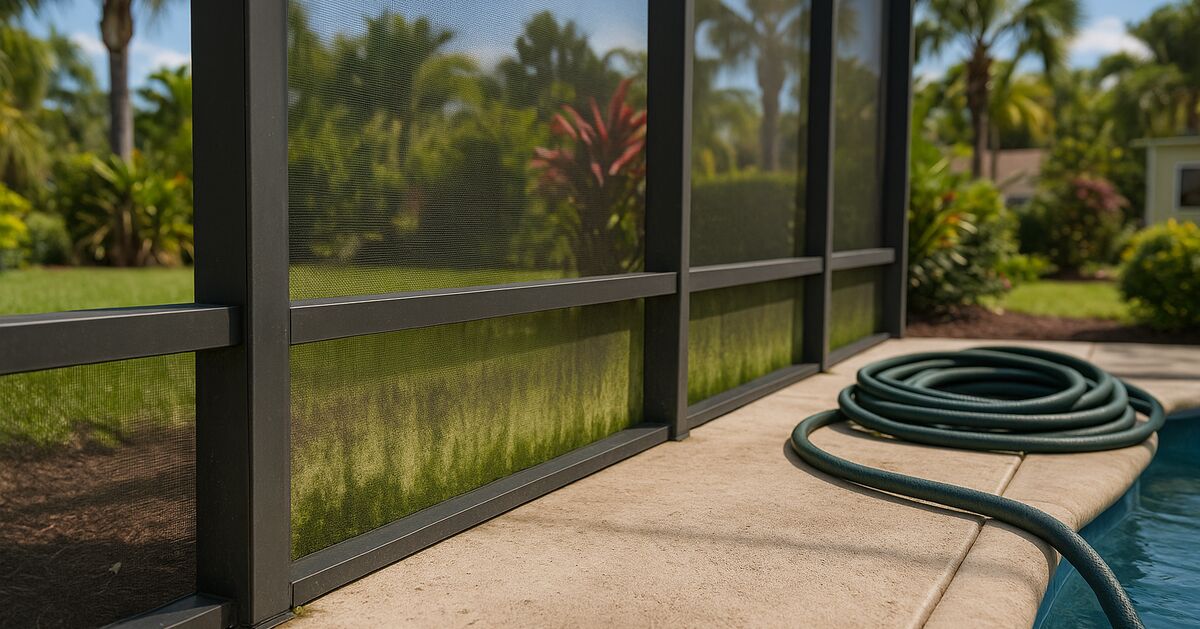
The bottom two feet of your pool cage are doing a job that no other part of the structure has to do, and they are doing it every single day in one of the most chemically aggressive, moisture-saturated outdoor environments in the country.
If you have replaced the same lower panels two or three times while the upper sections still look perfectly fine, you are not dealing with bad luck. You are dealing with a predictable set of physical and chemical forces that concentrate right at ground level. Understanding those forces is the first step toward actually stopping the cycle rather than just paying for it again.
What "bottom panels" actually means in a pool cage
Pool cages are typically framed in horizontal rails at set intervals. The panels from grade level up to the first horizontal mid-rail, usually somewhere between 18 inches and 36 inches off the deck depending on the builder's design, are what contractors call the bottom panels or base panels. In some cages, especially older ones throughout Bradenton and Palmetto, there is no mid-rail at all and the screen runs straight from the base frame to a beam several feet up. In that configuration, the lower portion of those tall panels takes the same concentrated punishment.
The specific height varies, but the zone of damage is consistent: it is the screen and spline that live closest to the pool deck, the lawn, and the standing water that accumulates after rain or splashing.
The five stacked problems that attack the base zone
The failure of bottom panels is never caused by one thing. It is a stack of five separate problems that arrive at the same location at the same time, and they reinforce each other.
1. Capillary moisture and the wicking cycle
Concrete pool decks, pavers, and the aluminum base rails of your cage all have microscopic pores. After a Florida rainstorm, or after a few hours of pool splashing, those surfaces pull moisture inward. The base rail of your cage sits directly on or just above the deck surface, and the spline channel in that rail stays wet long after the deck appears dry.
Spline is a flexible vinyl cord pressed into a channel to hold the screen tight. When spline is kept wet repeatedly, it swells, contracts, and gradually loses its grip. The screen goes slack at the base before it goes slack anywhere else. A slack bottom panel flutters and billows in any breeze, and a screen under repeated flutter stress develops micro-tears that grow into the visible rips you notice when you are standing at the pool edge. For a detailed look at what spline degradation looks like over time, the post on what happens to an unrepaired spline over a Florida summer lays out the progression month by month.
2. Pool chemistry splash and spray
Chlorinated water, whether from splash-out, backwash runoff, or a child doing a cannonball off the step, does not stay on the deck. It migrates to the base rail and into the spline channel. Chlorine accelerates the oxidation of aluminum. It also degrades the plasticizers in vinyl spline, making the spline brittle and prone to cracking. Some pools in the Sarasota and Siesta Key area run saltwater systems, and salt compounds the corrosion problem significantly. Per EPA guidance on corrosion in aquatic facilities, chlorinated and saline water accelerates aluminum oxidation in ways that plain rainwater does not.
The screen mesh itself is less vulnerable than the spline and hardware, but repeated chlorine exposure does weaken the vinyl-coated fiberglass that standard pool screen is made from. Mesh that lives in the splash zone ages faster at a material level, independent of any physical damage.
3. Lawn equipment and foot traffic impact
No one trims the grass and edges the sidewalk next to an upper panel. But every homeowner with turf running near the cage edge runs a trimmer or mower within inches of the base panels repeatedly throughout the year. String from a trimmer travels at speeds that can punch a clean hole through standard 18x14 fiberglass screen in a fraction of a second. Mower discharge flings small stones and debris laterally and at low angles, which is exactly where the base panels are. This mechanical impact is something upper panels simply do not face.
Foot traffic matters too. People walk through the cage door and brush against the nearest panel. Kids press against the screen to watch a lizard. Pets, even without claws, lean into the base screen when they want out. All of that contact is concentrated at the bottom of the cage, not the top.
4. Algae, mildew, and organic staining
Warm, humid air near a wet deck surface creates ideal conditions for algae and mildew growth on both the mesh and the spline. As we cover in detail in our pool cage and screen repair services work, algae mats are not just cosmetic. Algae growth on screen mesh can weaken it over time as organic material accumulates and degrades the fibers. Mildew produces mild acids as a metabolic byproduct, and those acids accelerate spline degradation in the spline channel.
Homeowners throughout Lakewood Ranch and Parrish, where landscaping is often dense and shading increases moisture retention, report base-panel algae as a persistent issue. Shaded base panels stay wet longer than panels that get direct afternoon sun, so the geography of your yard matters in predicting which side of the cage will go first.
5. Ground-level UV reflection
This one surprises people. UV degradation is generally understood as a top-down problem, since the sun shines down. But a pool's water surface is a near-perfect UV mirror. It reflects shortwave UV light upward and outward, and the lowest panels, which sit at close to the same elevation as the water surface, receive that reflected dose in addition to direct UV exposure. NREL's solar resource data for Florida indicates the region receives high annual solar exposure compared to much of the continental United States. Over several years, base panels accumulate a higher effective UV load than upper panels, hastening the embrittlement of both mesh and spline.
Common mistakes that make the cycle worse
A problem that comes up again and again among homeowners is patching only the torn screen without addressing the spline. If the spline in the base channel is already swollen, cracked, or discolored, putting new mesh into old spline means the new screen will start loosening within a season or two. The repair looks fine from ten feet away but the clock is already running.
Another frequent error is leaving the base rail unsealed where it contacts the deck surface. A small bead of appropriate sealant between the base rail and the deck reduces the capillary wicking that keeps the spline channel wet. This is a five-minute step that most homeowners and even some contractors skip.
Pressure washing the base panels too aggressively is a third mistake. High-pressure water directed at a low angle into the spline channel can force water deeper into the rail extrusion, defeating the modest drainage designed into the channel, and can stress the screen mesh at the spline-to-mesh junction point. If you are cleaning base panels, use lower pressure and sweep the water downward, not inward.
What you can do to slow down base-panel failure
Slowing the cycle does not require a major investment. It requires consistency on a few specific actions.
- Rinse, do not pressure-wash. After heavy pool use or a storm, rinse the base panels and rail with a garden hose on a gentle setting to remove chlorine residue and organic debris before it dries and concentrates.
- Keep vegetation trimmed back. Grass, ground cover, and shrubs pressing against the base rail retain moisture against the aluminum. A clean two-inch gap between landscaping and the base frame makes a measurable difference in how quickly algae establishes.
- Inspect the spline channel annually. Press your finger along the spline at the base panels every spring before storm season. Spline that is cracked, compressed flat, or pulling away from the channel should be replaced proactively, before the screen loosens.
- Watch the drip rail above the base panels. Many cage designs include a small drip flashing where the base panel meets the first horizontal rail above it. If that flashing is bent or missing, water channels directly down the mesh and into the base spline channel. A bent drip rail is a cheap fix that disproportionately protects the base panels.
- Choose the right mesh for the base zone. Standard 18x14 pool screen is appropriate for upper panels where the primary goal is insect exclusion. For base panels in the splash zone, a heavier-weight screen such as a pet-resistant or 20x20 no-see-um grade mesh offers better abrasion resistance, though it does reduce airflow slightly. Our post on why the same mesh and method don't always work for lanai vs. pool cage discusses this kind of zone-specific selection in more detail.
When to call a professional rather than patch again
If you have patched the same panel more than twice in three years, the problem has moved past the screen itself and into the rail or spline channel. At that point, a professional inspection of the base rail and the spline channel is a better investment than another patch. The inspector should look at whether the base rail has oxidized to the point where the channel walls no longer grip spline correctly, whether the fasteners anchoring the base rail to the deck have corroded or worked loose, and whether the frame geometry at the base has shifted enough to create uneven tension across the panel. For context on how frame-level issues create downstream screen problems, see our piece on why wobbly pool cages are usually a fastener problem, not a screen problem.
Homeowners on or near the water, including those on Anna Maria Island and throughout the coastal communities of Manatee and Sarasota County, should factor salt-air corrosion into the equation. Salt deposits on aluminum frame surfaces accelerate oxidation in the base rail at a rate that inland cages do not experience, and that can mean the rail itself needs cleaning or treatment even when the screen appears serviceable.
How a screen repair professional approaches base-panel work
A thorough base-panel repair by an experienced contractor is different from a simple re-screen. It starts with the rail, not the mesh. The contractor removes the old screen and spline, cleans the channel of debris and oxidation, inspects the channel walls for deformation, and assesses whether the existing spline groove width still matches the appropriate spline diameter for the chosen mesh weight.
If the base rail shows significant oxidation pitting or the channel walls are compromised, the contractor may recommend rail replacement rather than re-screening into a degraded frame. This is a larger job, but it is the only one that actually breaks the cycle. Re-screening into a failing rail is like putting new tires on a bent axle.
For homeowners across our full service area, from Ellenton and Parrish in the north down through Sarasota, Osprey, and Nokomis in the south, the consistent advice is the same: treat the base zone as its own maintenance category, not as the same job as re-screening an upper panel that simply got a hole from a bird.
The bottom line
Base panels fail first because they face a combination of mechanical impact, splash-zone chemistry, moisture wicking, ground-level UV reflection, and biological growth that no other part of the cage experiences in the same concentration. Each of those forces is manageable individually, but together, and left unaddressed, they create a repair cycle that costs more over time than a properly planned maintenance approach.
Rinse regularly, keep spline fresh, mind the landscaping, pick mesh appropriate for the splash zone, and when the rail itself becomes the problem, replace the rail rather than the screen a third time. That is how you stop paying for the same repair every 18 months.
If you have base panels showing any of the signs described here, the contact page is the fastest way to reach our team for an honest assessment. And if you want to browse more maintenance guidance specific to Gulf Coast pool cages, the full blog archive has you covered.
Sources & further reading
- Corrosion and material degradation guidance for aquatic facilities (U.S. Environmental Protection Agency)
- Florida Building Code - Residential, Swimming Pool Enclosures (Florida Department of Business and Professional Regulation)
- National Renewable Energy Laboratory (named in this article) (National Renewable Energy Laboratory)
Claim-by-claim audit (6 checked)
- “Per EPA guidance on corrosion in aquatic facilities, chlorinated and saline water accelerates aluminum oxidation in ways that plain rainwater does not.” (cited → epa.gov)
- “NREL's solar resource data for Florida indicates the region receives high annual solar exposure compared to much of the continental United States.” (rewritten to what the article can stand behind)
- “Chlorine accelerates the oxidation of aluminum.” (cited → epa.gov)
- “Some pools in the Sarasota and Siesta Key area run saltwater systems, and salt compounds the corrosion problem significantly.” (reasoning shown in the article)
- “Algae growth on screen mesh can weaken it over time as organic material accumulates and degrades the fibers.” (rewritten to what the article can stand behind)
- “Salt deposits on aluminum frame surfaces accelerate oxidation in the base rail at a rate that inland cages do not experience, and that can mean the rail itself needs cleaning or tr…” (reasoning shown in the article)