Screen door threshold gaps: the small problem that lets in big pests
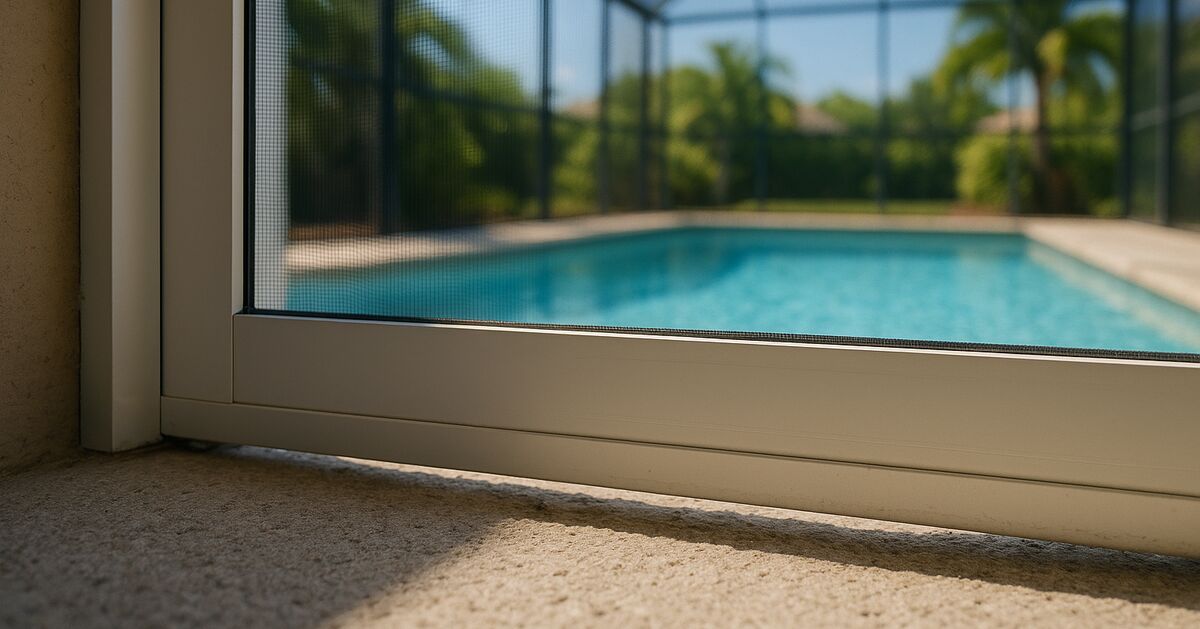
That thin sliver of light showing under your screen door is not just cosmetic. According to pest exclusion guidance, even small gaps at the base of a screen door, on the order of a quarter-inch to a half-inch, can be enough to let in cockroaches, young rodents, geckos, or tree frogs. On the Suncoast, where the warm, humid climate keeps pest activity high year-round, a threshold gap is a standing invitation.
The good news is that threshold gaps are often fixable without replacing the entire door or frame. The less-good news is that a lot of homeowners tolerate the gap for months, not realizing how much wildlife is using it as a highway into their lanai, pool cage, or living area.
Why threshold gaps form in the first place
Screen doors on Florida pool cages and lanais are exposed to some of the harshest conditions a door ever faces: intense UV, salt air, daily temperature swings between cool mornings and 95-degree afternoons, and sustained humidity that never really lets up. Several forces work together to open up a gap at the bottom of the door over time.
Frame sag and hinge wear. Every screen door hangs from hinges that are anchored to an aluminum frame. As the door is opened and closed hundreds of times a year, the hinge screws slowly work loose in their holes, the hinge leaf itself may develop a slight bend, and the door begins to drop on the latch side. Even a drop of three-sixteenths of an inch creates a visible and passable gap at the threshold on the opposite corner.
Aluminum extrusion warping. Pool-cage and lanai frames are made from extruded aluminum, which expands and contracts with temperature. A door frame that is perfectly plumb in February can be slightly racked by July. When a frame racks, the door no longer sits square inside the opening, and the bottom corners lift away from the sweep or sill.
Sweep and seal deterioration. Many screen doors are fitted with a rubber or vinyl sweep across the bottom rail. In Florida, UV and ozone degrade rubber relatively quickly. A sweep that looked fine two years ago may have shrunk, cracked, or hardened to the point where it no longer contacts the sill. Because the degradation is gradual, homeowners often don't notice until they watch an anole walk under the door in broad daylight.
Settled or damaged sill components. Some door openings have a low aluminum sill or threshold bar at ground level. Over time, foot traffic, lawn equipment bumping the frame, and minor flooding events can shift or dent that sill, creating an uneven surface that a door sweep cannot bridge.
Original installation gaps. A problem that comes up again and again in owner discussions online is the door that never sealed properly from day one. Builders and even some screen contractors install doors quickly and do not always test the full perimeter seal under load. If nobody checked the threshold at installation, a gap may have been present since the cage was new.
What actually comes through a threshold gap
The pest pressure on the Suncoast is real and documented. The University of Florida's Institute of Food and Agricultural Sciences (UF/IFAS) extension service notes that Florida's climate supports year-round breeding cycles for cockroaches, ants, and rodents that do not exist in cooler climates. A screened enclosure is only as effective as its tightest seal.
Here is a realistic rundown of what a threshold gap invites:
- Cockroaches. The American cockroach, commonly called the palmetto bug, is known for its ability to flatten its body and squeeze through very narrow gaps. German cockroaches, smaller and even more resilient, need less. Once inside a lanai or screen room, they find ideal conditions: warmth, moisture from the pool, and often food debris from outdoor dining.
- Rodents. The roof rat, common throughout Manatee and Sarasota County, is known to compress its body to pass through surprisingly small gaps. Norway rats need a slightly larger opening but are ground-level foragers who probe every gap at the base of a structure. Per the CDC's guidance on rodent exclusion, sealing all gaps larger than a quarter-inch is the primary prevention strategy.
- Lizards and frogs. Geckos and anoles are generally harmless but leave droppings on pool decks and furniture. Cuban tree frogs are invasive and consume native species; the Florida Fish and Wildlife Conservation Commission recommends humane removal and discourages establishing easy entry points.
- Ants. Ghost ants, fire ants, and big-headed ants are native to or well-established across the Suncoast. A threshold gap at ground level is a direct path to pool-deck areas where food crumbs, sweet pool chemicals, and moisture attract foragers.
- Snakes. This one surprises homeowners, but even a modest gap at the threshold can be enough for a small juvenile snake to slip through. The pool area, with its warmth and supply of frogs and lizards, is an attractive hunting ground.
Diagnosing your own threshold gap
Before calling anyone, do a quick survey on a sunny day. Look for a bright line of daylight along the entire bottom of the closed door. Then do the paper test: slide a sheet of printer paper along the threshold. If it slides freely with no resistance, the seal is inadequate. If it catches and requires force, the sweep is making contact.
Also check both bottom corners separately. A gap in one corner and a good seal in the other points strongly to hinge drop or frame rack, not just a worn sweep. A gap that runs uniformly across the full width more often points to a deteriorated or missing sweep, or to a raised sill that is no longer level.
Check the door frame itself for plumb. Hold a level against the latch-side vertical. If the frame has racked, fixing the sweep alone will not solve the problem; the door geometry has to be corrected first.
Repair options, from simple to structural
Replacing the door sweep
This is the right starting point when the frame is still square and the gap is caused by a worn or missing sweep. Screen door sweeps in Florida pool-cage applications are typically one of two styles: a flat rubber blade that drags lightly on the sill, or a pile-seal (a dense brush-style strip) that conforms to uneven surfaces.
For gaps over a smooth, level aluminum sill, a flat rubber blade sweep is durable and keeps a tight seal. For slightly uneven concrete decks or pavers, the pile-style seal conforms better and is less likely to tear when the door is dragged across a surface imperfection.
Installation is straightforward on a door with a standard bottom rail: the old sweep slides or screws out, the new one slides or screws in. Where it gets more nuanced is on custom frames or doors where the rail profile is not a standard residential size. Pool-cage door rails are often a different extrusion than what a big-box hardware store carries, so matching the sweep is a job that benefits from a contractor who stocks pool-cage-specific parts.
Correcting hinge drop
If the paper test shows the gap is larger at the latch corner than the hinge corner, the door has dropped. Try tightening the hinge screws first. If the screws spin freely and will not tighten (a sign that the screw holes have stripped in the aluminum), the fix is to either insert a slightly larger screw, fill the hole with an aluminum-compatible epoxy and re-tap it, or, in severe cases, install a new hinge in a fresh location on the frame.
Hinge replacement on pool-cage doors is not complicated, but getting the new hinge positioned correctly so the door hangs square again requires care and patience. A door that is rehung slightly out of square will gap somewhere along the perimeter even if the hinge itself is solid.
Addressing frame rack
A racked door frame is a structural issue. Aluminum frames can sometimes be coaxed back toward square by loosening the fasteners at the corners, adjusting, and re-securing. In other cases, the frame member has bent permanently and needs to be replaced. This is a situation where a professional assessment genuinely helps; a contractor who does this work daily can tell quickly whether the frame is adjustable or needs a new section.
Our screen and pool-cage repair services include door frame assessment as part of any door-related repair visit, so you get an honest read on what's actually going on before any work begins.
Adding a threshold bar or sill seal
When the gap exists because the deck surface is uneven or lower than the door frame's original design assumed, adding a low aluminum threshold bar at the base of the opening can raise the effective sill height to meet the sweep. These bars are anchored to the deck with concrete screws and are then sealed with a compatible caulk on the exterior edge to prevent water intrusion under the bar itself.
This option is particularly useful in pool-cage settings where pavers have settled, or where the original installation did not include a threshold and the contractor assumed the sweep alone would be sufficient.
Why this matters beyond pest control
A threshold gap does more than let pests in. It also means your screen enclosure is not providing the full environmental separation between outside air and your lanai or pool deck. Outdoor humidity, pollen, and airborne debris enter freely through a gap at the base of the door, working against the primary reason most Suncoast homeowners built a screened space in the first place.
If you use your pool cage or lanai for outdoor dining, morning coffee, or as an extension of your living space, a proper door seal contributes directly to comfort. It also protects pool water quality. Open gaps at low points allow windblown debris, leaves, and insects to enter and settle on the pool surface, increasing the chemical load needed to keep the water balanced.
You can read more about how small maintenance oversights compound over time in our post on what happens to an unrepaired spline over a Florida summer, which covers a similar dynamic with a different component.
Local factors that make this worse
Homeowners in coastal communities like Anna Maria Island, Longboat Key, Lido Key, and Siesta Key face accelerated hardware and rubber degradation because of salt air. Salt accelerates oxidation on aluminum fasteners and causes rubber and vinyl seals to dry and crack more quickly than inland locations. A screen door sweep on Anna Maria Island may wear out faster than one in Parrish or Lakewood Ranch, since coastal salt air tends to degrade rubber and vinyl more quickly than inland conditions.
Bradenton and Ellenton homeowners near tidal rivers and creeks also deal with elevated ground-level humidity and frequent ant pressure from the moist soils nearby. Palmetto, with its mix of older pool cages and new construction, sees threshold gaps frequently in older cages where sweeps have simply never been replaced.
If you're in any of these areas and haven't looked at your door threshold recently, it's worth checking. Our Bradenton screen repair page and our Lakewood Ranch service area page have more details about what we see on the ground in each community.
When to call a professional
Call a screen contractor rather than attempting a DIY fix when:
- The door frame itself is visibly racked or bent, because structural aluminum work requires specific tools and familiarity with pool-cage extrusion profiles.
- Screws are stripping out repeatedly, suggesting the frame section may be compromised.
- The gap exists across multiple doors or in combination with other signs of frame settlement.
- You've replaced the sweep yourself and the gap is still there, which points to a geometry problem rather than a seal problem.
A professional visit also gives you a chance to catch related issues. Threshold gaps often appear alongside worn screen panels and failing spline, especially on pool cages that haven't had a full service in several years. Catching everything at once is more cost-effective than addressing issues one at a time.
If you'd like to talk through what you're seeing on your door, our contact page is the fastest way to reach us, and our FAQ covers many of the questions homeowners ask before scheduling a visit.
A straightforward problem with a clear fix
Threshold gaps are not mysterious, and they are not expensive to fix when caught early. The frustrating part is that they are easy to overlook because the gap is at floor level and not at eye height. Getting into the habit of doing the paper test once a season, the same way you check your pool equipment or clean your gutters, is the kind of low-effort maintenance that keeps a small problem from becoming a pest infestation problem.
Screened enclosures on the Suncoast are one of the best investments a homeowner can make in outdoor livability. Keeping the full perimeter sealed, including that easy-to-miss threshold, is what makes the investment actually pay off. If you're unsure where to start, browse our full service area to find the team closest to you.
Sources & further reading
- UF/IFAS Extension: cockroach biology and management in Florida (University of Florida Institute of Food and Agricultural Sciences)
- Florida Fish and Wildlife Conservation Commission: Cuban tree frog management (Florida Fish and Wildlife Conservation Commission)
- EPA integrated pest management: structural pest exclusion (U.S. Environmental Protection Agency)
- Centers for Disease Control and Prevention (named in this article) (Centers for Disease Control and Prevention)
Claim-by-claim audit (8 checked)
- “According to pest exclusion guidance, even small gaps at the base of a screen door, on the order of a quarter-inch to a half-inch, can be enough to let in cockroaches, young rodent…” (rewritten to what the article can stand behind)
- “The American cockroach, commonly called the palmetto bug, is known for its ability to flatten its body and squeeze through very narrow gaps.” (rewritten to what the article can stand behind)
- “The roof rat, common throughout Manatee and Sarasota County, is known to compress its body to pass through surprisingly small gaps.” (rewritten to what the article can stand behind)
- “Per the CDC's guidance on rodent exclusion, sealing all gaps larger than a quarter-inch is the primary prevention strategy.” (cited → cdc.gov)
- “Cuban tree frogs are invasive and consume native species; the Florida Fish and Wildlife Conservation Commission recommends humane removal and discourages establishing easy entry po…” (cited → myfwc.com)
- “The University of Florida's Institute of Food and Agricultural Sciences (UF/IFAS) extension service notes that Florida's climate supports year-round breeding cycles for cockroaches…” (cited → edis.ifas.ufl.edu)
- “This one surprises homeowners, but even a modest gap at the threshold can be enough for a small juvenile snake to slip through.” (rewritten to what the article can stand behind)
- “A screen door sweep on Anna Maria Island may wear out faster than one in Parrish or Lakewood Ranch, since coastal salt air tends to degrade rubber and vinyl more quickly than inlan…” (rewritten to what the article can stand behind)