What re-tensioning actually fixes - and what it cannot
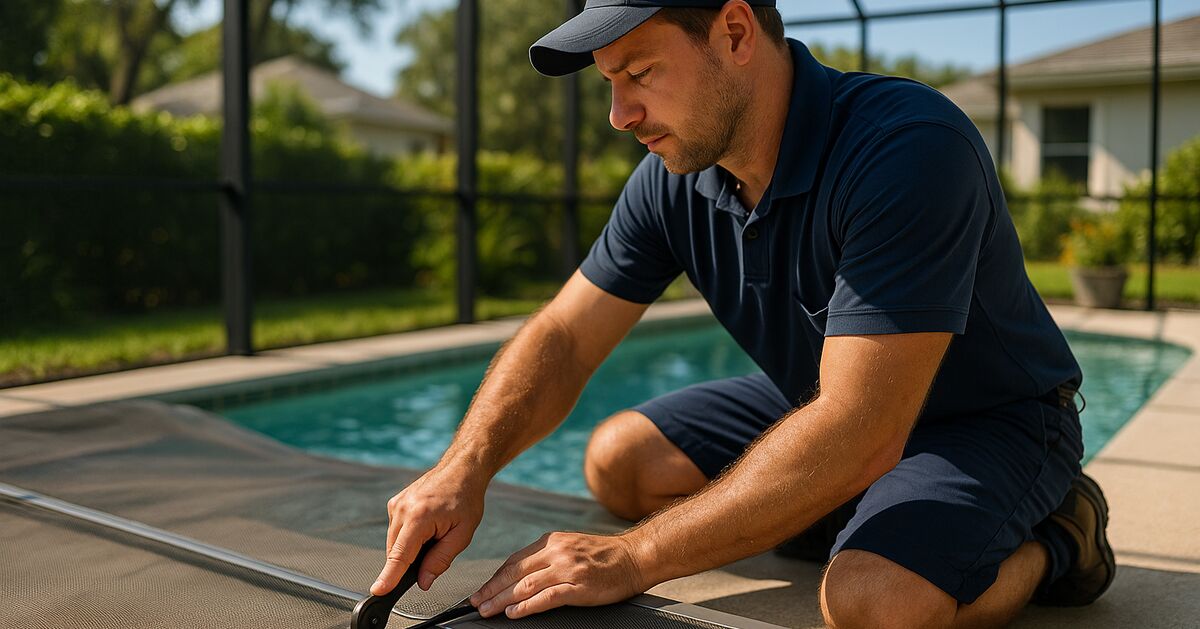
Saggy, rippled screen looks like it just needs a good tightening - but pulling on the mesh rarely fixes anything for long, and sometimes makes things worse. Understanding what re-tensioning actually does (and does not do) will save you time, money, and a second service call.
What "re-tensioning" means in plain English
When a screen installer talks about tensioning, they mean the process of stretching the mesh taut across a panel frame before pressing the spline into its channel. Tension is set once, at installation. The screen is pulled evenly in both directions so it lies flat, sheds water cleanly, and resists billowing in a breeze.
"Re-tensioning" means doing that again after the fact. In practice, it typically requires pulling the existing spline out of its channel, repositioning the mesh, and re-inserting the spline - or replacing the spline entirely. It is not a quick tug-and-done adjustment. Real re-tensioning is a full reinstallation of the screen into the same frame.
That distinction matters enormously, because it means re-tensioning carries essentially the same labor as a straight re-screen of that panel. The screen material itself may or may not be reused depending on its condition.
The one problem re-tensioning genuinely solves
Re-tensioning corrects installation-induced looseness - meaning the screen was never pulled tight enough in the first place, or a section of spline was not fully seated and allowed the mesh to creep inward over time.
Signs this is your situation:
- The screen looks wavy or pouchy but the mesh fabric itself is intact, with no tears, holes, or brittleness
- The looseness appeared within the first year or two after installation
- You can press the screen inward with your palm and it springs back without any cracking or powdering
- The sagging is uniform across the panel rather than concentrated at one corner or edge
When all of those things are true, re-tensioning (pulling the spline, repositioning the mesh, re-seating the spline) can restore a flat, properly taut panel. If the screen material is still in good shape, a skilled technician may be able to reuse it and you only pay for labor and possibly new spline.
This scenario is real but narrower than many homeowners assume. Most calls we get about "loose screen" turn out to involve at least one of the problems described below, which re-tensioning cannot fix.
Problem 1: UV-degraded mesh
Florida's sun is relentless. Ultraviolet radiation breaks down the polymer coating on fiberglass and aluminum mesh over time, leaving it brittle and inelastic. When you try to re-tension brittle mesh, it does not stretch - it tears or crumbles at the spline channel.
A quick field test: press lightly on the screen with one finger. If it gives without springing back, or if small flakes appear at the edges near the spline, the material is past tensioning. The panel needs new mesh, full stop.
Homes on Siesta Key, Longboat Key, and Lido Key may face more reflected UV off the water, which can accelerate mesh wear compared to enclosures further inland. Even Bradenton and Lakewood Ranch homes with west-facing enclosures that catch afternoon sun see accelerated UV wear on those panels.
You can read more about what UV does to mesh at a chemical level in our post on screen panel spline failure over a Florida summer.
Problem 2: Stretched or torn mesh
When a screen has been pushed outward repeatedly - by a branch, a ball, a pet, or wind pressure during a storm - the mesh fibers themselves elongate. A fiberglass screen that has been stretched even a small amount will not re-tension properly. The geometry of the weave has changed, and re-seating the spline will produce a panel that looks wrinkled at one spot and overly tight at another.
Torn mesh is the obvious case: if there is a hole, re-tensioning does nothing. But stretched mesh without a visible tear is the tricky one, because it looks like a looseness problem. The telltale sign is that the sagging is localized - one bulging area in the middle of an otherwise flat panel, or a diagonal wave that tracks from one corner toward the opposite side.
Our screen repair and pool-cage services include a visual and tactile assessment of each panel before any work begins, specifically so technicians can tell the difference between a tensioning issue and a material issue.
Problem 3: Spline that has hardened and shrunk
The rubber or vinyl spline sitting in the channel around your panel does two jobs: it locks the mesh in place, and it applies continuous inward pressure to keep things snug. Spline ages. It dries out, shrinks, and loses its grip.
When old spline is the root cause of looseness, re-tensioning with the same spline just repeats the problem. The mesh will settle back into looseness within months. The correct fix is new spline - the right diameter for your frame channel - installed while the mesh is properly stretched.
Many homeowners (and some less experienced contractors) skip spline replacement to save a few dollars. The result is a call-back within a season. Always confirm that any re-tensioning job includes new spline.
Problem 4: Frame damage or channel deformation
A pool-cage frame is aluminum extrusion. The spline channel is a groove pressed into that extrusion. When the frame gets bent, corroded, or crushed - by a ladder leaning on it, by a storm impact, or by corrosion working from the inside out - the channel can deform.
A deformed channel cannot grip spline properly regardless of how carefully the mesh is tensioned. The screen will simply pop back out, often within days. Re-tensioning into a damaged frame is wasted effort. The frame member needs to be straightened or replaced before the screen work begins.
This is one reason a thorough inspection of the frame - not just the mesh - belongs at the start of every service call. Homes in Palmetto and Ellenton that went through Hurricane Idalia saw a number of frames that looked fine from ten feet away but had subtly crushed channels that became obvious when the screen kept refusing to stay seated.
Problem 5: Bottom-panel wear and moisture damage
Bottom panels on pool cages live in a different world than panels six feet off the ground. They collect splash water, lawn irrigation overspray, and leaf debris. Over time that chronic moisture exposure causes the mesh to stiffen, the spline to rot, and in severe cases, the lower frame channel to corrode.
Re-tensioning a bottom panel that has been wet for years typically reveals all of these problems at once. The mesh breaks when pulled, the spline crumbles, and the channel may need cleaning or treatment before new material will seat properly. Budget for a full panel re-screen rather than a tensioning adjustment on any enclosure that shows brown staining or algae growth at the base.
For a deeper look at why these panels take the hardest beating, see our post on why bottom pool-cage panels fail first.
The "re-tension or re-screen" decision tree
Use this as a starting guide before calling for a quote:
- Mesh intact, no brittleness, looseness appeared soon after installation - Re-tensioning with new spline is likely the right call.
- Mesh intact but looseness developed over several years - Spline replacement with re-tensioning. Inspect mesh carefully for UV degradation before deciding to reuse it.
- Localized bulge, diagonal wave, or stretched-looking sag - New mesh. Re-tensioning will not produce a flat result.
- Any visible hole, tear, or crumbling at the edges - New mesh. No discussion needed.
- Brown staining, algae, or wet-zone location (bottom panels) - New mesh and inspect the frame channel.
- Screen pops back out within days of any repair attempt - Inspect the frame channel for deformation before trying again.
When in doubt, a professional assessment costs nothing but a phone call. An honest contractor will tell you which situation you are in rather than upsell a full re-screen when tensioning is all that is needed, or undersell a tensioning fix when the mesh is already gone.
Why this matters more in a coastal climate
Suncoast conditions like heat, humidity, salt air, and intense UV can push materials toward failure faster than in milder climates. The combination of heat, humidity, salt air on barrier islands like Anna Maria Island and Longboat Key, and intense UV can shorten the window between needing tensioning and needing full replacement compared to milder climates.
A screen that is a little loose in October could become brittle within months given local sun exposure. That is why routine inspections before and after storm season are worth scheduling. Catching a tensioning issue while the mesh is still viable saves the cost of new material. Waiting too long turns a labor-only fix into a material-plus-labor job.
Homeowners in Bradenton and Lakewood Ranch often ask whether they should just re-screen everything at once rather than selectively re-tensioning panels. The honest answer depends on the age and UV exposure of the existing mesh. If the enclosure is under four or five years old and most panels are still supple, selective repair makes financial sense. If the enclosure is seven or more years old and panels are showing brittleness, a full re-screen is typically more economical than repeated panel-by-panel repairs over the next two seasons.
What a re-tensioning visit should include
If you hire someone to re-tension a panel, here is what the work should cover:
- Remove the existing spline completely (do not try to re-seat old spline)
- Inspect the frame channel for corrosion, deformation, or debris and clean as needed
- Inspect the mesh for UV degradation and stretch before deciding to reuse it
- Pull the mesh taut with proper tensioning tools - not by hand alone
- Install new spline in the correct diameter for the channel (undersized spline will not hold; oversized spline will not seat)
- Trim excess mesh flush with the frame
A job that skips any of those steps is cutting corners. The spline diameter question is especially important: frame channels on older enclosures and newer ones are not always the same size, and mismatched spline is a common reason screens pop out again quickly.
Our frequently asked questions page covers spline sizing and other common questions about what goes into a proper screen repair.
One thing re-tensioning will never change
No amount of tensioning fixes a screen that has the wrong mesh type for its location or use. A standard 18x14 fiberglass mesh re-tensioned perfectly is still going to let no-see-ums through on Anna Maria Island. A re-tensioned standard mesh is still going to show pet damage within weeks if a large dog is pushing against it daily.
If you are re-tensioning or re-screening, that service call is also the right moment to evaluate whether the mesh type itself should change. Upgrading to a tighter weave, a heavier pet-resistant material, or a corrosion-resistant coated aluminum mesh at the same time as a re-screen adds little to the labor cost and significantly extends the life of the repair.
The full range of options - mesh types, frame materials, and service types - is outlined on our services page, and our team covers all of Manatee and Sarasota County, from Parrish in the north to Osprey and Nokomis in the south. You can see the full list of areas we serve or get in touch to schedule an assessment.
The short version
Re-tensioning fixes exactly one thing: a properly intact mesh that was never pulled tight enough (or whose spline failed to hold tension). It cannot restore UV-degraded fiber, cannot un-stretch a pushed-out mesh, cannot repair a deformed frame channel, and cannot replace rotted spline if you skip replacing the spline. Knowing which problem you have before the technician arrives makes the conversation faster and the outcome better.
When the mesh is still good, re-tensioning with new spline is a smart, economical repair. When the mesh has aged past its useful life, honest advice is to put new material in rather than labor over screen that will not last another season in Florida's sun.
Sources & further reading
- UV Degradation of Polymers and Coatings (National Institute of Standards and Technology (NIST))
- Florida Building Code - Residential Structures (Florida Department of Business and Professional Regulation)
- Corrosion of Aluminum in Coastal Environments (NACE International (Association for Materials Protection and Performance))
Claim-by-claim audit (8 checked)
- “Ultraviolet radiation breaks down the polymer coating on fiberglass and aluminum mesh over time, leaving it brittle and inelastic.” (cited → nist.gov)
- “Homes on Siesta Key, Longboat Key, and Lido Key may face more reflected UV off the water, which can accelerate mesh wear compared to enclosures further inland.” (rewritten to what the article can stand behind)
- “Some homes in Palmetto and Ellenton that went through Hurricane Idalia had frames that looked fine but had subtly crushed channels, which became obvious when the screen kept refusi…” (rewritten to what the article can stand behind)
- “When the frame gets bent, corroded, or crushed - by a ladder leaning on it, by a storm impact, or by corrosion working from the inside out - the channel can deform.” (reasoning shown in the article)
- “A deformed channel cannot grip spline properly regardless of how carefully the mesh is tensioned.” (reasoning shown in the article)
- “Suncoast conditions like heat, humidity, salt air, and intense UV can push materials toward failure faster than in milder climates.” (rewritten to what the article can stand behind)
- “The combination of heat, humidity, salt air on barrier islands like Anna Maria Island and Longboat Key, and intense UV can shorten the window between needing tensioning and needing…” (rewritten to what the article can stand behind)
- “A screen that is a little loose in October could become brittle within months given local sun exposure.” (rewritten to what the article can stand behind)