Why Salt Air Destroys Pool-Cage Hardware on the Gulf Coast
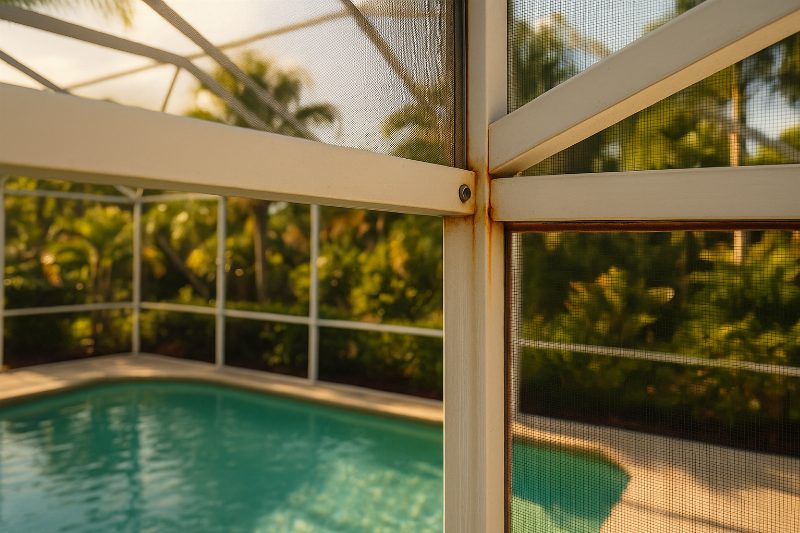
Salt air is working on your pool cage right now, even on a calm sunny day with no rain in the forecast. If you live in Sarasota, Siesta Key, Longboat Key, Anna Maria Island, or anywhere else within a few miles of the Gulf of Mexico, this is simply the reality of owning a screened enclosure in paradise. Understanding why it happens, and what you can actually do about it, will save you money and headaches down the road.
What Salt Air Actually Does to Metal
The Gulf of Mexico keeps the air along the coast perpetually loaded with microscopic salt particles. When ocean water evaporates or waves break, tiny aerosol droplets become suspended in the breeze. Those droplets travel inland, settle on every surface they touch, and leave behind sodium chloride crystals when the water evaporates again. The salt itself is not the enemy so much as what it does to metals in the presence of moisture and oxygen.
Steel and aluminum form a thin protective oxide layer naturally. That layer is what keeps raw metal from rusting or corroding under normal inland conditions. Salt ions, specifically chloride ions, are small enough to penetrate that oxide layer and attack the metal underneath. Once chloride ions get under the surface, they create localized "pits" that accelerate corrosion far faster than general surface rust. Electrochemical reactions take over, and what started as a microscopic pit becomes a flaking, crumbling fastener or hinge in a matter of months rather than years.
The technical term for this process is chloride-induced pitting corrosion, and it is one of the most aggressive forms of metal degradation in the world. It is the same reason steel bridges near coastlines require constant maintenance, and it is precisely what happens to the hardware holding your pool cage together.
Which Pool-Cage Hardware Fails First
Not all parts of your enclosure are equally vulnerable. Understanding the hierarchy of failure helps you know where to look and what to prioritize.
Fasteners and screws are almost always the first casualties. They are small, often made from standard aluminum or mild steel, and they have threads, which means far more exposed surface area than a flat sheet of metal. Once corrosion begins on a screw, it can seize inside the aluminum frame, making future removal nearly impossible without drilling it out. Stripped or corroded fasteners are also structurally significant, because they are what holds frame sections and screen panels in place during wind events.
Hinges and door hardware come next. The pivot points of a pool-cage door see constant movement, which wears away any surface coating quickly. Bare metal exposed by that wear corrodes rapidly in salty air. A door that swings fine today may be stiff, squeaky, and eventually frozen shut within a season if the hinges are already showing surface corrosion.
Screen spline and screen mesh are secondary victims in a different way. The spline, the flexible bead of rubber or vinyl that locks screen mesh into the frame channel, can harden and crack as UV and salt air degrade it together. Once spline fails, screen panels begin to sag or pull away from the frame. You can read more about how each of these components works together in our post on the anatomy of a pool cage: frame, screen, spline, and hardware.
Frame extrusions are generally the last to show serious damage because aluminum is naturally more corrosion-resistant than steel. But "more resistant" is not the same as "immune." Aluminum can still suffer from pitting, and oxidation leaves a chalky white residue on the surface that signals the protective layer is breaking down. Once frame sections are deeply pitted, they lose structural integrity and may need full replacement rather than repair.
Why the Gulf Coast Is Especially Harsh
Coastal corrosion is a nationwide problem anywhere near salt water, but the Gulf Coast has a specific combination of factors that makes conditions here particularly aggressive.
First, there is the geography. The Gulf of Mexico is a semi-enclosed body of water with relatively calm wave action compared to the Atlantic, but that calm means salt aerosols linger in the air rather than being constantly churned and dispersed. Prevailing southwest winds push that salty air directly into communities like Lido Key, Nokomis, Osprey, and Longboat Key on a near-daily basis.
Second, Florida's heat accelerates chemical reactions. Corrosion is fundamentally a chemical process, and most chemical processes speed up as temperature rises. A fastener that might take three years to corrode noticeably in a moderate coastal climate can show the same damage in twelve to eighteen months here.
Third, the humidity never really lets hardware dry out. Even on days with no rain, relative humidity in Sarasota, Bradenton, and the surrounding area routinely climbs above 80 percent. That thin film of moisture on every metal surface keeps chloride ions active and the electrochemical corrosion process running around the clock.
Fourth, pool chemistry adds another layer of attack. The chlorine and other chemicals in pool water create their own corrosive vapor environment immediately around the enclosure. Hardware on the inside of your pool cage is being hit from two directions simultaneously: salt air from outside and pool chemical vapor from below.
This combination of factors is why homeowners in Siesta Key or Anna Maria Island will typically see hardware fail noticeably faster than homeowners even a few miles inland in Lakewood Ranch or Parrish.
Common Warning Signs to Watch For
You do not need to be a contractor to spot early corrosion. A slow walk around your enclosure a couple of times a year, ideally in good morning light, will reveal most problems before they become urgent.
- White or grey powdery residue on frame extrusions. This is aluminum oxide, the visible result of surface corrosion on the frame itself.
- Brown or orange streaking around screw heads. This indicates the fastener is rusting, and that rust is beginning to stain the frame around it.
- Screws that look raised or "proud" of the surface. Corrosion products build up and expand inside the hole, actually pushing the screw slightly outward. This is a sign the fastener is failing structurally.
- Door hinges that are stiff, squeak, or show flaking. Surface coatings are gone and bare metal is corroding.
- Screen panels that sag or have gaps at the edges. The spline holding them in has likely dried out and contracted, often driven by combined UV and salt-air degradation. For more on UV-specific damage to screen mesh, see our post on why your screen looks grey and brittle: UV damage explained.
- Any rust streaking on concrete or pavers below the cage. This means a fastener is corroding significantly enough to run stained water down the structure.
If you spot two or more of these signs, it is worth having a professional take a look before a single point of failure cascades into a larger structural problem.
What You Can Do to Slow Corrosion
The honest answer is that you cannot fully stop salt-air corrosion on the Gulf Coast. You can, however, slow it down meaningfully with some straightforward habits.
Rinse your enclosure regularly. A gentle rinse with a garden hose, focusing on hardware and frame joints, removes salt deposits before they have time to set and penetrate. After any significant windstorm or storm surge event, a rinse is especially valuable. This is more important the closer you are to open water.
Apply a protective coating to exposed hardware. Products like a corrosion-inhibiting spray or a thin coat of marine-grade grease on hinges and screw heads create a physical barrier between metal and salt air. This needs to be reapplied periodically, but it extends hardware life noticeably.
Do not skip annual inspections. An experienced eye can catch early-stage corrosion at fasteners that a homeowner might miss. Catching a failing screw early means a simple fastener swap rather than a torn screen panel or collapsed frame section.
Choose hardware rated for coastal environments when you repair or replace. Stainless steel fasteners rated 316-grade, which is designed for marine environments, are dramatically more corrosion-resistant than standard aluminum or 304-grade stainless. If you are having repair work done, ask specifically about the hardware grade being used. Our services page covers the types of repairs we handle and the materials we work with.
Keep pool chemistry balanced. Properly balanced water produces less off-gassing of corrosive chlorine compounds. This will not eliminate the problem, but it reduces one of the two sources of chemical attack on your hardware.
When Repair Makes More Sense Than Full Replacement
A common question is whether corroded hardware signals that the whole cage needs to come down and be rebuilt. In most cases, the answer is no, at least not immediately. Hardware is a consumable component in a coastal environment. Fasteners, hinges, and door closers can be replaced selectively without touching the main frame structure, as long as the frame extrusions themselves are still sound.
The calculus shifts when frame sections show deep pitting, when multiple structural members have been compromised, or when the damage is severe enough that the enclosure could not be expected to perform adequately in a significant storm. Florida's hurricane season makes structural integrity more than a cosmetic concern. If you have had recent storm damage, our post on what to do after a hurricane damages your screen enclosure walks through the right steps to take.
For homeowners in areas like Bradenton or Palmetto who may be slightly further from the immediate shoreline, enclosures often have a longer hardware lifespan, but the same principles apply. Salt air travels further inland than most people expect, particularly during active wind events.
If you are unsure where your enclosure stands, the best starting point is a straightforward inspection. Our frequently asked questions page covers what to expect from an assessment, and getting a second set of eyes on your enclosure costs nothing. You can reach us directly through our contact page to schedule a visit at your convenience.
The Bigger Picture
A pool cage is a meaningful investment, and on the Gulf Coast, protecting that investment means understanding the environment it lives in. Salt air is not a freak occurrence or a seasonal problem. It is a constant, slow, invisible force that requires consistent attention. The homeowners who get the most life out of their enclosures are the ones who take corrosion seriously before it becomes dramatic, rinse and inspect regularly, and choose the right materials when repairs become necessary.
The Gulf Coast is a genuinely beautiful place to live, and a well-maintained screen enclosure is one of the things that makes daily life here so enjoyable. A little proactive attention to the hardware that holds it all together is a fair trade for years of comfortable evenings poolside without the bugs, the heat, or the salt spray ruining the experience.