Tree canopy and screen enclosures: what Osprey and Nokomis homeowners need to know
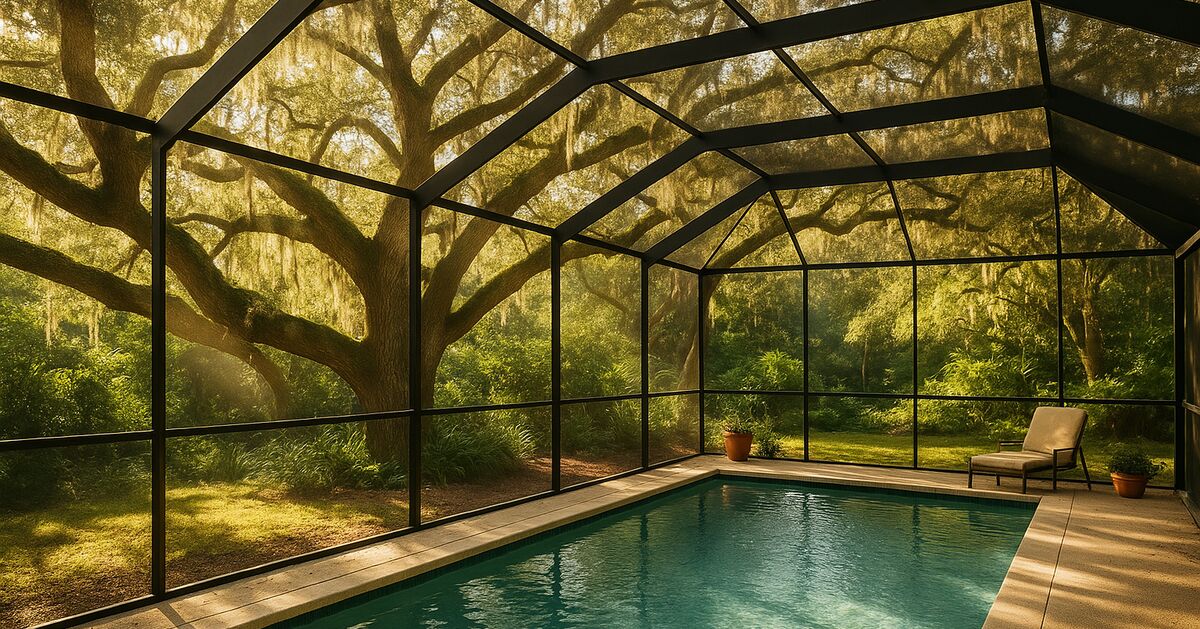
Living under a canopy of live oaks and slash pines is one of the great pleasures of owning a home in Osprey or Nokomis - right up until that canopy starts tearing holes in your screen enclosure.
It is a tension that comes up again and again for homeowners in this corridor: the same mature trees that keep your back patio fifteen degrees cooler than your neighbor's concrete slab are also dropping branches, dripping sap, shedding bark, and funneling moisture onto the very screens you rely on to enjoy the outdoors without the bugs. Understanding why trees cause the damage they do - not just the obvious falling branch scenario - helps you make smarter decisions about trimming schedules, screen material, and maintenance timing.
Why Osprey and Nokomis have a unique tree-canopy situation
The neighborhoods tucked between U.S. 41 and the Intracoastal in Osprey and Nokomis were developed later than many Sarasota County communities, which means a lot of older established trees were left in place during construction. Subdivisions like Willowbend, Sorrento South, and the older streets near Blackburn Point Road often have mature live oaks with canopies extending well over back-yard pool cages. The Suncoast's clay-and-sand soil holds moisture well, which encourages those canopies to keep growing.
That combination - large established trees, close lot lines, and humid coastal air - creates conditions that put screen enclosures under stress from multiple directions at once. It is not just the dramatic hurricane branch-fall that does the damage. It is the slow, daily accumulation of debris, moisture, and biological growth that quietly shortens the life of your screens and frame.
If you are curious how this compares to a more open-exposure environment, the post on Longboat Key vs. Lakewood Ranch wind exposure and screen enclosure choices is a useful contrast - the stressors are genuinely different when you have wind-driven salt air versus a shaded inland yard.
The four ways tree canopy damages a screen enclosure
1. Physical impact from falling debris
This is the one everybody thinks of first, and it is real. Live oaks are not deciduous in the traditional sense - they drop leaves steadily throughout the year rather than all at once, and they shed small branches constantly. Slash pines shed needles in clumps and drop cones that can be heavy enough to tear standard fiberglass screen when falling from a height.
The damage from a single branch is usually obvious: a clean tear, a popped spline, or in the case of a heavier limb, a bent frame rail. What owners sometimes miss is the cumulative effect of smaller debris. Dozens of small twigs and seed pods landing on a horizontal screen panel over months creates concentrated load points, especially near the center of a large panel where the screen has the least support. Over time those repeated micro-impacts loosen the spline channel and let the edge of the screen pull free.
If your enclosure has large horizontal panel spans (common in older pool cages in the Osprey area that predate current building code wind-load requirements), this kind of debris loading is worth taking seriously.
2. Moisture retention and biological growth
A pool cage under a heavy canopy stays wet longer after rain than an enclosure in full sun. The tree cover blocks the drying effect of direct sunlight and wind. Per the EPA's guidance on mold and moisture in residential settings, organic debris sitting in standing moisture provides exactly the conditions that support mold, algae, and mildew colonization.
On a screen enclosure, this plays out in two ways. First, the screen mesh itself collects debris that holds moisture against the fibers. Fiberglass mesh degrades more slowly in this environment than you might expect, but aluminum mesh can begin to oxidize at the weave intersections when kept continuously damp. Second, and more consequentially, the frame is affected. Aluminum extrusions are generally corrosion-resistant, but the fasteners holding them together - typically steel or zinc-plated screws - are not. When those fasteners corrode, the joints lose clamping force and the frame begins to rack slightly. For a detailed look at how this process unfolds, see our post on how trapped humidity corrodes screen-enclosure frames and fasteners.
The practical takeaway: under a heavy canopy, keeping the screen surface and the frame channels clean is not just aesthetic maintenance. It is structural maintenance.
3. Sap, tannins, and organic staining
Live oaks produce tannins - the same compounds that make tea brown - and these leach out of fallen leaves and bark. When rainwater flows through a pile of oak leaves sitting on a screen panel, it carries tannin-rich water through the mesh and down the frame. Over time this stains aluminum a reddish-brown that is easy to mistake for rust (which is iron oxide; tannin staining is different, though both are worth addressing).
More damaging than the staining is the way pine sap behaves. Pine resin is sticky and hydrophobic. When it lands on screen mesh it traps debris, blocks airflow through the mesh, and is difficult to remove without solvents. Aggressive scrubbing to remove hardened sap can damage the mesh weave. Homeowners in the pine-heavy neighborhoods east of Nokomis Avenue report this problem frequently. The practical solution is to remove fresh sap with a rag dampened with mineral spirits before it hardens, and to rinse the screen panels with a gentle hose-down after any significant needle or cone drop.
4. Root growth and ground-level frame effects
This one surprises people. A large live oak or Laurel oak with its root structure close to the pool deck can lift concrete slab sections over years. When the slab moves, the base plates and anchor bolts for the pool cage can shift with it. The result is a frame that is no longer plumb, which puts uneven stress on the corner joints and horizontal rails. Screens in a racked frame tend to pop their splines because the panel opening is no longer the rectangle the screen was cut for.
If you notice that your screen door is suddenly binding or that corner panels seem loose even though they were fine after your last re-screen, it is worth having someone look at the base of the frame where it meets the deck.
What to look for during your own walkaround
You do not need to be a screen professional to spot early warning signs. Walk the perimeter of your enclosure after any significant wind event and look for:
- Spline that has pulled partially out of its channel, especially on horizontal top panels
- Screen mesh that has gone from taut to slightly billowed or saggy in the center of a panel
- Any visible tears, even small ones (a pinhole in a bottom panel is a gap for no-see-ums and mosquitoes)
- Frame corners where the aluminum sections meet that show separation, gaps, or visible fastener heads that look dark or rusty
- Debris accumulation on horizontal panels, particularly in the valley where a sloped roof panel meets a vertical wall panel
Our screen enclosure and pool-cage repair services page gives an overview of what a professional inspection covers if you want to understand what a trained eye looks for beyond the obvious.
Trimming strategy: how close is too close?
The University of Florida IFAS Extension, which publishes guidance on tree management for Florida homeowners, recommends maintaining clearance between tree canopies and structures to reduce debris load and improve airflow. For screen enclosures specifically, aiming for several feet of clearance between the nearest branch tips and the enclosure roof can help debris blow clear rather than land directly on the screen.
That said, Osprey and Nokomis homeowners often face a real trade-off: aggressive trimming can harm the health of a live oak and reduces the shade that makes the screened area comfortable during Florida's hottest months. A certified arborist familiar with Florida's native species can help you find a trimming approach that protects both the tree and the enclosure. The goal is directional trimming to redirect growth away from the structure, not topping or heavy reduction that stresses the tree.
A practical schedule that works for many homeowners in this area: trim in late winter (February or early March), before the spring growth flush, and again in late September after storm season winds down. This keeps the canopy manageable without repeated cuts during the period when the tree is most stressed.
Screen material choices under a heavy canopy
Standard 18x14 fiberglass screen is fine for most Florida enclosures, but under a heavy canopy it faces conditions it was not optimized for: prolonged moisture, debris loading, and reduced UV exposure. UV from sunlight actually helps keep some biological growth in check, so a deeply shaded panel stays wetter and dirtier longer.
A few material considerations worth discussing with your contractor:
- Phifer BetterVue or equivalent high-transparency mesh - these have a tighter weave that blocks more insects but also catches more debris. Under a canopy, they may require more frequent cleaning than a standard mesh.
- Super-screen or pet-screen - heavier PVC-coated polyester mesh that resists puncture from falling debris better than standard fiberglass. Worth considering for top panels directly under tree canopy.
- Aluminum mesh - not recommended under a heavy canopy specifically because of the moisture-retention issue with oxidation at the weave intersections.
For a broader look at how geography affects material choices along the Suncoast, the post on screen enclosures and material choices on Casey Key covers coastal stress factors that partially overlap with the canopy-moisture problem.
Cleaning: frequency and method under a canopy
Homeowners in full-sun environments often get away with once-a-year cleaning. Under a heavy canopy in Osprey or Nokomis, twice a year is a more realistic minimum - and after any significant storm or heavy cone/needle drop, a rinse-down is worth doing promptly.
The method matters. High-pressure washing can force water behind splines and into frame channels, and the mechanical force can actually push debris into mesh openings rather than clearing them. A garden hose with a spray nozzle on a medium-fan setting, working from the top down, clears most organic debris without stressing the screen. For algae or mildew on the frame itself, a dilute solution of water and white vinegar (roughly 1:10) applied with a soft brush works without the corrosive effects of bleach-based cleaners on aluminum.
When to call a professional
Some damage is straightforward enough that an observant homeowner can monitor it over a season. But a few situations warrant a professional look sooner rather than later:
- Any frame rail that has visibly bent or bowed after a branch strike
- Multiple panels with popped splines in the same area (suggests the frame opening has changed shape)
- A door that no longer latches or closes squarely
- Visible fastener corrosion at the base plates where the frame meets the deck
Our team works throughout Osprey and across our full Suncoast service area, so a service call does not mean a long wait or a drive-up charge. And if you are not sure whether what you are seeing is a watch-and-wait situation or a fix-now situation, our FAQ page covers many of the common judgment calls homeowners face.
Putting it all together
The screen enclosure under your live oaks is not fighting one enemy - it is managing a slow accumulation of moisture, debris, biological growth, and occasional physical impact, all at once. The good news is that none of these forces is fast-moving. A homeowner who does a careful walkaround twice a year, keeps the panels reasonably clean, and addresses small spline or mesh issues before they grow has a good chance of getting a full service life out of a well-built enclosure even under a heavy canopy.
The mistake that comes up again and again when owners bring in damaged enclosures is that something small - a single popped spline on a top panel, a small corner tear - was visible for a season or two but left alone. Rain gets in through the gap, wets the spline channel repeatedly, the spline swells and becomes harder to re-seat, and eventually the frame corner starts to show stress. Small repairs done promptly are nearly always less expensive than the same repair done after the secondary damage has accumulated. Our blog covers many of these compounding damage patterns if you want to go deeper on any one issue.
If you are in Osprey, Nokomis, or anywhere else across our service area and you want a professional eye on your enclosure before the next storm season, get in touch with us and we can walk through what you are seeing.
Sources & further reading
- Mold and Moisture in Homes - Guidance for Homeowners (U.S. Environmental Protection Agency)
- Florida-Friendly Landscaping: Tree Trimming and Structural Clearance Guidance (University of Florida IFAS Extension)
- Homeowner's Guide to Protecting Trees During Construction and Landscaping (University of Florida IFAS Extension)
- Florida Building Code - Residential Structures and Wind Load Requirements (Florida Department of Business and Professional Regulation)
- UF/IFAS Extension (named in this article) (UF/IFAS Extension)
Claim-by-claim audit (6 checked)
- “Slash pines shed needles in clumps and drop cones that can be heavy enough to tear standard fiberglass screen when falling from a height.” (rewritten to what the article can stand behind)
- “Aluminum extrusions are generally corrosion-resistant, but the fasteners holding them together - typically steel or zinc-plated screws - are not.” (reasoning shown in the article)
- “For screen enclosures specifically, aiming for several feet of clearance between the nearest branch tips and the enclosure roof can help debris blow clear rather than land directly…” (rewritten to what the article can stand behind)
- “A large live oak or Laurel oak with its root structure close to the pool deck can lift concrete slab sections over years.” (reasoning shown in the article)
- “High-pressure washing can force water behind splines and into frame channels, and the mechanical force can actually push debris *into* mesh openings rather than clearing them.” (reasoning shown in the article)
- “Subdivisions like Willowbend, Sorrento South, and the older streets near Blackburn Point Road often have mature live oaks with canopies extending well over back-yard pool cages.” (rewritten to what the article can stand behind)