Screen enclosures on Casey Key: elevation and storm surge change your material choices
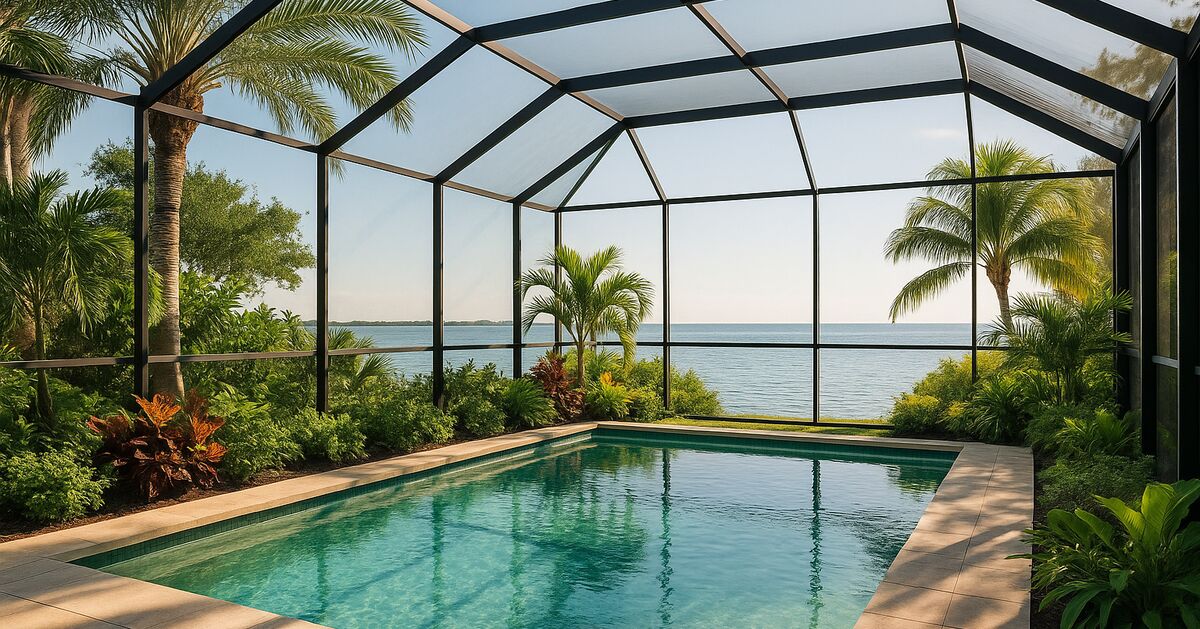
Casey Key is unlike almost anywhere else on the Suncoast. The island is barely a quarter mile wide in places, bracketed by the Gulf of Mexico on one side and Little Sarasota Bay on the other, with no buffer communities between your lanai and open water. If you own or are buying a home there, the decisions you make about your screen enclosure are not the same decisions a homeowner in Lakewood Ranch or Parrish would face. Lot elevation, FEMA flood zone designation, and storm surge risk all push you toward different materials, different hardware, and a different maintenance schedule than what you might find in a generic contractor brochure.
This post walks through exactly how those site-specific factors should shape your choices, what to ask your contractor, and what shortcuts are genuinely worth skipping.
Why lot elevation matters more than most homeowners expect
Florida's building codes treat structures differently based on the Base Flood Elevation (BFE) assigned to a parcel by FEMA's National Flood Insurance Program (NFIP). On Casey Key, many lots sit in FEMA Zone AE or even VE, the coastal high-hazard zone where wave action is factored into the flood model alongside simple inundation. A VE designation means the lot is expected to experience wave velocities high enough to exert lateral force on any structure, including a screen enclosure frame.
That matters because aluminum pool-cage frames are typically engineered to resist wind uplift and internal pressure, not sustained lateral hydraulic force. When saltwater surge rolls across a low-elevation parcel, it does not just wet the frame. It carries suspended debris, it exerts pressure on the mesh panels, and it leaves behind mineral deposits and biological material that begin degrading your hardware within days if you do not rinse thoroughly. The lower your finished floor elevation relative to the BFE, the more frequently your enclosure's lower sections will interact with brackish or salt water, and the faster standard hardware will fail.
FEMA guidance generally encourages designs in VE zones that minimize obstruction to flood flow, so it's worth asking your local building department how that principle applies to enclosure frames on your lot. A screen enclosure sits in a gray area here: the mesh is porous enough that it does not create a solid barrier, but the frame still resists lateral movement. If you are building new or doing a full replacement on a low-elevation Casey Key lot, this is worth discussing with both your contractor and your local building department in Sarasota County before you finalize the frame design.
The salt environment is compounded by surge, not just spray
Homeowners on Longboat Key or Siesta Key already deal with salt-air corrosion on their enclosures, but Casey Key's surge exposure adds a layer that simple coastal spray does not. There is a real difference between airborne salt mist, which deposits gradually on surfaces, and direct salt-water immersion or run-up, which saturates fasteners, soaks into spline channels, and wicks up behind trim pieces where fresh water never reaches to rinse it out.
Standard aluminum pool-cage extrusions use alloys in the 6000-series range (typically 6063), which have reasonable but not unlimited corrosion resistance in salt environments. What fails first is often not the aluminum itself. It is the steel hardware: the screws, the hinges, the door closers, the spline-retention clips, and any galvanized connector plates a framing crew might have used to save a few dollars. Once steel hardware corrodes inside an aluminum sleeve, the swelling rust exerts pressure that cracks the surrounding extrusion from the inside out. On Casey Key, that process runs faster than it would in an inland community because the electrolytic chemistry is accelerated every time surge water bridges two dissimilar metals.
Our post on why salt air destroys pool-cage hardware on the Gulf Coast covers the electrochemical side of this in more detail. The short version: every fastener in your enclosure should be 18-8 stainless steel or better, and anything described as "zinc-plated" or "galvanized" should not be near your cage if you are within a mile of open water.
Choosing frame alloy and finish for a surge-prone lot
For Casey Key specifically, here is what experienced enclosure contractors look for in a frame specification:
- Alloy: 6063-T5 or 6063-T6 aluminum is standard. Some contractors sourcing from premium suppliers can get 6061-T6, which has higher tensile strength. On a low-elevation lot, the extra rigidity is worth the modest cost difference because it reduces micro-flex in the frame members, which is where micro-cracks and water infiltration begin.
- Finish: Powder-coat over a chromate conversion primer is the baseline. For VE and AE zones, ask specifically whether the powder-coat was applied to a minimum 2.5 mil dry film thickness and whether the supplier can provide a spec sheet. Thin powder-coat fails at the cut edges of the extrusions, which is exactly where water sits longest after a surge event.
- Fastener spec: Every screw, bolt, and anchor should be 304 or 316 stainless steel. Grade 316 has better chloride resistance and is the logical choice within direct surge reach. Do not accept "stainless" without confirming the grade; there is a meaningful difference between 304 and 316 in a marine environment.
- Anchor system: Base channel anchors that are epoxied into concrete rather than expansion-anchored tend to hold better when the concrete deck is repeatedly wetted and dried, because the expansion anchor relies on friction that salt-contaminated concrete progressively loses over time. Chemical (epoxy) anchors are worth the small upcharge.
Mesh weight and type: not a one-size answer on Casey Key
The mesh you choose is probably the decision that will have the biggest visible impact on your day-to-day use of the space, but it is also the one most influenced by your lot's flood exposure.
Standard 18x14 fiberglass mesh (what most pool cages use) is reasonably durable against UV and wind, but it degrades faster in repeated surge contact because the PVC coating on the glass strands does not recover well from mechanical abrasion by debris-laden water. For Casey Key homeowners whose enclosures have been swamped even once, it is worth upgrading to:
- No-see-um mesh (20x20 or finer): Blocks the tiny biting midges that breed prolifically in the mangrove-edged tidal flats of Little Sarasota Bay. The tighter weave does reduce airflow slightly, but on a lot with consistent Gulf breezes, this rarely becomes uncomfortable.
- Super-screen or "pet-screen" grade: Heavier coated polyester mesh marketed for pets also handles surge debris abrasion significantly better than standard fiberglass. It costs more, but on a lot that has seen three-foot surge, the extra investment in mesh life is defensible.
- Aluminum screen: True aluminum mesh is rarely used on residential enclosures today because it is prone to denting and oxidizing to a white powder, but a small number of contractors still offer it. Avoid it on a coastal lot. Aluminum mesh corrodes in the same salt environment as your frame hardware, and once the weave begins oxidizing it cannot be cleaned back to usable condition.
The mesh you choose should also reflect your orientation to the prevailing storm track. Casey Key runs roughly north-south, and Gulf-facing elevations take the worst of tropical systems moving northeast. If your enclosure faces southwest toward the Gulf, consider whether your contractor is using a heavier bead of sealant where the screen frame meets the roof beam, because that joint is where driving rain and surge spray enter first.
For a broader look at how geography shapes screen material decisions, our post comparing Longboat Key vs. Lakewood Ranch screen enclosure choices covers similar terrain for those communities and the reasoning transfers well to Casey Key's exposure profile.
What a surge event actually does to your enclosure: the sequence
Understanding the failure sequence helps you prioritize post-storm inspection. Here is what typically happens in order after a significant surge event on a low-elevation lot:
- Water enters the spline channel. Spline is the rubber or vinyl cord that holds the mesh in the frame groove. Saltwater wicks into this channel, softens the spline, and leaves mineral deposits as it evaporates. Over repeated cycles, the spline shrinks, hardens, and loses its grip on the mesh. Panels that looked fine two weeks after the storm may begin popping out six weeks later as the spline contracts.
- Fasteners begin corroding from the inside. If any fastener is sub-grade steel, the rust begins within days in a salt-saturated environment. The visible sign appears weeks later as rust staining streaks down from screw heads.
- Door hardware fails. Hinges and closers are the most mechanically complex parts of the enclosure and typically have the lowest-grade metal components. A surge event frequently strips the lubrication from door closers and leaves grit in the hinge pins, which accelerates wear. Test your screen door for drag and misalignment about two weeks after any surge event.
- Micro-cracks develop in powder-coat at welds. Heat-affected zones around frame welds are where powder-coat adhesion is weakest. Surge debris sandblasting those zones starts micro-crack infiltration, which leads to oxidation of the underlying aluminum. Look for a white, chalky oxidation line running along welds as the early warning sign.
If you have already noticed some of these signs, our screen and pool-cage repair services page describes what a proper post-surge assessment includes.
Elevation certificates and insurance: a practical note
If you are undertaking a full enclosure build or replacement on Casey Key, your flood insurance carrier may require or strongly encourage an updated Elevation Certificate, especially if the enclosure footprint is changing. The Elevation Certificate is prepared by a licensed surveyor and documents your finished floor elevation, lowest adjacent grade, and enclosure characteristics relative to the BFE. It is not something a screen contractor provides, but a good contractor working in flood-prone barrier island communities will know to ask whether you have one and will understand how it affects permitting.
Sarasota County's building department will require permits for new enclosures and substantial modifications. In a VE zone, the permit review pays closer attention to the structural connection details than it would in an inland zone, so having a contractor who has pulled permits on Casey Key and similar barrier island lots (Osprey waterfront parcels and the southern end of Nokomis beach, for example) is a genuine advantage.
Post-storm inspection: what to look for and when
After any named storm or significant surge event, walk your enclosure within 48 hours if it is safe to do so, and look for the following:
- Panels bowed outward or inward, which indicates mesh has partially separated from spline
- Any screw head showing orange or brown surface rust
- Water still sitting inside the base channel extrusion (this should drain; if it does not, the weep holes are blocked)
- Screen door that no longer closes flush or self-latches
- White oxidation powder at any weld joint or cut end of extrusion
- Debris still caught in the mesh (remove it before the next rain event, because trapped debris holds moisture against the screen and accelerates mold)
For a closer look at how deterioration compounds over time if small issues are left unaddressed, our blog post on what happens to an unrepaired spline over a Florida summer shows the month-by-month progression in practical terms.
The maintenance schedule a Casey Key enclosure actually needs
The honest maintenance answer for a low-elevation Casey Key lot is more frequent than the generic "once a year rinse" advice you will find in most homeowner checklists. A practical schedule looks more like this:
- After any surge or heavy rain event: Rinse the frame, base channel, and door hardware with fresh water within 24 hours. This is the single most impactful thing you can do to slow corrosion.
- Every three months: Check spline tension across all panels by pressing lightly on the center of each panel. A well-tensioned panel gives slightly and springs back. A panel that is loose and "pillowy" has spline issues developing.
- Every six months: Inspect all visible screw heads for surface rust. Any rust on fasteners should be addressed promptly, because once rust is visible at the head, the shank has already been corroding inside the aluminum for weeks.
- Annually: Have a professional run a systematic inspection of the entire frame, including the anchor points at the concrete deck, the ridge beam connections, and any knee-wall sections.
A more frequent maintenance schedule is likely to extend the service life of enclosures in high-surge, high-salinity locations compared to a minimal-maintenance approach. You can find more specifics about our service area by visiting our locations page, and if you want to talk through what your particular lot's needs look like, the contact page is the easiest place to start that conversation.
Putting it together: the material spec for a Casey Key enclosure
If you are getting quotes for a new or replacement enclosure on a low-elevation Casey Key lot, here is a simple summary of the specification points worth holding your contractor to:
- 6063-T5 or better aluminum alloy, powder-coated to a minimum 2.5 mil dry film
- All fasteners 304 or 316 stainless steel, with 316 preferred below the BFE
- Epoxy-anchored base channel on concrete decks
- 18x14 fiberglass mesh as the minimum; no-see-um or heavy polyester screen recommended for Gulf-facing panels
- Weep holes in base channel verified open and unobstructed before final sign-off
- Permit pulled with Sarasota County, with elevation information documented in the permit file
These are not luxury upgrades. On a barrier island lot with real surge exposure, they are the baseline that will get you a decade or more of reasonable service life rather than a few years before hardware failures and spline failure start cascading.
For ongoing questions about what to expect from screen enclosure work throughout the Suncoast, from Bradenton and Parrish in the north to Sarasota and Siesta Key in the south, our frequently asked questions page covers many of the common ones, and we are always happy to talk through anything that is specific to your lot.
Sources & further reading
- National Flood Insurance Program: Flood Map Service Center (Federal Emergency Management Agency (FEMA))
- Florida Building Code - Residential, Chapter 32: Enclosures (Florida Building Commission)
- AAMA 2605 Voluntary Specification for High Performance Organic Coatings on Architectural Extrusions and Panels (American Architectural Manufacturers Association (AAMA))
Claim-by-claim audit (2 checked)
- “FEMA guidance generally encourages designs in VE zones that minimize obstruction to flood flow, so it's worth asking your local building department how that principle applies to en…” (rewritten to what the article can stand behind)
- “A more frequent maintenance schedule is likely to extend the service life of enclosures in high-surge, high-salinity locations compared to a minimal-maintenance approach.” (rewritten to what the article can stand behind)