Repainting vs. restoring a pool cage frame: which makes financial sense
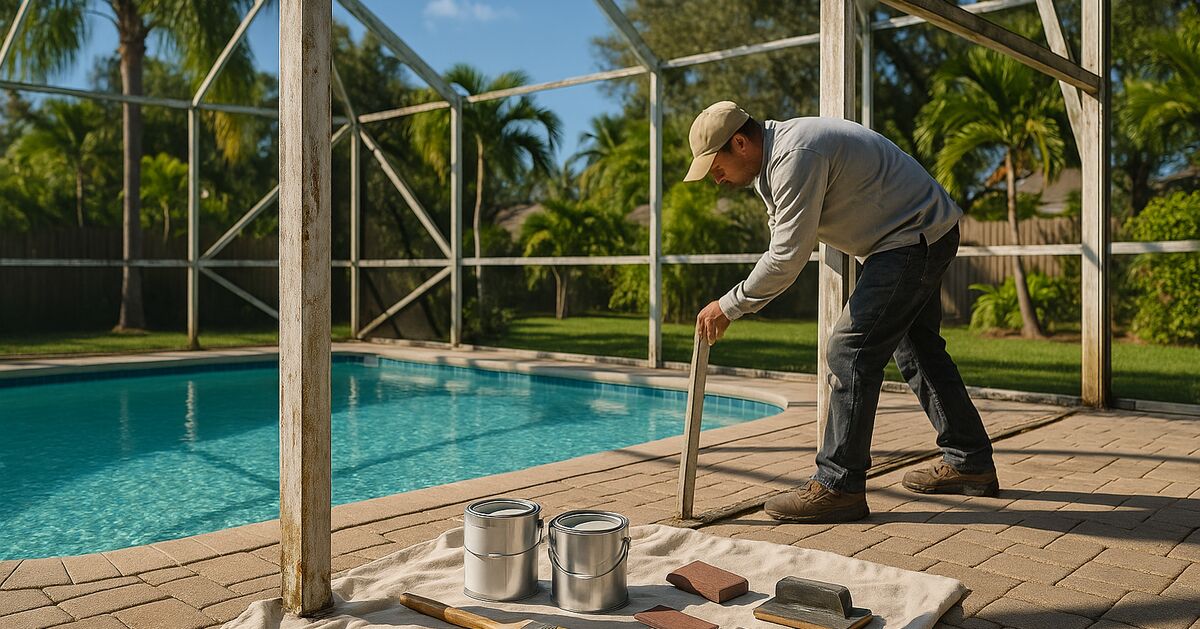
Your pool cage frame looked sharp when it was installed, and now it looks like it spent ten years in a salt shaker. That chalky white powder, those orange streaks at the joints, that paint peeling in long curls near the base - all of it is telling you something. The question is whether the frame needs a coat of fresh paint or something more involved. Getting that answer wrong in either direction costs real money.
This post breaks down what repainting and frame restoration actually involve, how to tell which one your cage needs, and why the local climate from Bradenton down through Sarasota and out to barrier islands like Siesta Key and Longboat Key makes the decision more consequential than it would be almost anywhere else in the country.
What "repainting" actually means
When most homeowners say they want to repaint their pool cage, they picture something close to painting a fence: clean the surface, roll or spray on a fresh coat, call it done. In practice, a proper repaint involves a few more steps than that, but the basic idea holds.
A repaint makes sense when the frame's structural aluminum is still sound and the existing factory coating (nearly all residential pool cage frames in this area are aluminum with a baked-on powder coat or a painted finish) has degraded cosmetically but has not allowed corrosion to work its way into the metal itself. Signs that point toward a repaint rather than something heavier:
- Chalking and fading. The surface feels dusty or leaves a white residue on your hand. This is the UV-degraded top layer of the coating breaking down. It looks bad but the metal underneath may be fine.
- Minor surface oxidation. A few orange or gray spots near fastener holes or welds, which can be sanded and treated before new paint goes on.
- Paint peeling in small areas. Particularly around the bottom rails and near the pool deck, where splash water sits. If the peeling is limited and the metal beneath is still smooth, you are still in repaint territory.
- Age under roughly eight to ten years on an interior property (less on barrier islands or waterfront lots in Palmetto or Ellenton where wind-driven salt is a real factor).
For a repaint to last, the prep work matters far more than the paint itself. The frame needs to be pressure-washed, hand-cleaned at joints and welds, and any loose or flaking coating needs to be removed. A metal-compatible primer goes on before the topcoat, and a quality acrylic or epoxy-based paint rated for aluminum and direct UV exposure will hold up far longer than a hardware-store exterior paint. Skipping the primer or painting over oxidation without treating it first is the kind of shortcut that produces a cage that looks great for one season and peels the next summer.
What "restoration" means - and why it is a different category of work
Frame restoration is not simply a more thorough repaint. It addresses structural and corrosion issues that paint alone cannot fix. Depending on what a frame inspection reveals, a restoration might include some or all of the following:
- Replacing corroded or bent uprights, cross members, or base rails. Aluminum corrodes from the inside out when the coating fails at welds or cut ends, and by the time you can see pitting on the surface, the wall of the extrusion may already be compromised.
- Re-fastening or replacing hardware at every connection point. Pool cage frames on the Suncoast use aluminum pop rivets, stainless steel bolts, or a combination of both. When dissimilar metals meet in the presence of moisture and salt, galvanic corrosion attacks the joint. Loose connections and corroded fasteners are a structural concern, not just a cosmetic one - a point covered in more detail in our post on why wobbly pool cages are usually a fastener problem, not a screen problem.
- Treating and encapsulating active corrosion. Where the corrosion has not yet eaten through the wall of the extrusion, a restoration technician will grind or wire-brush back to clean metal, apply a corrosion-inhibiting primer, and seal the area. This is not permanent, but it arrests the process and extends the life of the frame significantly if done correctly.
- Re-anchoring the base to the pool deck. Bottom rails that sit against concrete accumulate moisture under them. Over years, that moisture wicks up into the rail, the concrete anchors corrode, and the rail lifts or rocks. A restoration addresses the anchor system, not just the surface.
A full restoration followed by a quality repaint is the right answer when the frame has meaningful structural compromise. It costs more than a repaint alone, but it is typically still less than replacing the entire frame - which involves new permits, new engineering, and new screen installation.
The financial logic: when each option wins
Here is how to think about the money side honestly.
A repaint makes financial sense when:
The frame is structurally sound, the cosmetic degradation is uniform (not concentrated at specific joints or the base), and the expected remaining life of the frame after repainting is long enough to justify the cost. If the paint is chalked but the extrusions are smooth, the fasteners are tight, and the anchors are solid, a well-done repaint can restore another seven to ten years of service life on an inland property in a community like Lakewood Ranch or Parrish, where the corrosive salt load in the air is lower than on the coast.
A restoration makes financial sense when:
You can see active pitting, feel soft or flaking metal at any joint, notice the cage rocking when you push on it, or find that paint is peeling specifically at welds and cut ends rather than uniformly across the frame. Those are signs that the coating failed at a vulnerable spot first and corrosion has been running underneath the visible surface. Painting over that without structural work is money wasted - the new paint will bubble and peel within one to two seasons as the corrosion continues beneath it.
It also makes sense to restore rather than simply repaint if the cage is approaching the age where a full replacement might otherwise be on the horizon. A properly restored and repainted frame can extend service life enough to make financial sense even at higher cost, particularly when you factor in the expense and disruption of a full frame replacement.
A mistake that comes up again and again among homeowners is choosing the cheaper option (repaint only) on a frame that actually needs restoration work, then finding themselves back at square one within 18 months. That double-spend is typically more expensive than doing the right thing once.
How Gulf Coast conditions change the math
This region accelerates frame degradation in ways that are worth understanding. Salt air does not just affect waterfront properties on Anna Maria Island or homes on the water in Osprey and [Nokomis]. The Gulf onshore breeze pushes salt-laden air well inland, and fine salt particles deposit on aluminum surfaces and begin working at any unprotected area, particularly cut edges and welds where the factory finish is thinnest or absent.
The Florida Building Code requires that aluminum used in pool cage construction meet specific alloy and thickness standards for our wind zone, and manufacturers' finishing specifications for powder coat on architectural aluminum typically call for a minimum dry film thickness and adhesion standards. (The American Architectural Manufacturers Association, AAMA, publishes widely referenced voluntary specifications for coatings on architectural aluminum, including AAMA 2604 and 2605, which cover performance expectations for painted finishes in high-UV and coastal environments.) A frame that received a finish meeting those specs when it was built will degrade more slowly than one that was painted in the field with a lesser product after the fact.
Pool chemistry adds another layer of stress. Chlorine vapor and the occasional splash of pool water at a pH that is even slightly off accelerates coating breakdown on lower rails and any members near the waterline. Per EPA guidance on pool water chemistry, a pH consistently below 7.2 is corrosive to metal surfaces. If the bottom six to twelve inches of your cage frame shows more deterioration than the upper portions, pool chemistry is likely contributing alongside weather exposure.
What to look for in a pre-decision inspection
Before committing to either option, a thorough frame inspection should cover these areas:
- Base rail and anchor points. Push down and sideways on the rail with moderate pressure. Any rocking or movement at the deck suggests anchor corrosion.
- Upright posts at mid-span. Flex them gently. A properly intact aluminum extrusion should feel essentially rigid. Soft, spongy, or crinkled areas at the surface suggest internal corrosion has hollowed the wall.
- Welds and riveted connections. Look for rust staining or white powdery aluminum oxide coming specifically from joint areas. That means the coating failed there first, as it nearly always does, and corrosion has been working from that point outward.
- Corner castings and ridge connections. These are high-stress points. Cracked or separated castings are a restoration item, not a repaint item.
- Screen attachment channels (spline channels). While you are there, check whether the channels holding your screen are still crisp and holding tension. Damage or deformation here affects your re-screening options later.
If an inspection turns up only cosmetic issues, you are in repaint territory. If it turns up even one of the structural warning signs above, get a restoration quote before you authorize paint-only work.
Choosing the right contractor for either job
The standards for a contractor doing a repaint or a restoration on a pool cage frame are similar: they should be comfortable working with aluminum (not just wood or drywall), familiar with the correct primers and coatings for architectural aluminum, and willing to explain their prep process in detail. Prep is where the longevity of either job is won or lost.
For restoration work specifically, ask whether corroded sections will be replaced with matching aluminum extrusion or simply patched and painted. Patching with filler is a short-term cosmetic fix; replacing the affected section is the durable answer. Also ask about the fastener specification for any new connections - stainless steel hardware is worth specifying in coastal applications even if it costs slightly more than the standard option.
Our services page covers the full range of pool cage work we do across Manatee and Sarasota County, and our FAQ has answers to the questions homeowners ask most often before scheduling an inspection.
If you are weighing a frame refinishing project alongside a re-screen, the timing matters too. Ideally, frame work (repaint or restoration) happens before new screen goes in, since pressure washing, grinding, and spraying all create conditions that can damage new mesh. See our related post on lanai vs. pool cage re-screening for more on the sequencing and material decisions involved in a combined project.
The short version, for homeowners who want to act now
Your pool cage frame needs a repaint when the metal is sound but the finish is cosmetically degraded. It needs restoration when the structure itself has been compromised by corrosion, loose fasteners, or failing anchor points - issues that paint will hide but not fix. The way to tell the difference is a hands-on inspection before any work is authorized.
Homeowners across our service area from Bradenton and Lakewood Ranch to the barrier islands deal with this decision every few years. The Gulf Coast environment is hard on aluminum finishes, and the right call depends entirely on what the frame is actually doing beneath its surface, not just what it looks like from ten feet away.
If you are not sure which category your cage falls into, the safest and most cost-effective move is to have a professional take a close look before spending anything. Contact us to schedule a frame inspection and get an honest recommendation before you commit to either path.
Sources & further reading
- AAMA 2604 and 2605 voluntary specifications for high-performance organic coatings on architectural extrusions (American Architectural Manufacturers Association (AAMA))
- Florida Building Code - Residential, Aluminum construction and pool enclosure structural requirements (Florida Department of Business and Professional Regulation - Florida Building Commission)
- Corrosion of Aluminum and Aluminum Alloys (ASM International)
- EPA guidance on swimming pool water chemistry and pH ranges (U.S. Environmental Protection Agency (EPA))
Claim-by-claim audit (7 checked)
- “When dissimilar metals meet in the presence of moisture and salt, galvanic corrosion attacks the joint.” (reasoning shown in the article)
- “Per EPA guidance on pool water chemistry, a pH consistently below 7.2 is corrosive to metal surfaces.” (cited → epa.gov)
- “The Florida Building Code requires that aluminum used in pool cage construction meet specific alloy and thickness standards for our wind zone, and manufacturers' finishing specific…” (cited → floridabuilding.org)
- “The American Architectural Manufacturers Association, AAMA, publishes widely referenced voluntary specifications for coatings on architectural aluminum, including AAMA 2604 and 260…” (cited → aamanet.org)
- “Aluminum corrodes from the inside out when the coating fails at welds or cut ends, and by the time you can see pitting on the surface, the wall of the extrusion may already be comp…” (cited → asminternational.org)
- “A well-done repaint can often add several more years of service life on an inland property, where the corrosive salt load in the air is generally lower than on the coast.” (rewritten to what the article can stand behind)
- “That double-spend is typically more expensive than doing the right thing once.” (reasoning shown in the article)