Common screen-door hardware problems and how they get fixed
Your screen door slams shut but the latch never catches. Or it drags across the threshold so badly you have to lift it to close it. Maybe it swings open on its own the moment you let go. These are not quirks you have to live with - they are fixable hardware problems, and most of them have straightforward causes once you know what to look for.
Screen-door hardware takes a beating in Southwest Florida. The combination of intense UV, salt-laden air from the Gulf, daily humidity swings, and simple high-frequency use all work against the small springs, rollers, closers, and latches that keep a screen door doing its job. Understanding what each component does - and how it fails - puts you in a much better position to describe the problem, decide whether it's a DIY fix, and know whether a technician is giving you a reasonable diagnosis.
The five hardware components that matter most
Before getting into problems and fixes, it helps to name the parts so the rest of this makes sense.
- Hinges - the pivot points, usually two or three per door, that bear the full weight of the panel.
- Door closer - the pneumatic or spring-loaded cylinder that pulls the door shut after you walk through.
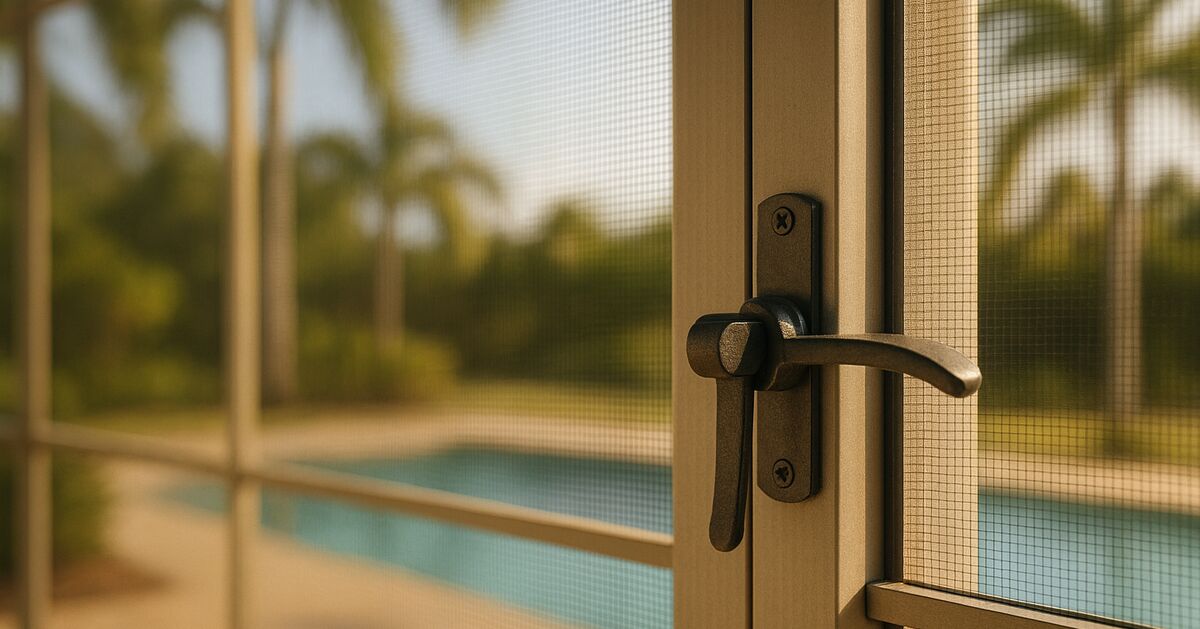
- Latch and strike plate - the mechanism that holds the door closed; often called a "pull latch" or "thumb latch" on screen doors.
- Handle or pull - the grip hardware, which is sometimes integrated with the latch and sometimes separate.
- Rollers and tracks - present on sliding screen doors instead of hinges; small wheels ride in an aluminum channel at the top and bottom of the frame.
Most problems come from one of these five. Let's go through the most common failures one by one.
Problem: the door won't stay closed or the latch won't catch
This is the complaint we hear most often, and it almost always traces back to one of three causes.
The latch is misaligned with the strike plate. Over time, hinges loosen and the door sags a fraction of an inch. That's enough for the latch tongue to miss the strike plate opening entirely or to hit the edge and bounce back. The fix is usually to tighten the hinge screws first. If the screw holes have stripped out in the aluminum frame, the technician will fill them with a slightly larger screw or a thread insert before reassembling. If the sag is significant, the strike plate itself can be repositioned.
The latch mechanism is worn or broken internally. The spring inside a thumb latch is small and cheap, and it fatigues. When it goes, the thumb paddle either stays depressed or the tongue no longer springs back into position. Replacing the latch body is a quick fix and the part costs very little. The catch is finding a matching style - especially on older enclosures where the original hardware may be discontinued. A technician who stocks a variety of replacement latches can match it in one visit rather than leaving you hunting online.
The door frame itself has racked. Florida's clay-heavy soils shift seasonally, and concrete slabs can settle unevenly. If the entire pool-cage or lanai frame has moved even slightly, the door opening can go from square to parallelogram-shaped. A latch that caught perfectly when the enclosure was new suddenly hits aluminum frame instead of the strike plate opening. Correcting a racked frame is a bigger job than replacing a latch, and it's worth having a professional evaluate whether the shift is cosmetic or structural.
Problem: the door drags or sticks when opening and closing
A dragging door usually points to a hinge issue. Here is the typical progression:
- Hinge screws work loose from repeated use.
- The door tilts slightly - the top pulls away from the frame and the bottom corner drops toward the threshold.
- The bottom corner scrapes the sill or the door panel binds against the side jamb.
Tightening the screws often solves it immediately. If the frame has corroded or the screw holes have enlarged, the repair takes a bit more work, but it is still a same-day fix in most cases.
Salt air accelerates this process noticeably in coastal communities. Homeowners on Anna Maria Island and Siesta Key often find their hinges corroding and their screw holes failing much faster than homeowners further inland in Lakewood Ranch or Parrish would expect. Stainless-steel hardware or properly coated aluminum hardware makes a real difference in those environments. If you are replacing hinges on a door within a mile or two of the water, it is worth asking specifically about marine-grade options.
Problem: the door swings open on its own
A screen door that won't stay open would be an inconvenience - one that won't stay closed is a bug-control failure. The culprit is almost always the door closer.
Screen-door closers work by storing energy as you open the door and releasing it in a controlled way as the door swings shut. There is usually a small adjustable valve that controls the closing speed. When that valve fails, the closer either slams the door shut instantly (annoying, and hard on the latch) or loses tension and can no longer hold the door against the breeze.
The fix depends on the specific failure:
- Loose tension valve - sometimes just needs adjustment with a small flathead screwdriver; the valve has a limited range of turns before it bottoms out and you've reached maximum adjustment.
- Failed air seal inside the cylinder - the closer needs replacement. Rebuild kits exist but swapping the whole unit is usually faster and more reliable.
- Wrong closer for the door weight - closers are rated for different door weights and widths. If someone installed an undersized closer, it may never have been able to hold the door reliably. Matching the correct closer rating to the door is part of a proper repair.
One thing to be aware of: on windy afternoons along the Gulf Coast, even a correctly functioning closer can struggle against a sustained breeze. If your lanai or pool cage faces the prevailing southwest wind, a slightly heavier-duty closer - or a hold-open clip that keeps the door open when you want it open - may serve you better than fighting the problem forever.
Problem: the sliding screen door jumps off its track
Sliding screen doors sit in top and bottom tracks and roll on small plastic or nylon wheels. When those wheels wear down or break, the door drops in the track and either sticks or pops out entirely when you slide it.
The repair process is straightforward:
- Lift the door out of the track entirely.
- Locate the roller assemblies at the bottom corners (and sometimes the top).
- Remove the old rollers and install new ones, adjusting the height so the door sits correctly in the track.
- Slide the door back in and test the glide.
A common mistake homeowners make is spraying lubricant into the track without replacing the rollers. The lubricant helps briefly but the worn roller still wobbles in the channel, and the problem returns within weeks. Replacing the rollers is the actual fix.
Track damage is another matter. If the aluminum channel has been bent - by a lawn mower, a cart, or a hard door slam - the door will never glide smoothly no matter how good the rollers are. Bent track sections can sometimes be straightened carefully; in other cases, the track section needs to be replaced. This is worth knowing before you invest in new rollers only to find the real problem is a kinked track.
Problem: the handle is loose, spinning, or missing entirely
This one sounds minor but matters more than people expect. A loose handle puts stress on whatever screw or rivet holds it to the door frame with every use. Eventually the frame material strips and the handle has nothing to anchor to. A missing handle means people are grabbing the screen mesh itself to open the door - and that leads to torn mesh, bent frame corners, and more expensive repairs down the line.
Handle replacement is usually a simple screw-in or rivet-in job. The harder part is matching the existing hardware style so the replacement looks intentional rather than cobbled together. If you are replacing one handle on a door that has matching hardware throughout the enclosure, it is worth noting the brand or profile so the replacement fits in visually.
If the frame material where the handle mounts has corroded or cracked, a small reinforcement plate can often be installed behind the panel to give the new hardware something solid to grip.
What a proper hardware repair visit looks like
When a technician comes out to address screen-door hardware, a good visit involves more than just swapping the broken part. The door should be checked for square, the hinges inspected for corrosion and tightness, the closer tested for proper tension and speed, and the latch alignment verified before the technician leaves. A door that gets a new latch but still sags is going to chew through that new latch quickly.
If the screen panel itself is torn or the spline is pulling out of the channel, that work typically happens at the same visit - there is no reason to pay for two trips. Our screen and pool-cage repair services cover both the hardware and the mesh, so everything gets addressed together.
For a broader look at how all the components of a screen enclosure fit together and interact, our post on the anatomy of a pool cage: frame, screen, spline, and hardware is a good companion read to this one.
When to call a professional versus doing it yourself
Some hardware fixes are genuinely DIY-friendly. Tightening loose hinge screws, adjusting a closer valve, and even swapping a simple thumb latch are tasks a handy homeowner can handle with basic tools and a replacement part from a hardware store. Our post on DIY screen repair vs. hiring a pro covers this tradeoff honestly and in detail.
Where it gets trickier:
- Finding the right replacement part for an older or less common enclosure style.
- Diagnosing a problem that has multiple contributing causes (for example, a door that sticks because of both a loose hinge and a racked frame).
- Working on hardware in a pool-cage setting where the frame is tall, the angles are awkward, and a dropped screw can end up in the pool.
- Dealing with corrosion damage that has progressed beyond the surface into the structural aluminum.
For homes in communities like Bradenton, Palmetto, and Ellenton where many pool cages were built in the 1990s and early 2000s, the hardware is often at the age where multiple components are failing at once. Getting a professional eye on the whole door - not just the one part that broke this week - can save money over piecemeal repairs.
A note on hardware upgrades
If you are already replacing failed hardware, it is worth thinking about whether the original specification was adequate in the first place. Original builder-grade hardware on many Florida enclosures was the lowest cost option available at the time. Upgrading to a heavier-duty closer, stainless-steel hinges, or a more robust latch costs more upfront but typically lasts two to three times as long - particularly in salt-air environments.
This is especially true if you have pets. Dogs in particular lean on screen doors, and standard latches are not designed for that load. A reinforced latch plate and heavier-gauge hinges make a real difference in how long the hardware holds up.
Getting the right help on the Suncoast
Screen-door hardware is one of those things that seems small until it stops working, and then it is suddenly very obvious every time you walk in or out of your own backyard. The good news is that virtually every hardware problem described here is solvable, usually in a single visit, without replacing the whole door or the whole enclosure.
If you are not sure what is causing the problem with your door, describing the symptom accurately is the most useful thing you can do before calling. "The latch doesn't catch unless I lift the door" tells a technician something very specific - it points immediately to hinge sag or strike-plate misalignment. "The door slams" points to the closer. Working from symptoms to causes is how a good repair conversation starts.
You can find answers to many common questions on our frequently asked questions page, and if you are ready to have someone take a look, get in touch with us to describe what is going on. We serve communities all across the Suncoast, from Parrish and Ellenton in the north down through Sarasota, Osprey, and Nokomis - you can see the full list on our service locations page.
A screen door that works properly is a small thing, but it is part of what makes Florida outdoor living actually enjoyable rather than just theoretically nice. Getting the hardware right is worth doing correctly.